The 4 agentic commerce trends reshaping the next decade
AI agents, open-source platforms, and a shifting cost model are rewriting the rules for commerce. IDC’s latest study sponsored by WooCommerce reveals what’s changing and what commerce leaders should do about it.

Why this matters now
↑ Revenir en hautTwo forces are converging to reshape commerce for the next decade — and most platforms aren’t built for either of them.
First is agentic AI: software that doesn’t just answer questions, but acts on behalf of buyers, from comparing products and applying discounts to completing the checkout process. Second is the accelerating shift toward open-source commerce to give brands full control over their stack, data, and roadmap.
This IDC InfoBrief sponsored by WooCommerce, authored by Research Director Heather Hershey, examines where these forces intersect. It maps where the traditional SaaS commerce model is hitting structural limits, identifies four commerce trends to watch through 2027, and offers concrete guidance for leaders making platform decisions now.
The research draws on IDC’s FutureScape 2026 predictions across five practice areas, the Worldwide AI Spending Guide, and the AI Maturity Model Benchmark.
Who it’s for: Commerce, digital, and platform leaders evaluating whether to extend their current stack or invest in an open, AI-ready foundation for the next decade.
Data points
↑ Revenir en hautforecasted global AI spending by 2028
of organizations expected to orchestrate AI agents at scale by 2030
of digital leaders cite legacy platform rigidity as a top barrier to scaling AI in commerce
Source: IDC InfoBrief, sponsored by WooCommerce. Build for What’s Next: Open-Source Architecture and the Future of AI Commerce, doc US54662026, June 2026.
The SaaS platform model is breaking
↑ Revenir en hautCommerce is entering a new era where AI agents don’t just assist shoppers, they act on their behalf. They compare products, evaluate inventory, check pricing, and complete purchases without a human ever opening a browser. IDC projects a 10x increase in agent use among Global 2000 companies by 2027. Agentic automation will enhance capabilities in more than 40% of enterprise applications.
This isn’t a future trend — it’s already reshaping how brands get discovered, how buyers make decisions, and what “good enough” looks like for your ecommerce platform.
Most platforms weren’t built for this. They were designed for human browsers, not AI agents, and their structural limits are becoming harder to ignore: closed ecosystems that can’t expose data to agents, rigid release cycles that can’t keep pace with weekly advances in AI, and pricing models that penalize you for growing.
This IDC study examines the trends at the intersection of agentic AI and open-source commerce, and makes the case that the platforms built to thrive in this new era share one thing: they’re open.
Trend 1: Freedom vs. friction
↑ Revenir en hautAI is advancing weekly, but most SaaS roadmaps move quarterly. That gap is widening — and for brands locked into a closed platform, every quarter they wait makes switching harder and more expensive. IDC found that 65% of digital leaders cite legacy platform rigidity as a top barrier to adopting AI in commerce.
When a new AI model, payment method, or agent protocol ships, brands on open platforms can integrate it immediately without filing a feature request or waiting for the next release cycle.
At the same time, closed platforms are raising fees, narrowing their ecosystems, and locking AI capabilities behind premium tiers.
AI is also reducing the barriers for entry for open-source platforms. Previously, custom integration work took weeks and dedicated developers to build it. AI tools know open-source code and can now generate and maintain custom integrations.
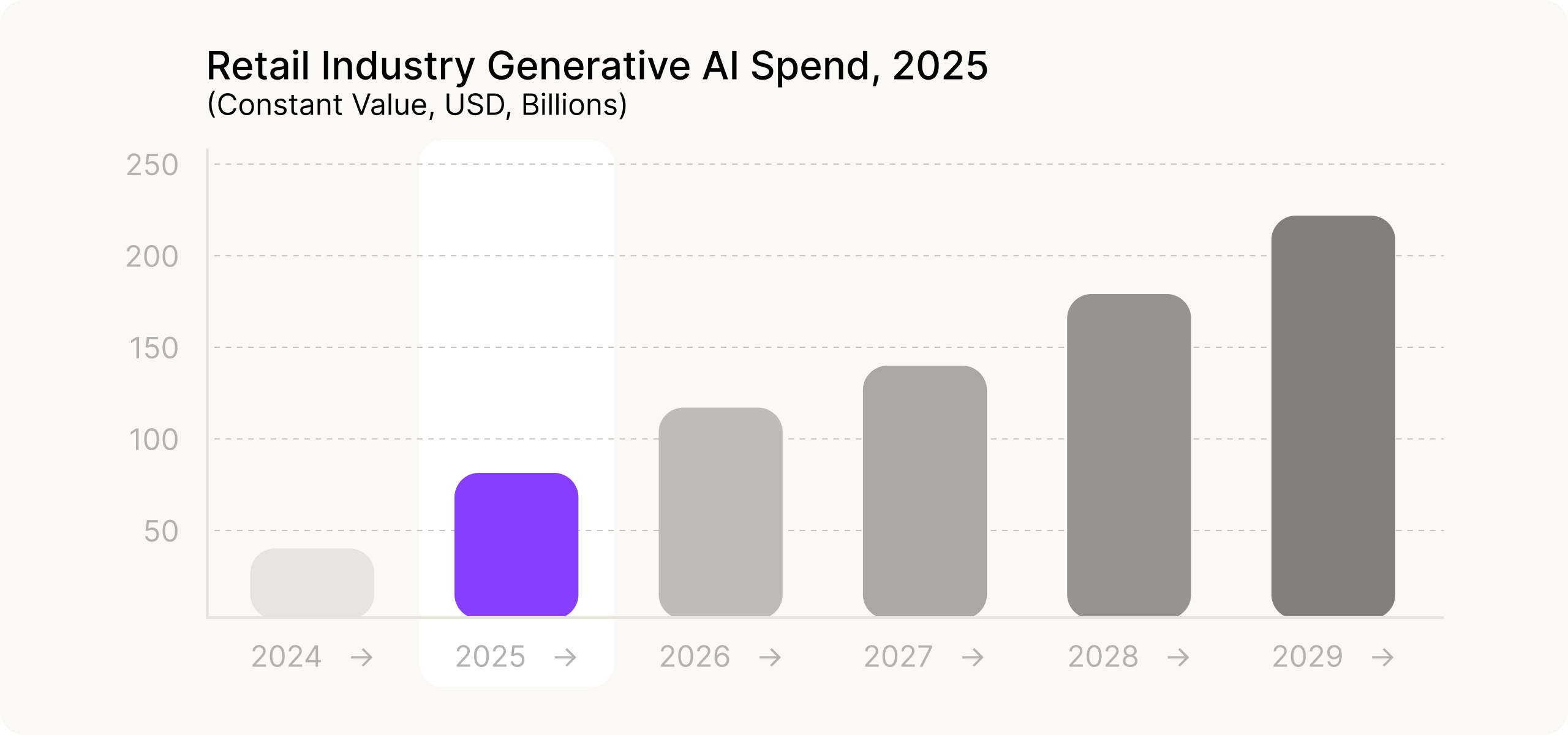
IDC projects $632B in global AI spending by the end of the decade. The brands on platforms that can take advantage of that innovation will capture it. The ones on closed stacks will wait for their vendor to resell it.
Source: IDC InfoBrief, sponsored by WooCommerce. Build for What’s Next: Open-Source Architecture and the Future of AI Commerce, doc US54662026, June 2026.
Trend 2: Two modes of consumption
↑ Revenir en hautYour next customer might not be human. AI agents are already acting on behalf of shoppers, and IDC forecasts that 50% of enterprises will use AI agents to redefine human-machine collaboration by 2027. Agents will only refer buyers to brands they can verify structurally.
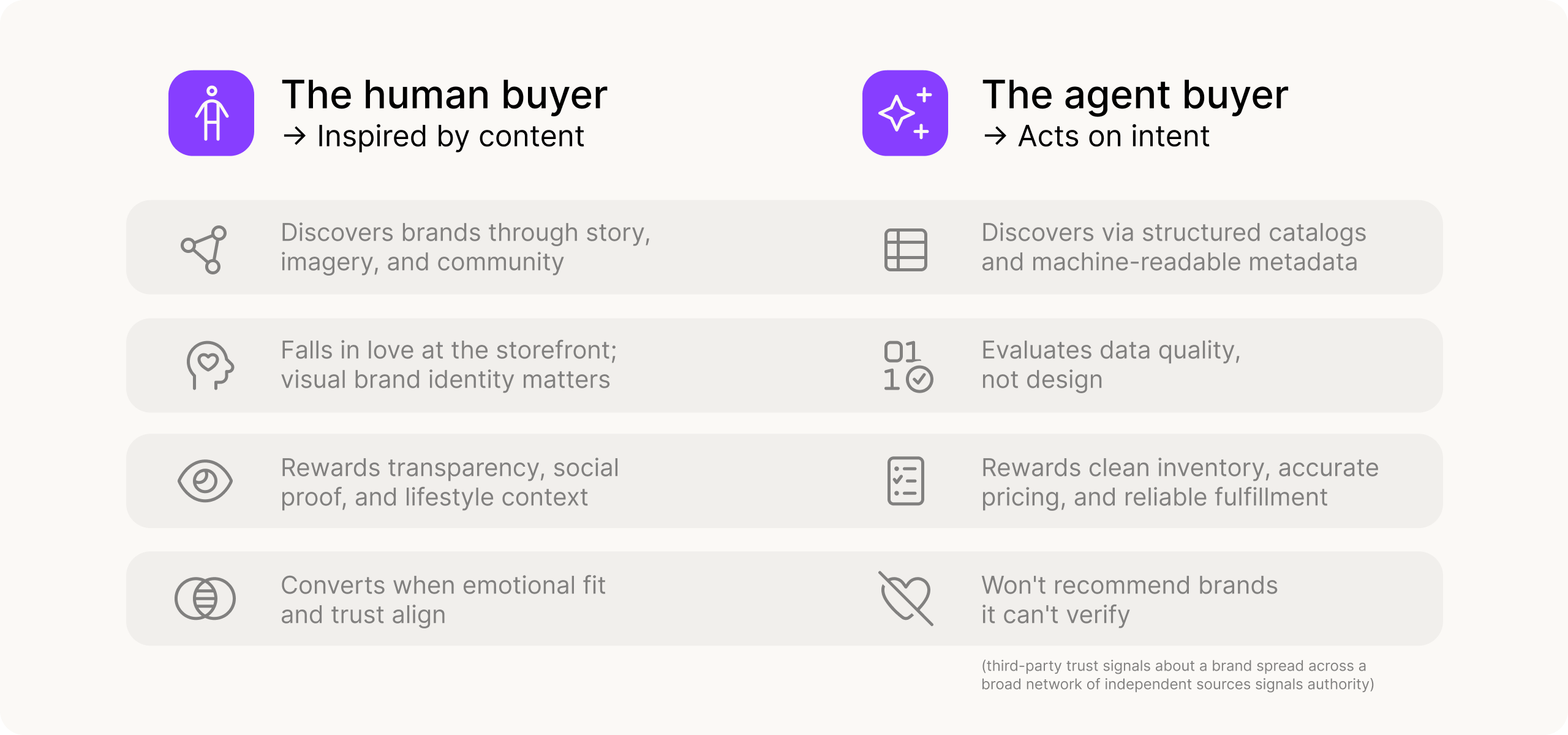
Successful brands now need to win over two very different audiences — human and AI — simultaneously. Human buyers discover brands through content, community, and visual storytelling. They often convert based on trust, product usefulness, and brand loyalty.
However, agent buyers discover brands through structured catalogs and machine-readable data. They evaluate data quality, not design, and they won’t recommend a brand they can’t verify. And as a brand, you’ll need to appeal to both.
Source: IDC InfoBrief, sponsored by WooCommerce. Build for What’s Next: Open-Source Architecture and the Future of AI Commerce, doc US54662026, June 2026.
Trend 3: Trust as infrastructure
↑ Revenir en hautYour product data, inventory accuracy, and catalog structure aren’t just operational concerns anymore. They’re how you get found. In an agent-driven economy, your data quality is your new storefront.
AI speaks open source natively, which means large language models (LLMS) are trained on open code and open standards. They build integrations, write extensions, and potentially execute API calls more reliably in open-source environments.
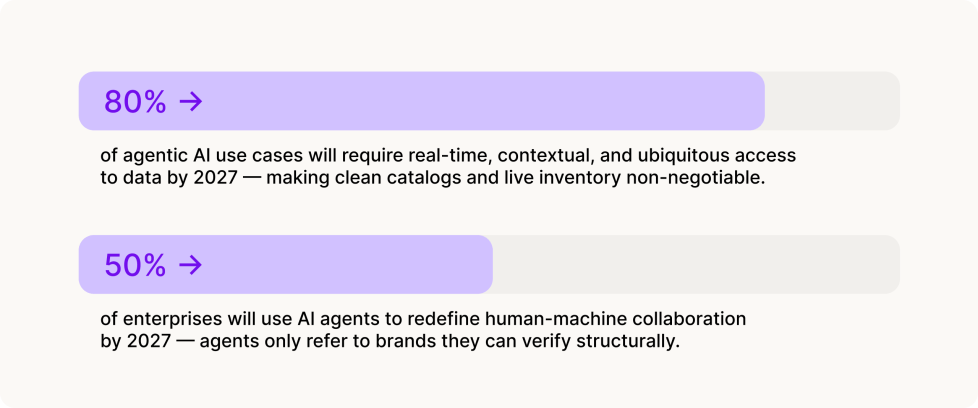
This changes the game for brands. All your catalog and product data needs to be well-structured and accurate so that AI agents can find your stock and serve it up to shoppers. By 2027, 80% of agentic AI use cases will require real-time, contextual, and ubiquitous access to data, making clean catalogs and accurate inventory non-negotiable for brand discoverability.
AI agents are already acting on behalf of shoppers, and IDC projects that 50% of enterprises will use AI agents to redefine human-machine collaboration by 2027. Agents will only refer buyers to brands they can verify structurally.
Trend 4: The collapsing stack
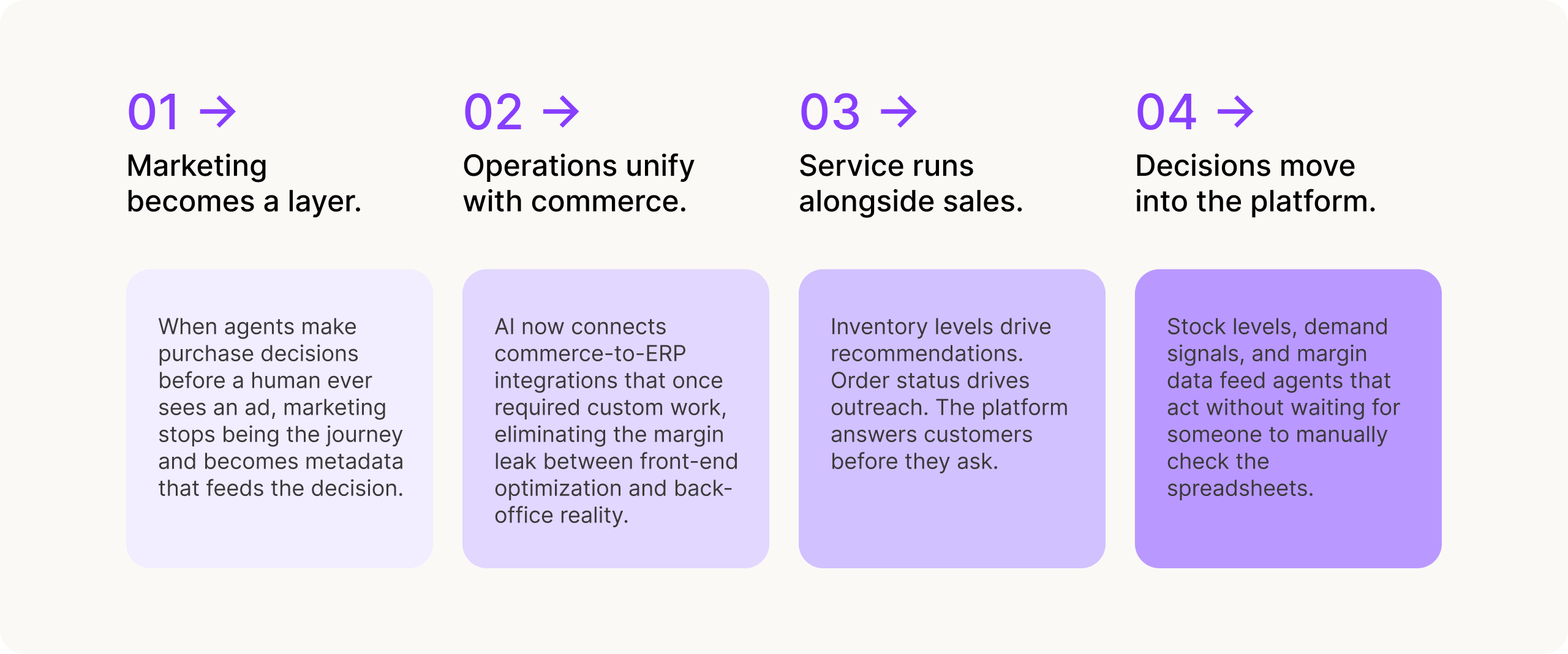
↑ Revenir en hautThe days of managing commerce, marketing, operations, and service as separate systems with separate tools are ending. AI is collapsing these layers into a single platform. The brands who get there first will operate with a speed and efficiency competitors can’t match.
Here’s what that looks like in practice: Products you add to your catalog automatically become marketing content, customer reviews feed campaigns without a separate tool, orders trigger smart follow-ups, inventory levels drive recommendations and outreach, and AI connects your commerce platform to your ERP without the custom integration work that used to take weeks.
The result is one source of truth for your entire commercial operation — pricing, demand, inventory, margins, and customer behavior — all in one place, all feeding each other.
Unfortunately, store owners face a significant cost for a fragmented stack. Margins leak between disconnected systems, agents lose trust in your data, your marketing falls behind your product catalog — and every manual handoff between tools costs you money and speed.
3 moves to make now
↑ Revenir en hautThe IDC research points to three factors every commerce leader should consider as they evaluate platforms for the next decade.
- Choose openness over convenience: Calculate what your platform charges per dollar of revenue, what it would cost to leave in 18 months, and whether your AI roadmap is gated behind their pricing tiers. The platform that’s easiest to start on is rarely the cheapest to grow on — and the cost of switching compounds every quarter.
- Build for humans and agents in parallel: Your brand experience and your product data are now the same job. Invest in both: the storefront that wins a human buyer’s trust and the structured catalog that earns an agent’s recommendation. One without the other leaves revenue on the table.
- Treat your platform as your operating system: The brands that win the next decade will run marketing, fulfillment, support, and operations through their commerce platform — not alongside it. Look for platforms where these functions unify around a single data layer, not platforms that require you to stitch them together yourself.
Get the full study
Agentic commerce is moving fast. Read the full IDC study to dive deeper on the trends and data shaping the next decade of commerce so you can choose the right platform for your brand.