
If your product pages were written for Google in 2022, they may not be working as hard as you need them to in 2026. Shoppers are finding products differently — through AI assistants, AI-generated summaries, and conversational search tools that evaluate your product data and either recommend you or move on. Traditional search is still part of that journey. But it’s no longer the whole picture.
Writing for this environment requires more than keyword optimization. AI agents read your structured product fields — weight, dimensions, materials, compatibility — and match them against what the shopper asked for. Vague marketing copy gives an agent nothing to work with. Specific, structured product data gives it everything it needs — and as it turns out, it makes for better SEO too.
This guide covers how to write product descriptions that serve all audiences: the human shopper reading your page, the search engine crawling it, and the AI deciding whether to surface it.
Why ecommerce search behaviors are shifting in 2026
↑ Nach obenShoppers are increasingly using AI to find and research products, and that’s prompting ecommerce teams to rethink how they write product descriptions. AI-powered tools need the same thing shoppers need: clear, specific, trustworthy product information. When your descriptions deliver that, you increase your chances of appearing in an AI Overview, showing up in Perplexity Shopping results, or being recommended when someone asks ChatGPT for the best option in your category.
The numbers back this up. An adMarketplace study found that 60% of consumers had used AI for shopping as of late 2025, and 55% said AI surfaces better product search results than traditional search.
This is where Answer Engine Optimization (AEO) and Generative Engine Optimization (GEO) come in — two overlapping approaches to structuring product content so AI tools can find what they need and use it confidently.
A simplified ecommerce customer journey involving AI may look something like this:
- A consumer uses AI to gather ideas, research, and find a product that’s “best for XYZ.”
- The consumer finds an option and conducts a branded Google search.
- The consumer reads the product page, gets more information, and adds it to their cart.
How product descriptions need to work in 2026
↑ Nach obenProduct descriptions should always prioritize your customers. But if your products aren’t visible to search crawlers and AI, the customer may not consider your brand.
The most important transition in this new era of search involves optimizing for answers over keywords. There may be technical adjustments to make, but this new focus is how you start moving toward product descriptions that rank, get cited, and convert customers.
Let’s walk through the steps to improve product descriptions on your ecommerce website to improve online visibility.
Step 1: Match product pages to buying intent
Considering search intent is a standard SEO strategy for basic keyword research. It often includes identifying search queries with informational, navigational, or commercial intent. Ecommerce teams should go deeper than that.
Before optimizing a product description, clarify why someone is searching and what they need to evaluate your offering. Most product page queries fall into practical patterns:
- Specific attributes or specs
- Use cases or problems to solve
- Product comparisons
- Replacement or restocking
- Branded product searches
Here are some examples of how intents map to queries and what your product descriptions need to provide:
| Intent | Example search | Product description focus |
| Attribute-based | stainless steel insulated water bottle 24 oz | Key specs, materials, size, colors, dimensions, etc. |
| Use case/problem | office chair for lower back pain | Who it’s for, what it solves, how it provides benefits |
| Comparison/evaluation | best network cabinet for a small server room | Standout features, technical fit, decision criteria |
| Replace/replenish | new water filter for Keurig | Compatibility, model details, pack/refill information |
| Brand/product-specific | Hydro Flask 32 oz wide mouth | Exact product confirmation, core details, trust signals |
Most product pages serve more than one type of intent. The trick is to identify the primary intent connected to the page, then structure the rest of the content to support secondary questions without burying the details shoppers need first.
Step 2: Write descriptions for human and machine clarity
When people use AI tools to research products, the LLMs often try to answer the next likely question, not just the one that was asked first.
They look for supporting details across product pages to help users compare options, narrow choices, and make decisions. AI search tools also break broader prompts into smaller related searches behind the scenes, combining those findings into a synthesized answer.
These AI agents differ from search crawlers because they look for more than just keywords. They don’t browse your product page the way a human (or a crawler) does. The AI agents read your structured product fields — weight, dimensions, materials, compatibility — and match them against what the shopper asked for.
A description that says ‘hand-stitched full-grain leather, fits laptops up to 14 inches, weighs 0.5lbs’ gives an agent three matchable facts. ‘Crafted from premium materials for the modern professional’ gives it zero. Every empty field and every vague description is a query your product can’t match.
Solve buyer friction faster
Avoid starting ecommerce product descriptions with fluffy marketing copy. Lead with what the product actually is before getting to how it makes the customer feel. Address the consumer’s main question, key pain point, or biggest objection as soon as possible.
That includes questions like:
- Will this work with my existing setup?
- Are these the right specs for my needs?
- Will this product be durable enough?
- Is it safe for my use case?
- How do I know it’s worth the price?
- Is this product the right fit for my lifestyle/business?
Answering the most important questions early helps shoppers evaluate the product faster. It also makes key information easier for AI tools to identify and surface when they’re interpreting product pages.
An approach like this also supports traditional SEO. Many of these questions and answers mirror long-tail searches from buyers who are further along in the decision-making process.
When you customize your product pages, don’t bury critical specs. Translate product features into language that supports decision-making, helping shoppers quickly rule the product in or out.
Structure product pages for scanning and extraction
A well-structured product page helps shoppers find what they need faster. It also makes it easier for AI tools to interpret product information and pull relevant details into generated answers.
To do this, you should organize content into clear, purposeful sections, often called “chunks.” Instead of combining all the information in long paragraphs, break it into distinct blocks that answer specific questions or highlight key details.
Below are some effective ways to organize product description content for humans, SEO, and AI visibility:
- Lead with a short description. Include the most important information first. Add an expandable, long description at the bottom of the page.
- Use bullet lists for scannability. These are ideal for specifications and product attributes. They also create an identifiable chunk for AI extraction.
- Add clear H2 and H3 headings as anchors. Group related product details inside these focused sections.
- Use tabs and accordions. This is where you include secondary information while avoiding clutter on the product page.
- Add FAQ blocks to high-traffic product pages. FAQ schema means the answers you write for shoppers are simultaneously readable by AI agents. Use real customer questions — ‘Is this dishwasher safe?’ ‘Does this fit a standard door frame?’ — sourced from your support inbox or the People Also Ask box for your primary keyword. Generic FAQs don’t do this work. Specific ones do.
Badeloft Luxury Bathrooms, for example, uses tabs for organization on its website.
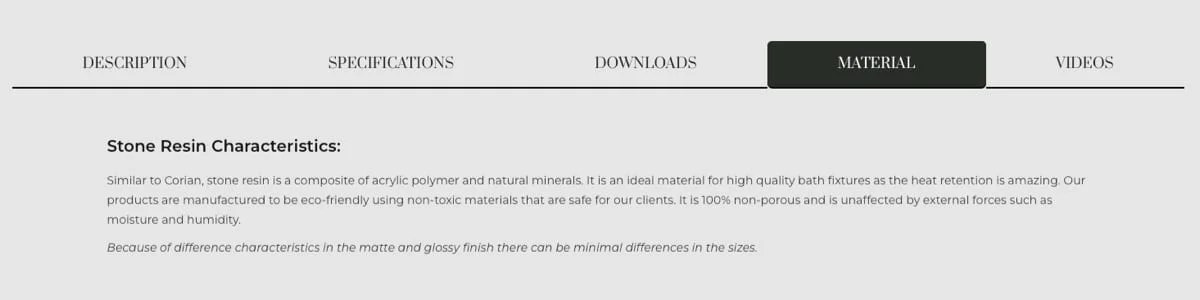
On WooCommerce, you can create tabs with extensions like the Custom Product Tabs Manager. Use tabs to call out size charts, related products, or technical details that guide purchase decisions.
WooCommerce also includes an Accordion Group Block that provides a clean way to add interactive functionality to product pages.
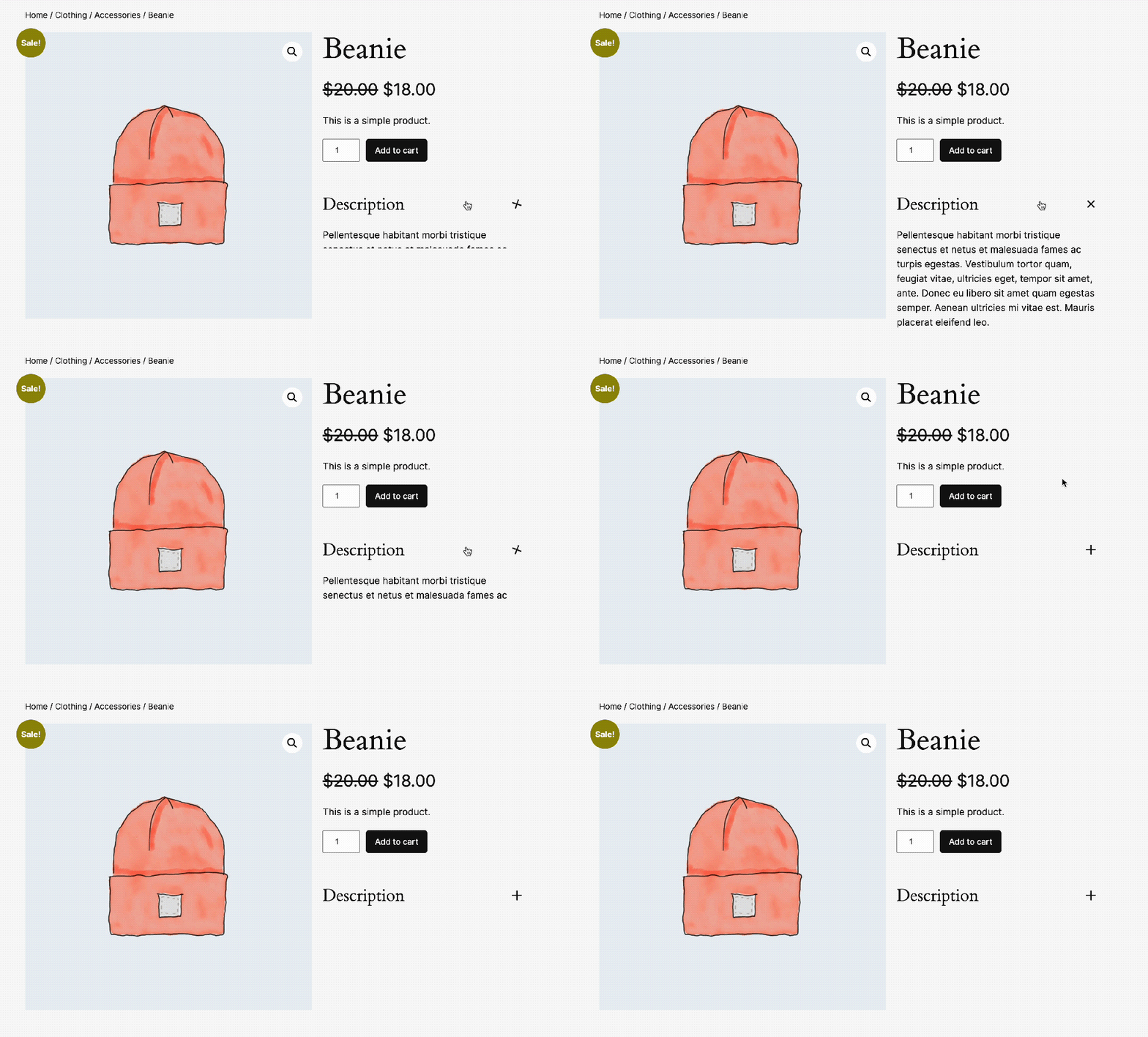
Intuitive content organization delivers an ideal ecommerce user experience. It also supports SEO and AI visibility, placing secondary information into clear, crawlable sections without hiding the details buyers need most.
Step 3: Optimize the full product page for technical integrity
Beyond the words and images on product pages that are immediately visible to shoppers, you also need to address technical factors, metadata, and duplicate or near-duplicate content across similar products.
As your catalog grows, these details become harder to manage manually and more important to get right consistently. The following areas represent important opportunities for product page optimization.
Optimize metadata
The product/page title, meta description, on-page copy, and schema markup should all reinforce the same core details. Mixed signals make product pages less trustworthy to both search engines and AI tools.
Metadata optimization has long been an SEO best practice. In a webinar with Sparktoro, Mike King from iPullrank suggested there’s evidence that AI uses titles and meta descriptions to decide whether to retrieve a page. He called the description an “advertisement” to the LLM.
Don’t overlook image metadata
AI crawlers can’t interpret photos the way humans do — they rely on alt text, file names, and captions. A file named ‘IMG_4392.jpg’ or alt text that conflicts with the product details on the page is a missed signal. Descriptive alt text supports accessibility, provides context for search engines, and helps AI agents understand what your product actually looks like.
Include specific schema markup
Product schema is markup that helps search engines and AI tools interpret product details like price, availability, ratings, and key attributes. For ecommerce stores, Product schema reinforces what your page is about while keeping structured data aligned with the details shoppers see on the page. The information may also show up in featured snippets on SERPs.
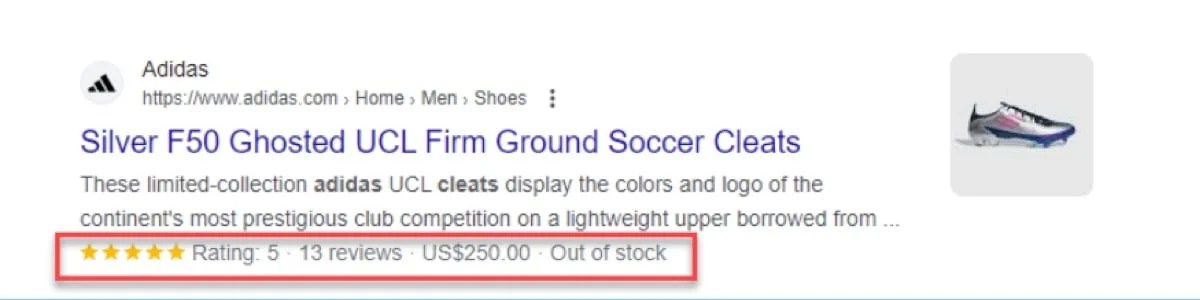
WooCommerce extensions, like Rich Snippets & Schema Markup for WooCommerce, help you with this process.
Differentiate similar products
Avoid relying on near-identical copy for product variations, replacements, or closely related items. When multiple pages target similar terms with nearly identical copy, search engines can struggle to determine which one should rank.
Use canonicalization, variation relationships, and distinct descriptions as needed to reduce internal competition and confusion.
For example, when multiple product pages are very similar, one URL may need to be treated as the canonical version. In other cases, the better solution is writing unique descriptions that reflect real differences between products.
Luna Glamping does this well. The site features products that differ only in size, each with unique, SEO-friendly product descriptions.

Catalog structure also matters. Category pages, product families, and variation groupings help search engines understand how similar products relate to one another and which page should carry the strongest ranking signals.
Check how your pages load without JavaScript
Several AI crawlers — including ChatGPT’s GPTBot and PerplexityBot — don’t render JavaScript. If your product details, pricing, or reviews only appear after JS executes, those crawlers see a blank page. You can test this by disabling JavaScript in your browser and checking what’s left. If critical product information disappears, that’s worth flagging to your development team.
Step 4: Maintain product pages at scale
On larger ecommerce teams, product page optimization is rarely owned by one person. Merchandising, SEO/content, and development teams all play a role in maintaining templates, structured data, page architecture, and product accuracy over time.
To keep product pages performing as catalogs grow:
- Performing regular SEO audits: Run periodic audits to ensure product pages remain technically sound. Focus on crawlability, indexing, internal linking, and page template issues that can affect large groups of products at once.
- Automating performance monitoring: Set up automated SEO and analytics reporting to track impressions, click-through rates, and engagement. Regular performance check-ins help identify optimization opportunities.
- Updating descriptions for accuracy: Revise product descriptions when specifications, positioning, or attributes change. Keep copy, metadata, and structured data in line so search engines and customers see consistent information.
Product page optimization is an ongoing process. You need to keep descriptions, metadata, and product details accurate and consistent as inventory, positioning, and consumer preferences change.
Cross-channel consistency matters here, too. If your title, price, or attributes differ between your online store, Amazon, and Google Shopping, AI agents treat that inconsistency as a reliability signal — and not a good one. Your online store should be the single source of truth that feeds every other channel. When product data drifts across platforms, it creates SEO problems and makes agents less confident recommending your products.
The bulk product updater in WooCommerce assists with this maintenance.
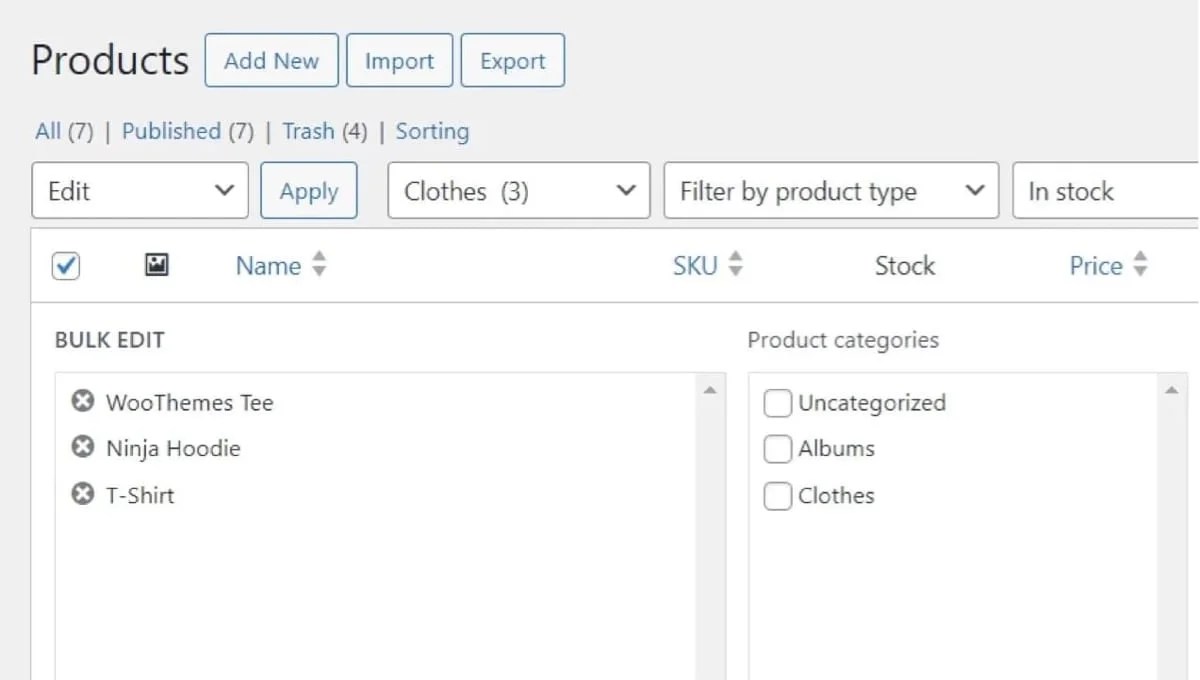
Rather than editing products one by one, you can filter items by category, type, or stock quantity and update them in batches. For larger stores, that kind of efficiency makes it easier to maintain accurate product information, roll out changes faster, and avoid quality issues as you scale.
Themes and templates also help standardize product page structure and speed up updates, but they should still leave room for the unique details that buyers need to evaluate each product. That balance makes it easier to scale product page optimization without creating repetitive, low-value content.
An SEO/GEO checklist for product pages
↑ Nach obenYour team can use this checklist to make sure product pages send clear, consistent signals across search, AI, and the buying experience:
- Title tag: Does it clearly name the product and its most important attributes?
- Meta description: Are you summarizing the page in a way that supports click-through and buying intent?
- On-page copy: Are you answering key buyer questions and surfacing important details above the fold?
- Product Schema: Does your markup match visible page content, including price, availability, attributes, and ratings?
- Image alt text: Are you describing what product images show in clear, useful language that also supports accessibility?
- Page structure: Does the page include headings, bullets, tabs, or accordions to organize information clearly?
- Variation/canonical setup: How do you help search engines understand how similar products relate to one another?
- FAQ schema: Do your highest-traffic product pages include FAQ blocks with specific, real customer questions? Are those questions marked up with FAQ schema so agents can read them?
- AI crawler accessibility: Do your key product details — price, description, availability, reviews — load without JavaScript? If not, AI crawlers may not be able to read them.
Before publishing or updating a product page, ensure the elements above reinforce the core product details.
Future-proof your product pages with WooCommerce
↑ Nach obenSearch behavior is changing, but the goal is still the same: help the right shoppers find the right product and feel confident enough to buy it.
In 2026, product descriptions will need to work harder. They need to support traditional SEO, improve AI visibility, and make key information easy to scan, trust, and act on.
The ecommerce teams poised to win are building product pages with better structure, clearer answers, and stronger systems behind them.
With WooCommerce, you have the flexibility to do exactly that across your catalog.
Ready to put these ideas into practice? Explore built-in features and extensions on the WooCommerce Marketplace. Find out how they help you improve product page structure, manage updates at scale, and create better shopping experiences across your catalog.


About