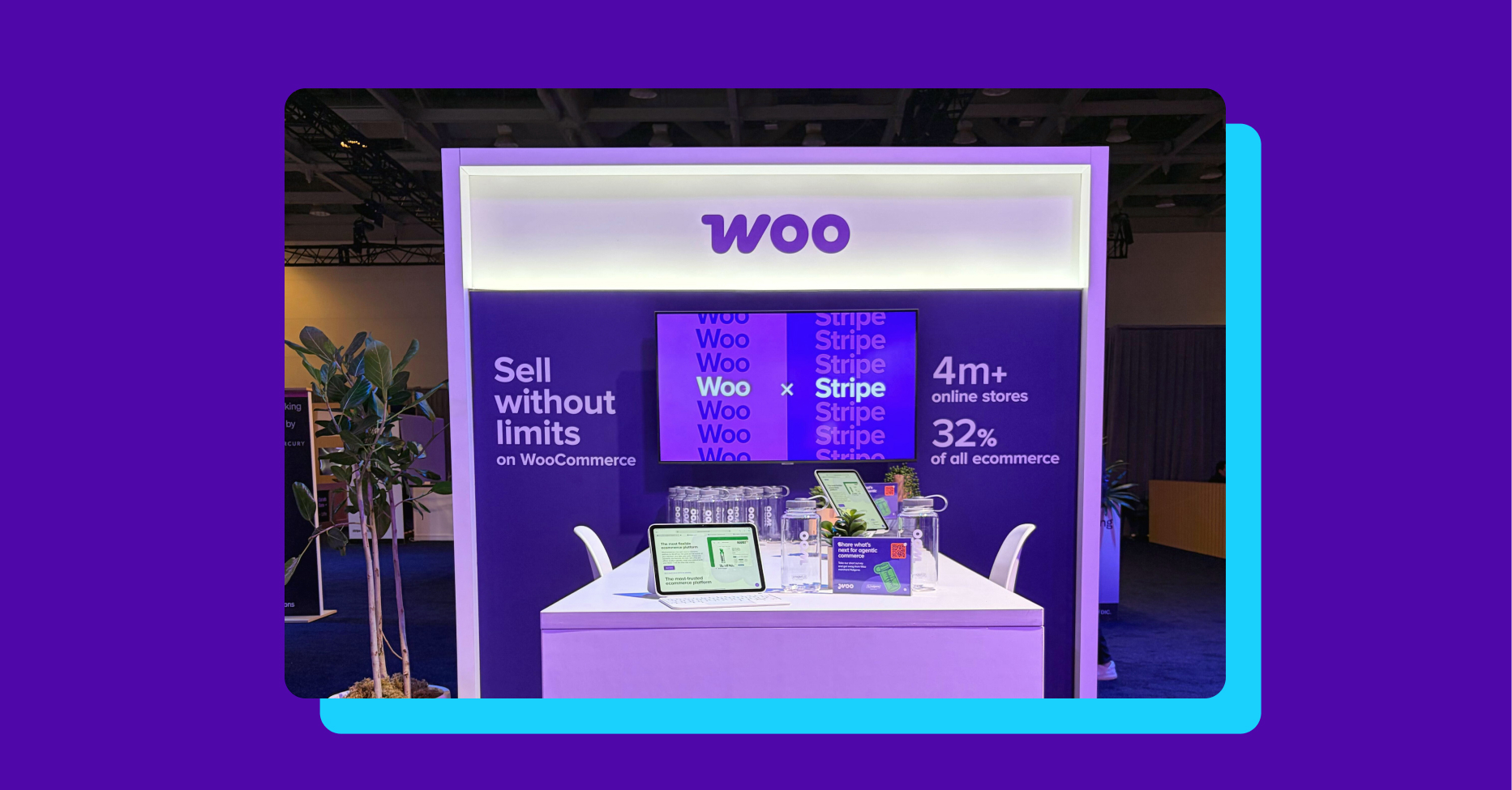
We set up a booth at Stripe Sessions 2026 and asked 225 commerce leaders where agentic commerce is headed. Software and SaaS builders, agency founders, brands, retailers, investors, and media professionals responded.
Three things stood out:
- Consumer trust was the one thing everyone agreed on.
- Discovery shifts first.
- No one knows yet who owns the customer relationship.
This is a builder-heavy perspective
↑ Torna in cimaOne thing to keep in mind: most respondents work on the infrastructure of commerce, not the storefronts. Software, platform, and SaaS companies made up 60% of the sample. Agencies and consultancies added another 12%. Brands and retailers were 7%, investors 4%, and the rest came from media and various write-in industries.
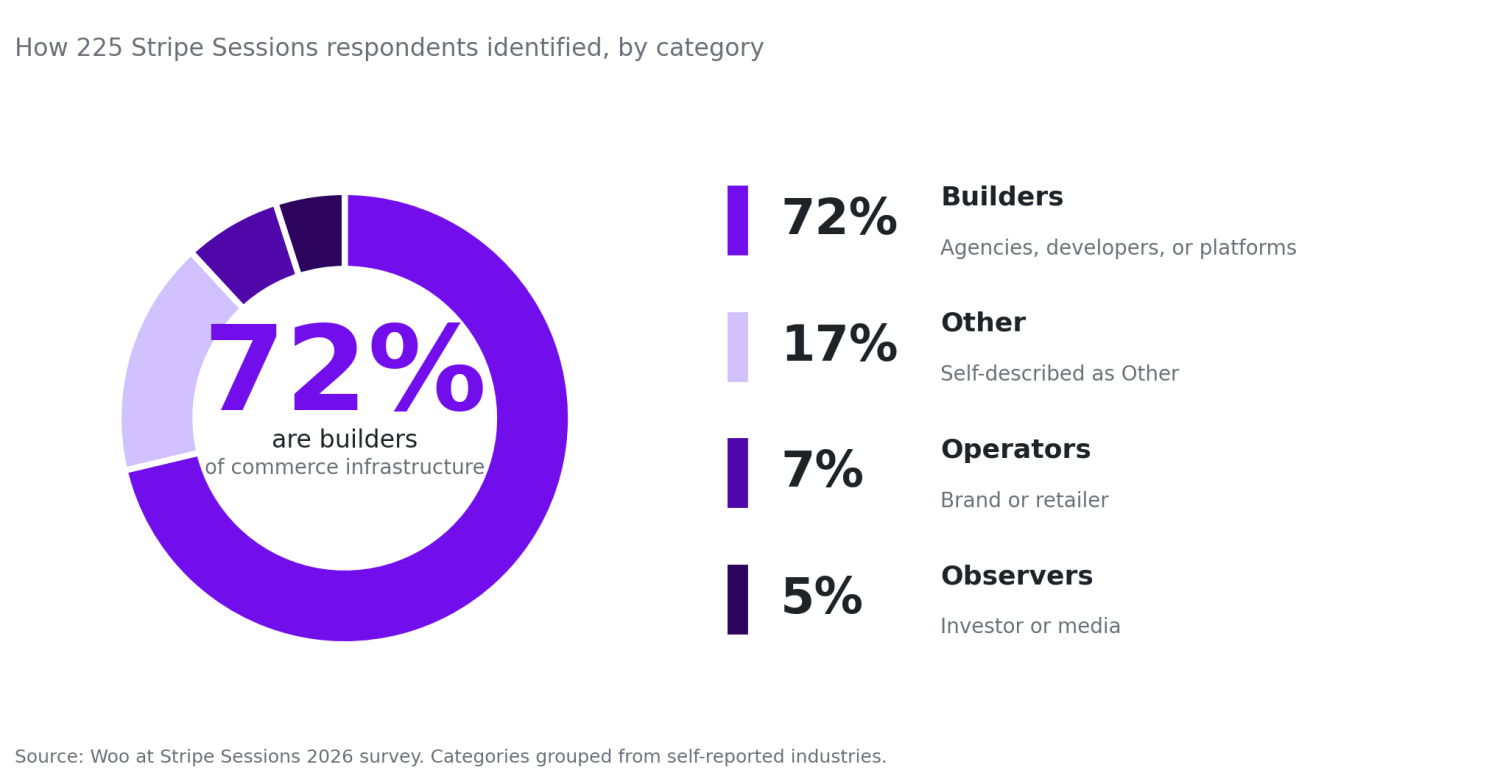
We’re mostly hearing from the people who build the rails. The brand and retailer responses give us the operator’s view, and I’ll flag where they see things differently.
Long term, trust pairs with everything
↑ Torna in cimaWe asked respondents to pick the two factors that will matter most in agentic commerce. The options were consumer trust, open protocols, payment infrastructure, regulation, and AI quality.
The most common pairing was consumer trust and payment infrastructure, named by 24% of respondents.
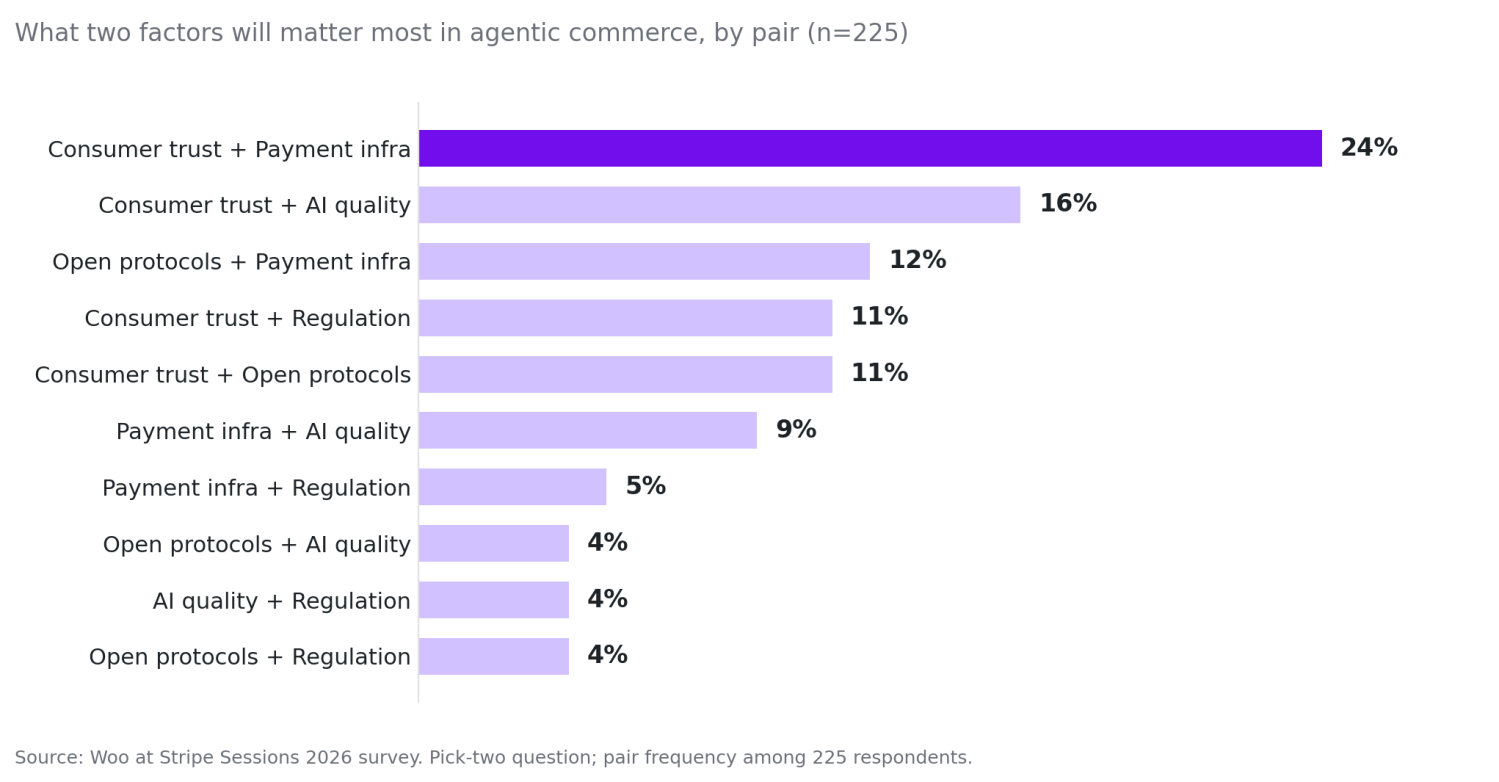
Consumer trust showed up in four of the five most common pairings, but the second factor split along industry lines.
- 6% paired trust with AI quality: a bet that the model itself is the deciding factor. If an AI agent recommends or buys the wrong thing, the rails don’t matter.
- 12% paired trust with open protocols or payment infrastructure: a bet on the rails. Get those right, and the rest follows.
- 11% paired trust with regulation: a focus on liability. When an agent buys something on your behalf, who’s accountable when something goes wrong?
Trust ran through every combination. The bets diverge on what comes second.
Search and discovery shift first
↑ Torna in cimaWhen we asked which part of commerce will be most disrupted by AI agents over the next 3 years, search and discovery topped the list at 26%. Ecommerce platforms came in right behind, at 24%. Advertising and paid acquisition followed at 17%.
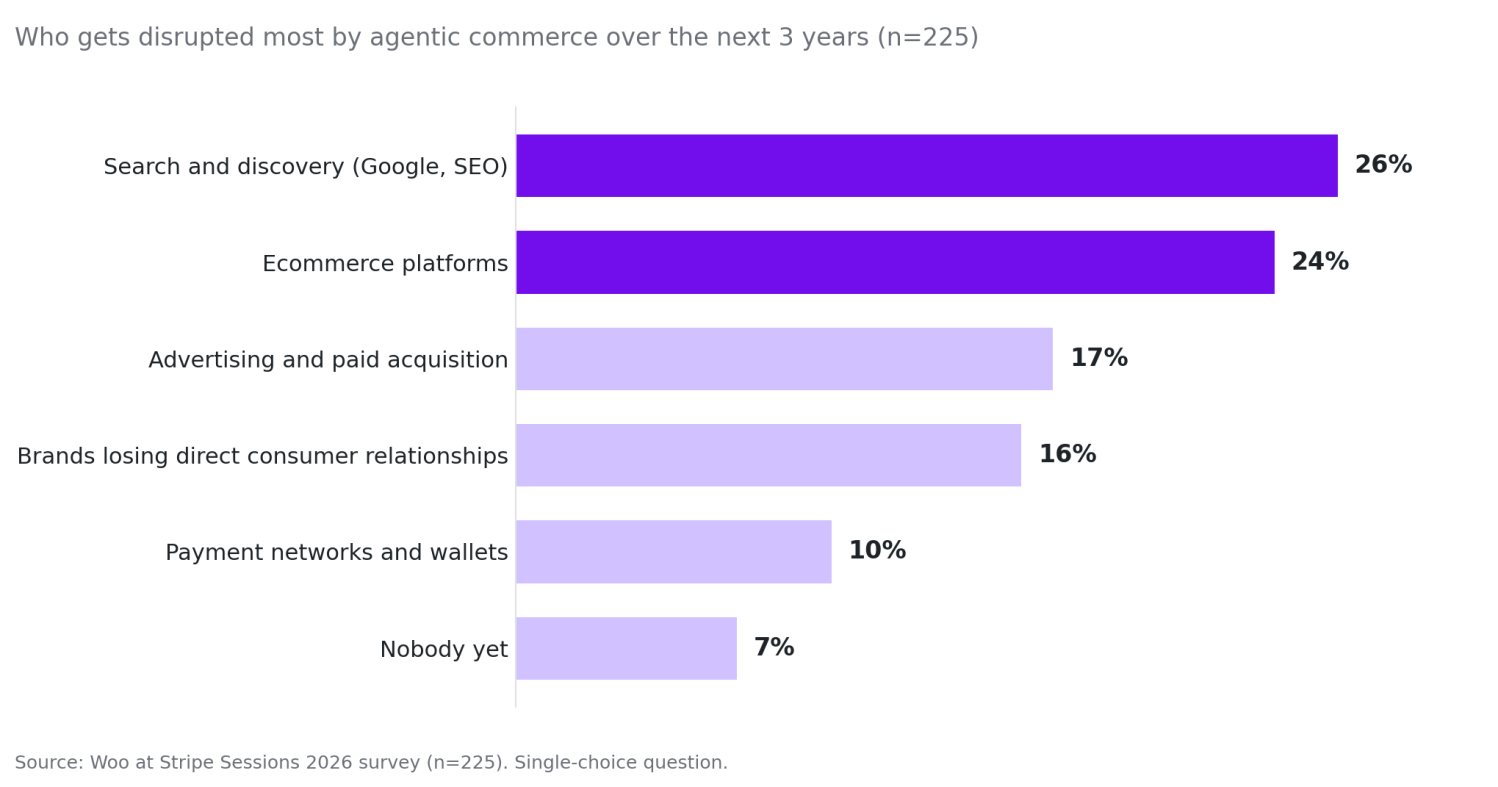
Respondents expect AI to change how shoppers find products before it changes how they buy them. The Visa April B2AI survey backs this up: only 38% of consumers are comfortable with an AI agent completing a purchase, and 60% wouldn’t let an agent spend any amount without prior approval. So, shoppers are still the ones completing purchases for now.
If your business depends on demand generation, the timeline is shorter. If it depends on checkout, there’s more runway, but the same shift is coming.
Brand and retailer respondents picked advertising as the most disrupted category. The people paying for ads expect ad spend to reshape first. The broader audience — which sells SEO, content, and platform services — sees its own market shifting first. Both are valid interpretations. They’re just looking at different links in the same chain.
No clear answer on who owns the customer relationship
↑ Torna in cimaOf all the questions we asked, this one had the least agreement — and arguably the biggest strategic stakes.
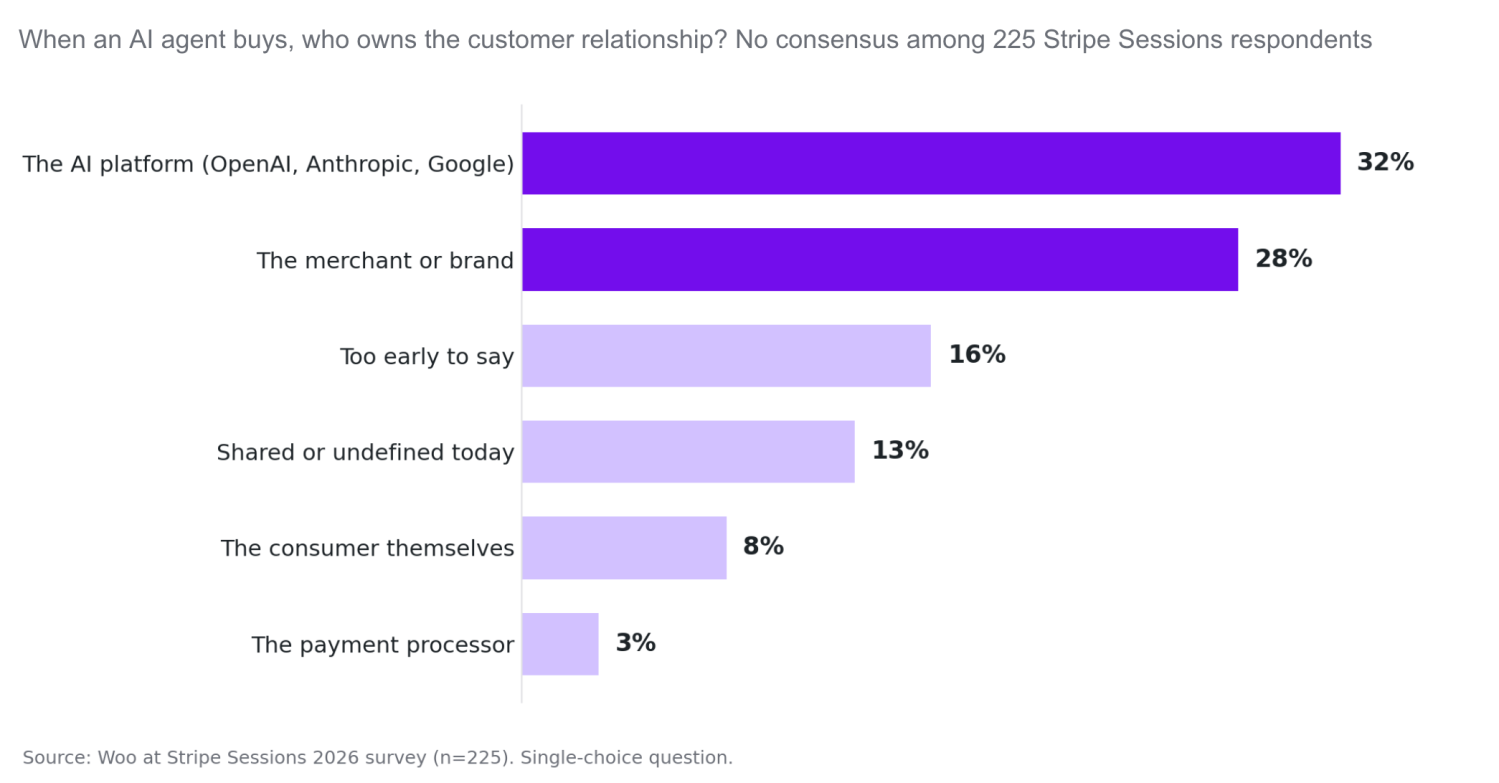
A 32/28 split, with another 29% combined in “too early” or “shared/undefined,” is not a winner. It’s contested territory. And among brands and retailers specifically (the people whose customer relationships are actually at stake), “too early to say” was the top answer.
AI agents are becoming a commerce channel. Discovery, recommendations, and in some cases, initiating a purchase. That’s already happening. But merchants still own fulfillment, returns, the support queue, the loyalty program, and the follow-up email. The relationship, basically.
It’s similar to selling on marketplaces. Merchants who kept their own customer relationships did fine when marketplace terms changed. The ones who let the marketplace own everything — the customer data, the purchase history, the whole relationship — learned that those customers belonged to the platform, not to them.
The same thing is happening with AI agents, and the rules aren’t written yet. Who owns customer and operational data isn’t locked down.
Brand still matters here, too. An AI agent recommending products uses signals such as what a customer has bought, what they liked, and which stores they return to. A brand that has genuinely earned someone’s trust is easier to recommend confidently. A forgettable one is harder to distinguish from the competition.
People will hand off more routine purchasing to AI over time. But what they buy still says something about who they are. That part doesn’t get delegated so easily.
Retailers are investing without a forecast
↑ Torna in cimaRetail respondents are investing real resources in being found by AI, even while admitting they don’t know what 2027 will look like. Over 7 in 10 said they’re actively investing in LLM discovery and traffic.
When we asked the same group to forecast what share of 2027 sales will come from AI-discovered shoppers or be completed by an agent, the dominant answer was: “We don’t know yet.”
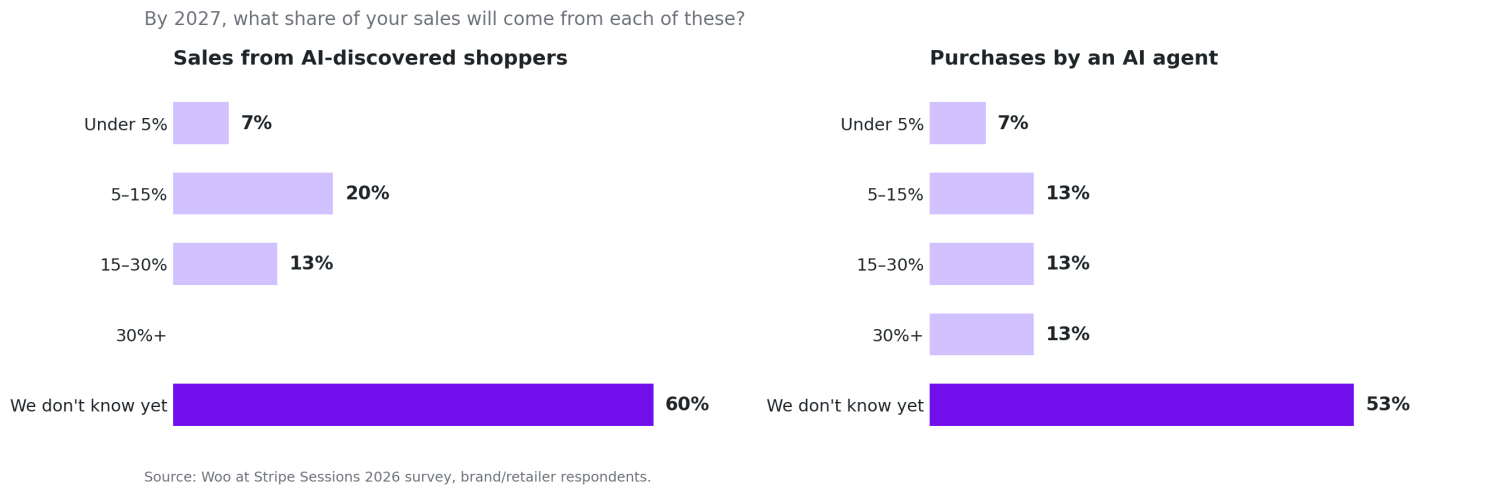
Respondents who did pick a number ranged from under 5%–30%+, with 5%–15% the most common range. There’s no consensus on the size of the shift; only that it’s coming.
What this means for your store
↑ Torna in cimaMerchants now have two audiences to reach: humans who browse and choose, and AI agents that filter and recommend. The agents will interact with your systems — from product data and APIs to structured content and your checkout reliability — not your design or conversion flow.
That means the foundations are exceedingly important. Product data that’s incomplete or outdated doesn’t just frustrate shoppers; it means your products don’t get surfaced at all. Schema markup, structured attributes, and descriptions that work for both humans and machines are now the baseline.
Your content and store also need to live on the same platform. AI agents read and cite buying guides, Q&As, and comparison pages. If your content lives on a separate system from your store, both become harder to parse. WooCommerce runs on WordPress, so those systems are already connected.
The protocol landscape is still being written. This is not the moment to lock in one bet.
Open platforms will outpace closed ones
↑ Torna in cimaWooCommerce is built on the principle that merchants should be able to extend, integrate, and adapt their store without asking permission.
Closed platforms pick a protocol (or build a proprietary one), and your store goes where they go. The integrations you can access, the agents your store can talk to, the AI workflows available to you: all of it runs through their roadmap, on their timeline, at their price. That’s a manageable tradeoff in a stable environment. But this isn’t a stable environment.
Open platforms can support multiple protocols. When a new protocol gains traction, it gets added. When one fades, you’re not locked into it. Your store connects to whatever the ecosystem produces, not just what one vendor chooses to support.
AI is also making open platforms easier to build on than they’ve ever been. The traditional tradeoff — power and flexibility at the cost of complexity — is shrinking. The speed advantage closed platforms used to have is eroding.
Meanwhile, closed platforms are moving in the opposite direction. Fees are going up. Ecosystems are getting tighter. Roadmap decisions are made in a black box. That gets harder to recover from the longer it goes on. And the protocol landscape is too uncertain and moving too fast for any single vendor to make all the right calls.
What Woo is building
↑ Torna in cimaMCP is live now. Model Context Protocol is how AI assistants connect to and operate software. Think of it as the layer that lets an AI actually do things in your store, not just answer questions about it. With WooCommerce 10.7, that connection is live. An AI assistant can now read your inventory, look up orders, and manage products directly, without copy-pasting or custom integrations.
Stripe’s Agentic Commerce Protocol integration is built. Woo is also a launch partner for Stripe’s Agentic Commerce Suite. The plumbing — catalog sync, checkout, order mapping, and inventory — is largely done. As Stripe’s agentic roadmap evolves, we’ll evolve with it.
The architecture supports what comes next. As new protocols emerge, Woo can add support for them without merchants having to switch platforms or rebuild anything. The work happens at the platform level, not the store level.
Nobody left Stripe Sessions with a 2027 forecast. But most people had made a decision about what kind of foundation they were building on. That’s probably where most merchants are right now, too.


About