
The Product Filters block helps shoppers narrow the products shown in a Product Collection by price, rating, attribute, availability, or a product taxonomy such as category, brand, or tag. The taxonomy filters available depend on the taxonomies exposed by your store.
Filters update the product list without a full page reload by default. If the surrounding Product Collection block has Reload full page enabled, applying or removing a filter reloads the storefront page instead. WooCommerce may enable and lock this setting when the collection contains blocks that do not support client-side navigation.
Add the Product Filters block
↑ Back to topAdd the Product Filters block to a page or template that contains a Product Collection block. For a store catalog, open Appearance > Editor > Design > Templates, select the Product Catalog template, and add Product Filters near the Product Collection.
If the template uses a pattern with restricted layout controls, select Edit pattern before selecting the Product Filters block.
Prerequisite: Add a Product Collection block to the same page or template. Product Filters uses that collection’s products as the filter results.
The block is context-aware. It filters the products in the relevant collection or archive, including product catalog and product taxonomy templates.
Choose how filters update the page
↑ Back to topSelect the surrounding Product Collection block, open its Advanced settings, and use Reload full page to choose the storefront behavior:
- Leave the setting disabled to update filtered products without a full page reload.
- Enable the setting to reload the storefront page whenever a shopper applies or removes a filter. This can help when another block or customization inside the collection requires traditional page navigation.
Choose when filters use an overlay
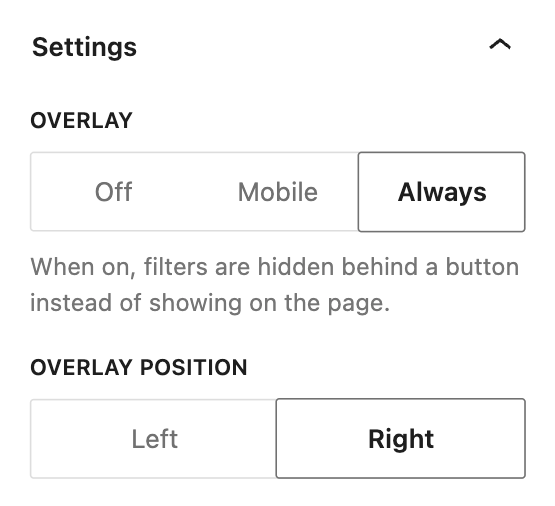
↑ Back to topSelect the Product Filters block and choose an Overlay setting in the block settings sidebar:
- Off keeps the filters visible in the page content.
- Mobile shows the filters in an overlay at or below the configured breakpoint and inline above it. This is the default when no overlay setting has been saved.
- Always shows the filters in an overlay at all viewport widths.
With Mobile or Always selected, choose Left or Right for Overlay position. This setting is available only when the overlay is on.
The Mobile breakpoint uses the configured Tablet viewport if one is set; otherwise, it uses the configured Mobile viewport. If neither is set, WooCommerce uses 782px. There is no Tablet option in the Overlay setting.
In the Product Filters block’s Styles tab, set Position to Sticky to keep it visible within its parent’s scrollable area.
Add and configure filters
↑ Back to topAdd individual filters inside the Product Filters block. The filters available for a store include:
| Filter | What shoppers can filter | Key settings |
|---|---|---|
| Active Filters | Displays the filters currently applied and lets shoppers remove them. | Includes removable chips and a clear filters control. |
| Price Filter | Products within a price range. | Show or hide price inputs and place them inline with the slider or on a separate line. |
| Rating Filter | Products by customer rating. | Show product counts. The filter appears on the storefront only when rated products are available. |
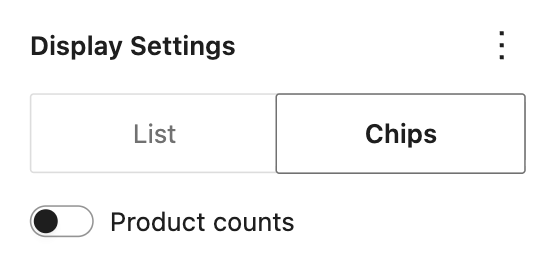
| Attribute Filter | Products by an attribute such as color or size. | Choose List or Chips and show or hide product counts. |
| Availability Filter | Products by availability, such as in stock. | Choose List or Chips and show or hide product counts. |
| Category Filter | Products by category. | Choose List or Chips and show or hide product counts. |
| Brand Filter | Products by brand. | Choose List or Chips and show or hide product counts. |
| Tag Filter | Products by tag. | Choose List or Chips and show or hide product counts. |
If you add more than one instance of the same filter to a page, their selected and active states stay synchronized. This supports layouts such as active filters above a collection and selectable filters in a sidebar.
Active Filters
↑ Back to topThe Active Filters block displays the filters a shopper has applied. Each active filter appears as a removable chip. Shoppers can remove one selection or clear all filters.
Active labels identify both the filter and selection. For example, selecting the in-stock option displays Availability: In stock.
Price Filter
↑ Back to topThe Price Filter lets shoppers choose a minimum and maximum product price with a slider.
- Use Input fields to show or hide editable minimum and maximum price fields.
- When input fields are shown, choose whether they appear inline with the slider or on a separate line.
Attribute Filter
↑ Back to topThe Attribute Filter lets shoppers filter products by a product attribute, such as color or size. Choose the attribute when adding the block.
In the block settings sidebar, choose List or Chips and decide whether to show the product count for each option. When the selected attribute uses the Color / image type, the List style can show each term’s color or image swatch with its label.
When you use Chips, select the Chips block to set its font size, letter spacing, text transform, padding, or border radius. These styles apply to text chips; color and image swatches use the attribute term’s visual settings.
Use Typography options to show Size, Letter spacing, and Letter case. Use Border options to show Radius.
The filter options depend on attribute terms assigned to products in the current collection. If an option is missing, check the products in that collection and the attribute terms assigned to them.
Availability Filter
↑ Back to topThe Availability Filter lets shoppers filter products by availability. Depending on the store’s products, options can include In stock, Out of stock, and On backorder.
Use the block settings sidebar to display the options as a List or Chips. You can also show the product count for each option.
Rating Filter
↑ Back to topThe Rating Filter lets shoppers filter products by customer rating. You can show a product count next to each rating option.
The filter does not appear on the storefront until at least one product has a customer rating.
If overlay behavior differs from what you expect, check the selected Overlay mode and the site’s configured viewport sizes. If styling controls are missing, select the inner Chips block and open its Typography or Border options.
Check your filters: Preview the page, select a filter option, and confirm the Product Collection updates. Remove the selection from the filter or Active Filters block and confirm the original results return.
Questions and support
↑ Back to topDo you still have questions and need assistance?
This documentation is about the free, core WooCommerce plugin, for which support is provided in our community forums on WordPress.org. By searching this forum, you’ll often find that your question has been asked and answered before.
If you haven’t created a WordPress.org account to use the forums, here’s how.
- If you’re looking to extend the core functionality shown here, we recommend reviewing available extensions in the WooCommerce Marketplace.
- Need ongoing advanced support or a customization built for WooCommerce? Hire a Woo Agency Partner.
- Are you a developer building your own WooCommerce integration or extension? Check our Developer Resources.
If you weren’t able to find the information you need, please use the feedback thumbs below to let us know.