

Most merchants try standard fixes for cart abandonment: fewer steps, a mobile-friendly checkout, and more payment options at checkout. These changes help, but they don’t fully explain why shoppers still walk away.
WooCommerce and Stripe surveyed over 1,400 shoppers across North America, Europe, and Asia-Pacific to learn what drives checkout decisions in 2026.
Failed transactions, not genuine declines, cause the most checkout-related abandonment at 28%. Network timeouts, routing errors, and missed retries — soft failures — create this loss. Checkout infrastructure that catches these failures can recover the lost revenue.
The research also shows how payment preferences shift sharply by region, cart size, product category, and shopper age. This reveals a checkout landscape far more contextual than most merchants plan for.
This report breaks down the results and what merchants can do about them.
The path to purchase is only as strong as checkout
↑ Back to topThree out of four shoppers in our survey abandoned a cart. Of those, 63% cited checkout and payment issues: failed transactions (28%), too many steps (21%), or inability to pay with their preferred method (21%).
Let’s look at two of those more closely:
One in five shoppers who abandoned their cart cited a missing payment method. A shopper on their phone may want to tap Apple Pay instead of hunting for a credit card, or someone considering a bigger purchase may complete it if they can split it into installments. When shoppers don’t find the expected option, they break the purchase path.
Failed transactions cause the most checkout-related abandonment at 28%. Often, these issues aren’t genuine declines, like a maxed-out card or a fraud flag. Instead, a network timeout during authorization, a bank’s brief system outage, or a system routing a transaction through a failing path instead of a better one can trigger soft failures.
Routing matters. The system sends every card transaction through a specific path to the issuing bank, and that path can determine success — especially for cross-border payments or less common card types. If your payment stack tries only one route or retries a failed attempt the same way, you leave approvable transactions on the table. Detecting soft failures, routing intelligently, and retrying with adaptive logic convert failed attempts into completed sales.
Look at your checkout with fresh eyes. How many steps does it require? Does it perform well on mobile? Are you offering the payment methods your customers actually expect? What happens behind the scenes at authorization? Is your payment processor optimizing routing, retrying failed attempts adaptively, and reporting authorization rates transparently, or are preventable failures costing you sales without you knowing it?
Going global means going local with payments
↑ Back to topCross-border demand is real and growing. In our survey, 59% of shoppers made an international purchase in the past year.
Here’s the regional breakdown:
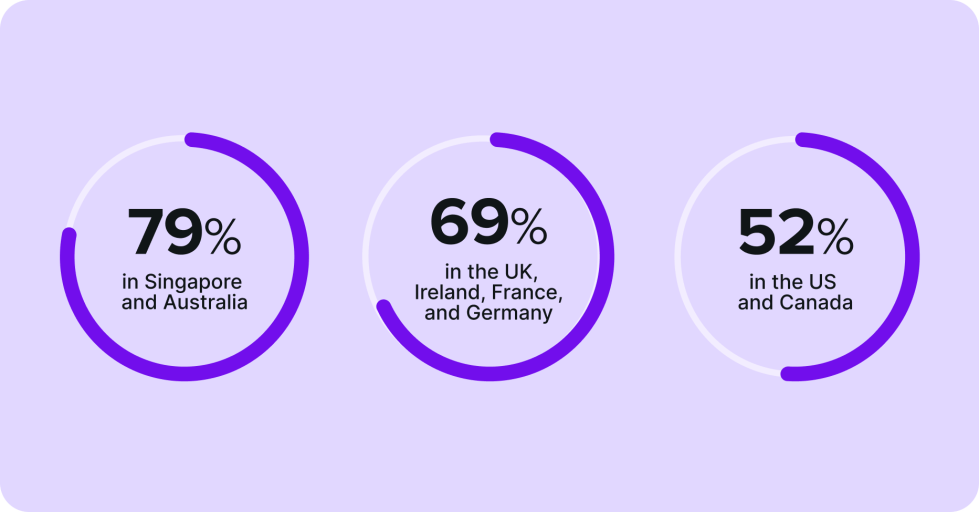
That represents a large opportunity. However, reaching international shoppers and converting them are two different things.
The data is clear: 80% of shoppers say the availability of their preferred payment method matters when shopping internationally, and additional Stripe global research shows that 30% are more likely to complete a purchase when they see local payment methods available.
Digital wallets are the most influential alternative method for cross-border purchase completion (35%), followed by buy now, pay later (15%) and one-click checkout (12%).
In Asia-Pacific, where cross-border purchasing is highest, 40% favor digital wallets and 20% prioritize one-click checkout, reflecting the region’s mobile-first infrastructure.
If you’re expanding internationally, treat payment localization the same way you treat currency, shipping, and duties — as a launch requirement. Pick 1–3 markets where you already see demand signals and localize checkout there first.
You might set up shipping to the Netherlands or China. Still, if your checkout doesn’t offer iDEAL (the popular payment method in the Netherlands) or Alipay (the leading Chinese payment method), you haven’t truly prepared to sell there. Stripe research shows that, on average, adding iDEAL in the Netherlands increases conversion by 39%, and adding Alipay in China increases it by 91%.
Payment preferences shift with context
↑ Back to topNo universal payment mix exists. Shoppers choose their payment method based on what they buy and how much they spend.
Cart size matters. Additional Stripe global research shows that 60% of shoppers have used buy now, pay later, and more shoppers use it as cart value grows; 28% are likely to use buy now, pay later (BNPL) for purchases over $250 USD; and 18% say they’re less likely to complete a purchase at that price point if BNPL isn’t offered. Nearly one in five shoppers are willing to walk away from a larger purchase because they can’t pay over time.
Category matters, too. Digital wallets perform best in categories like software (26%) and fitness (21%), where purchases are usually digital or subscription-oriented and speed matters most. BNPL attracts the most shoppers in higher-ticket categories: 12% for electronics and furniture, 10% for computer hardware, motor vehicles, and jewelry.
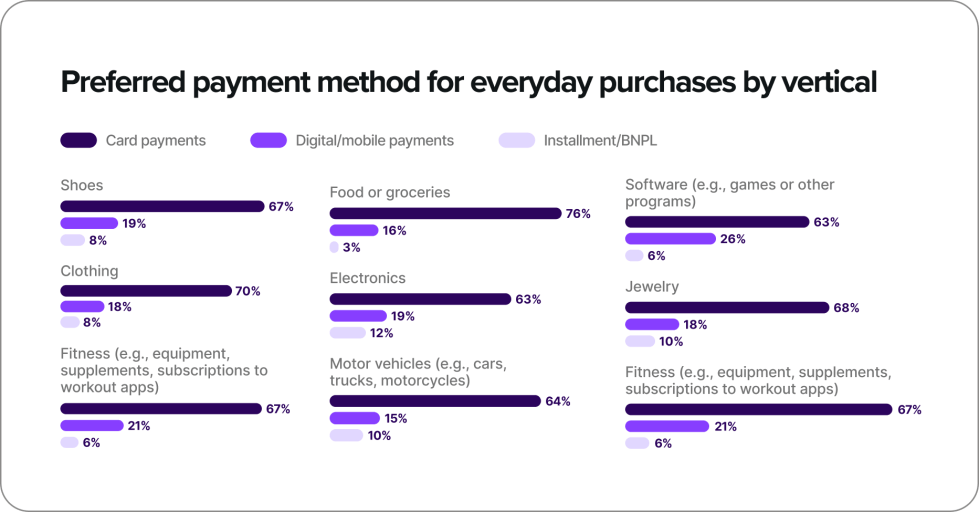
Cards remain dominant across the board, but their share varies, from 79% in car rentals down to 63% in electronics and software. As card share drops, alternative payment methods matter more.
Region, cart size, product category, device — the right payment mix shifts with every transaction. Managing all these variables manually is overwhelming. Your checkout should understand context and surface the right options automatically, so shoppers always see the most relevant way to pay without extra configuration.
Younger shoppers preview where payments are headed
↑ Back to topShoppers age 18–29 set the stage for mainstream payment expectations.
Younger shoppers adopt alternative payment methods at rates roughly 40% higher than the general population.
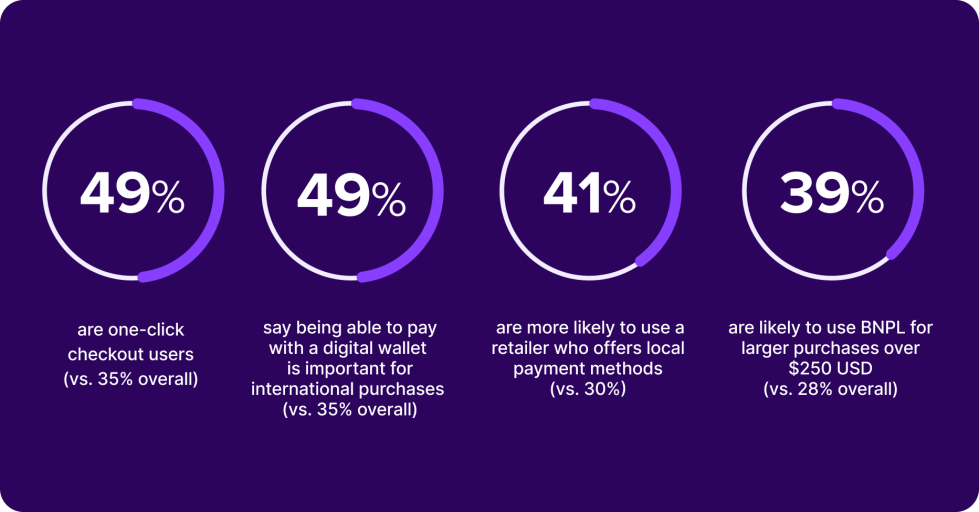
This pattern is consistent: speed, saved credentials, mobile wallets, and financing options shape how younger shoppers buy. Past trends like social shopping, mobile commerce, and free shipping all show that what younger shoppers prefer quickly becomes universal.
Even if your customer base skews older today, the infrastructure you build now determines whether you’re prepared when expectations shift. Support wallets, one-click checkout, BNPL, and local payment methods. Keep the architecture modular so you can add and test new methods as they become relevant rather than retrofitting your checkout every time expectations shift.
Implement these insights
↑ Back to topCheckouts face both user experience-related and infrastructure challenges.
You can easily identify user experience improvements. You can test and measure shorter checkout flows and better mobile layouts, so most merchants have already made these changes.
Infrastructure issues are less obvious. Check your authorization rate data to see if your processor recovers soft failures or marks them as declines. Compare your traffic sources with the payment options your shoppers use to ensure your payment methods match your customers’ locations. If the lack of BNPL causes you to lose sales on high-value orders, a standard sales report won’t reveal this. This research highlights three questions worth asking:
1. What’s your authorization rate, broken down by hard and soft declines?
If you’ve never asked your processor for that split, start there. Soft failures are recoverable, but only if your infrastructure is set up to handle them.
2. Does your payment method mix match where your customers come from?
If you’re seeing meaningful traffic from markets where you don’t offer the dominant local payment method, you’re losing conversions, and you’re probably crediting it to something else.
3. What’s your BNPL exposure relative to your average order value?
If your average order sits above $200 — remember that 18% of shoppers are less likely to complete a purchase over $250 without installment options — it’s worth stress-testing against your actual drop-off data at higher cart values.
These all depend on infrastructure and setup. Combined with UX improvements, you unlock the remaining growth.
How WooCommerce + Stripe can help
↑ Back to topWooCommerce provides a flexible, open-source commerce infrastructure, giving you full control over your storefront and growth strategy. WooPayments, the official Stripe extension for WooCommerce, embeds payment intelligence into checkout.
Here’s what they enable:
- Authorization rates: Most merchants don’t know how much revenue they’re losing to soft failures. The Stripe extension for WooCommerce includes adaptive acceptance, Stripe’s AI-powered feature that catches false declines and retries them before the shopper ever sees a failure message. It’s included at no extra charge, unlike most gateways that treat it like a premium add-on.
- Payment mix: You don’t need to build a separate checkout flow for each market because the system handles it automatically, surfacing local payment methods based on the customer’s billing country and currency. For example, it serves iDEAL to Dutch shoppers without requiring a separate checkout process for the Netherlands. The same logic applies across 150+ countries and 135+ currencies.
- BNPL: You can offer Affirm, Afterpay, and Klarna within the same checkout flow so the 18% of shoppers who won’t complete a purchase over $250 without installment options have a reason to stay. The system presents these options based on the shopper’s location, currency, and cart total, so the installment option appears at the right time without manual configuration.
The data points to a clear opportunity. WooCommerce and Stripe give you the infrastructure to act on it — from recovering soft failures to surfacing the right payments for every shopper, automatically.
Start building your checkout with WooCommerce and Stripe today.
Feeling stuck with your ecommerce solution? Let’s talk.

About