Active installs
100+
Product comparison
Subscription includes
Support
Selling tickets shouldn’t mean juggling three platforms, paying 10% commissions, or hiring a developer. QR Code Tickets & Check-in for WooCommerce lets you sell, deliver, and validate tickets entirely from your existing WooCommerce store — no third-party platforms, no per-ticket fees, no code required.
Whether you’re running a music festival with 5,000 attendees, a workshop with 20 seats, a museum tour, or a gym membership program, this plugin gives you everything you need: automated QR ticket generation, branded email delivery with PDF attachments, mobile check-in with camera scanning, and real-time attendance analytics — all inside the WordPress dashboard you already know.

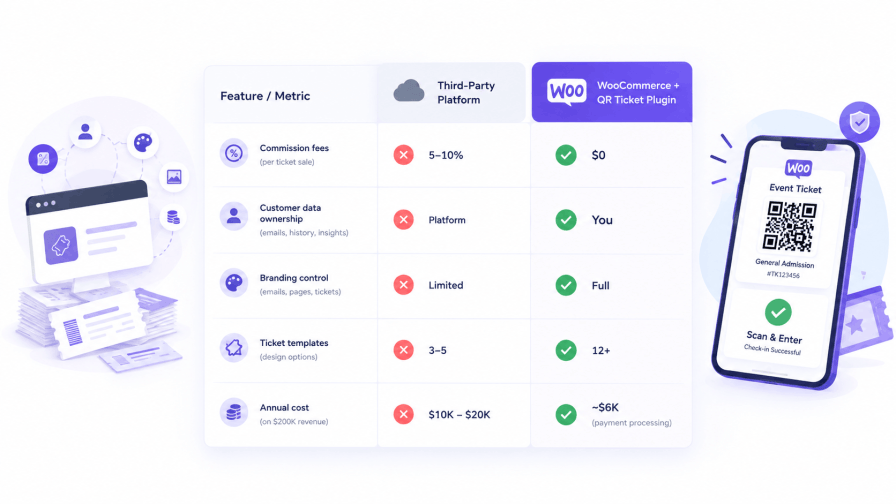
If you’ve ever sold tickets through Eventbrite, Ticketmaster, or similar platforms, you already know the pain: commission fees that eat 5–10% of every sale, limited control over branding, and customer data that belongs to someone else.
Here’s what switching to self-hosted WooCommerce ticketing looks like:
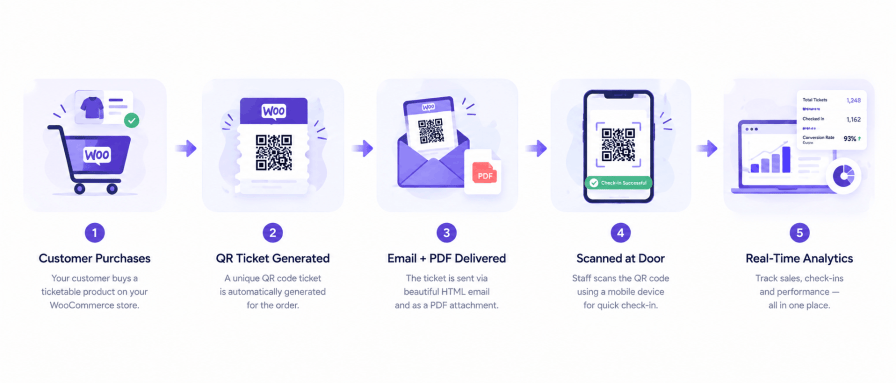
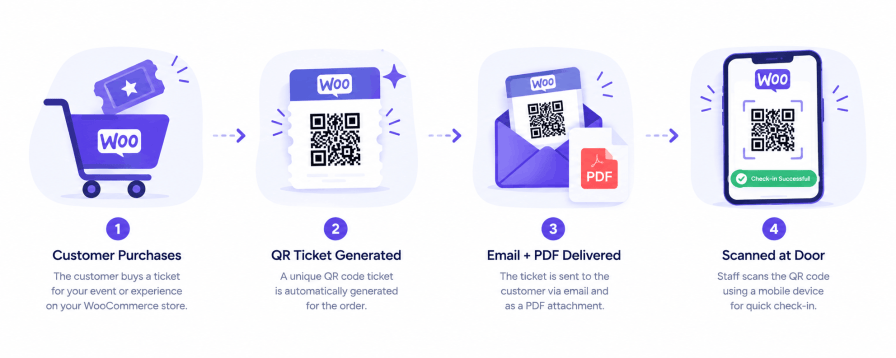
Unlike single-purpose ticketing tools, QR Code Tickets & Check-in is built for the full event lifecycle. From the moment a customer clicks “Buy Ticket” to the moment they walk through your gate — this plugin handles every step, and now includes AI-powered ticket management for the future of event operations.
We’ve been listening. Here’s what’s new in the latest release:
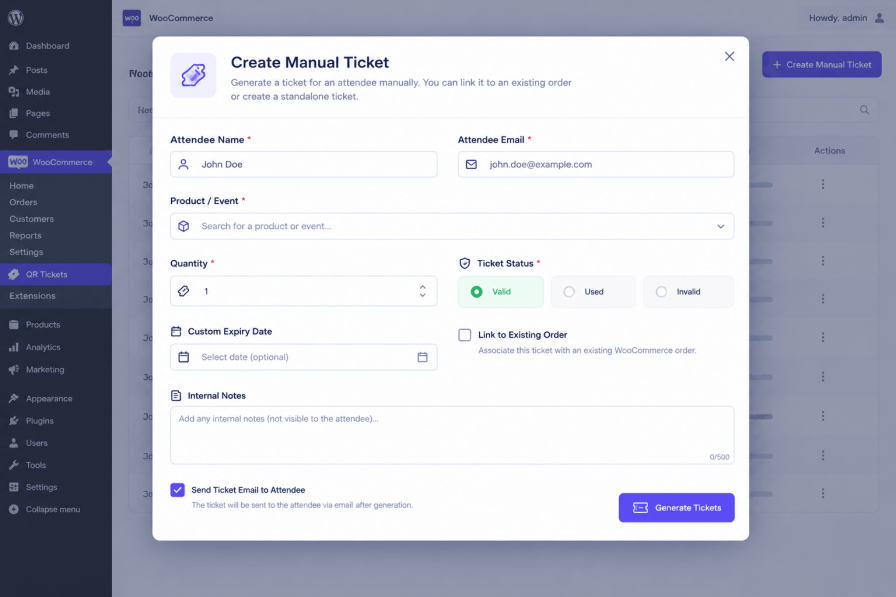
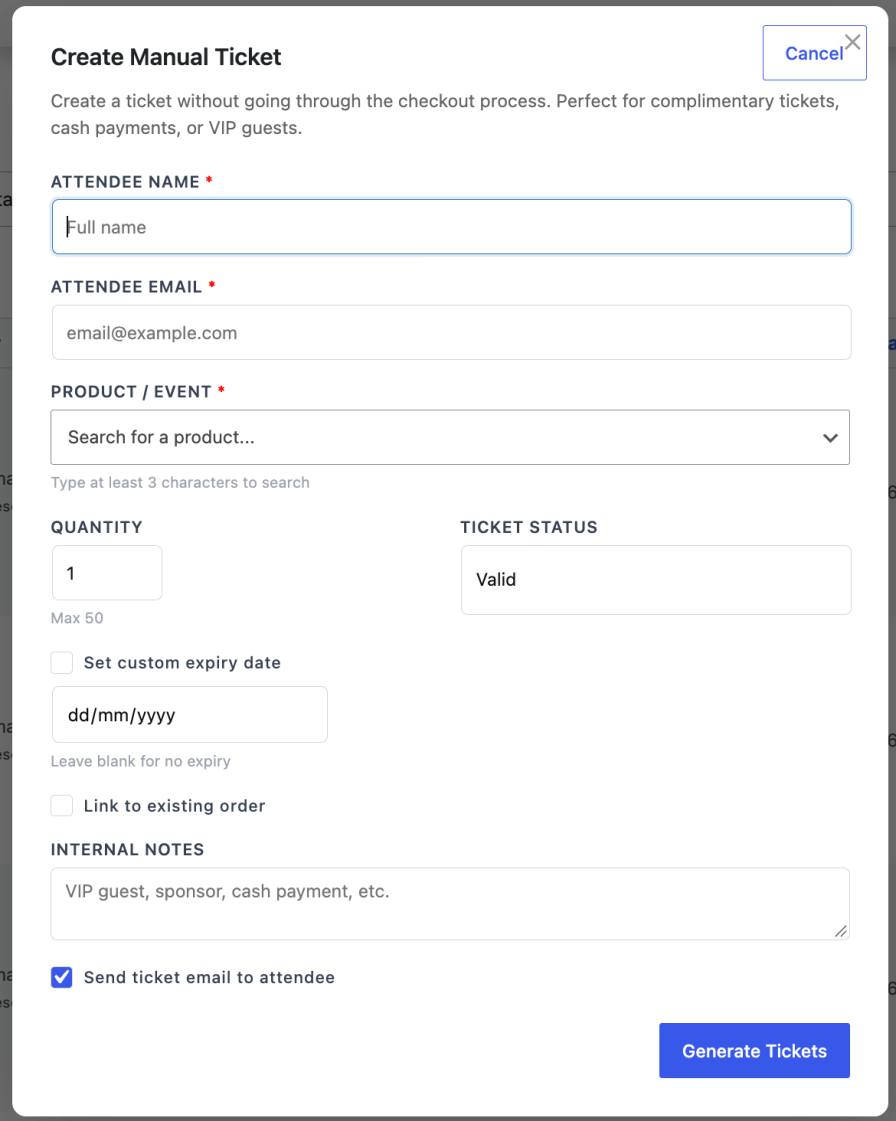
Issue tickets directly from the admin without creating an order. Perfect for:
Enter the attendee’s name and email, select the event, choose the status and quantity, and click “Generate Tickets.” The QR code is ready in seconds — with an optional email delivered to the recipient.
Every ticket email now includes a downloadable PDF attachment. The PDF uses the same template you’ve selected for print — so your tickets look consistent across every touchpoint. Attendees can print the PDF, save it to their phone, or bring it to the event as a backup.
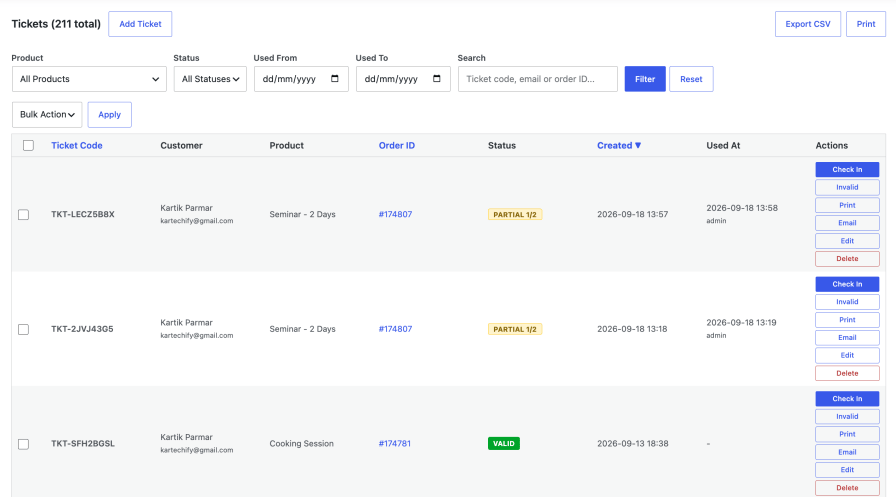
Managing hundreds of tickets no longer means clicking through them one at a time. Select multiple tickets from the listing and act on them in bulk — delete old tickets after an event, re-export attendee lists, or perform bulk check-ins. The same familiar bulk-action pattern WooCommerce uses on the Orders page.
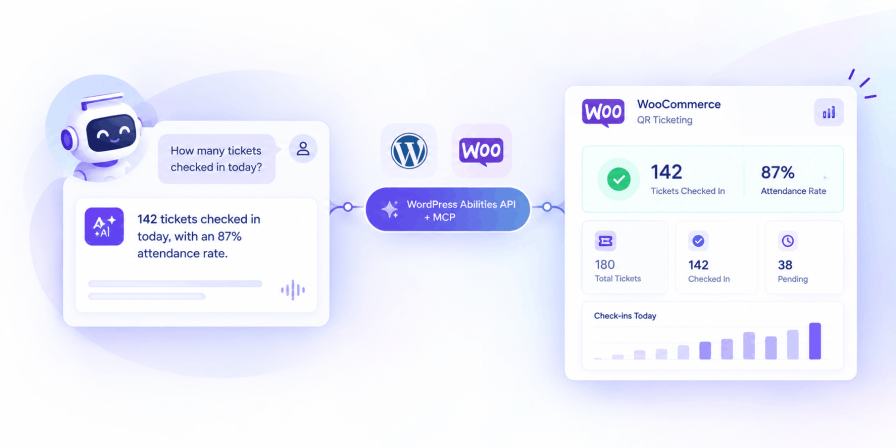
The plugin now registers WordPress Abilities — a standardized interface that lets AI assistants and automation tools interact with your ticketing system. Through the WordPress Abilities API and Model Context Protocol (MCP), AI can:
If you’re building the future of agentic event operations, this is where it starts.
The REST API now exposes 30+ endpoints covering everything from ticket creation to statistics to webhooks. Developers can build custom dashboards, integrate with CRMs like HubSpot or Salesforce, or connect to mobile apps. Full documentation is available in the plugin’s FAQ tab.
Tickets are generated the moment an order reaches the status you choose — usually “Completed.” Each quantity in the cart creates its own unique ticket with its own QR code. Order 3 tickets, get 3 unique tickets, each individually checkable.
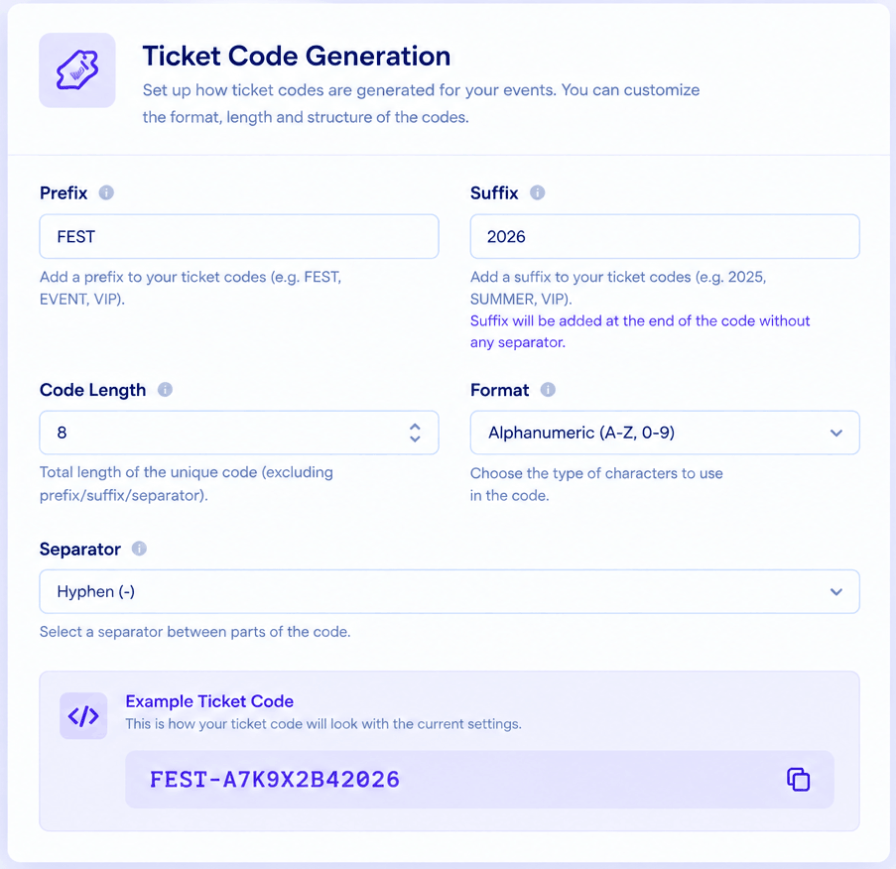
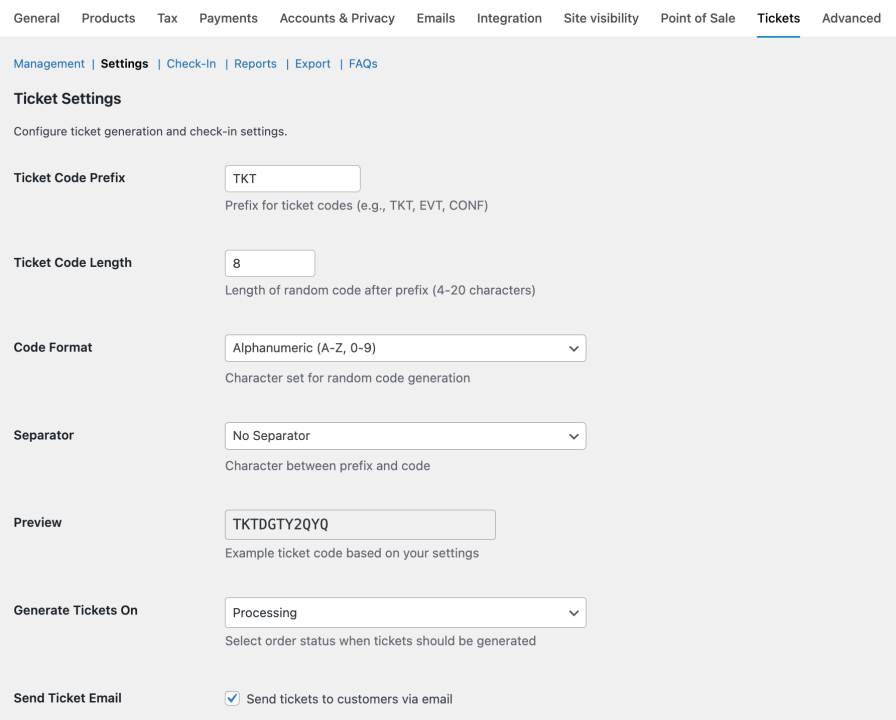
You control the format entirely: prefix, suffix, length (4–20 characters), character set (alphanumeric, letters only, numbers only, or hex), and separator. Want tickets that look like FEST-A7K92026? That’s one field change.
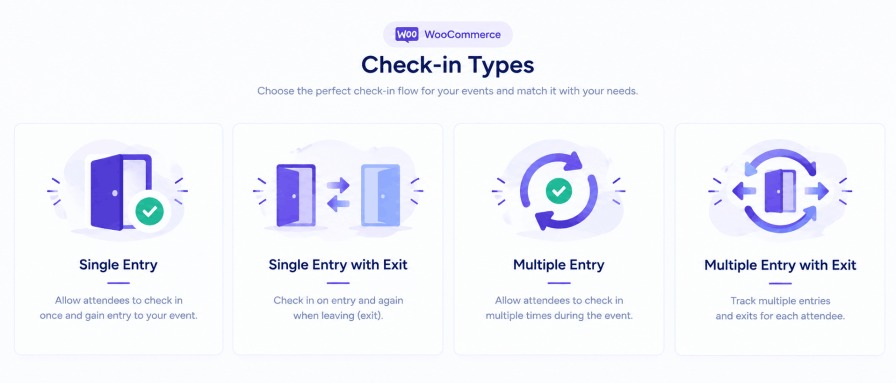
Different events need different entry rules. The plugin gives you four check-in types, configurable globally or per product:
Your tickets are often the first physical artifact your attendees receive. They shouldn’t look like a default WordPress page.
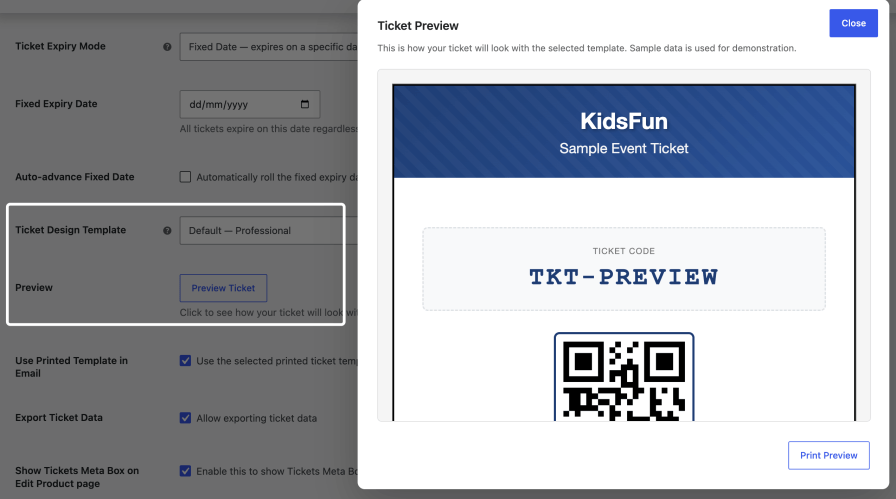
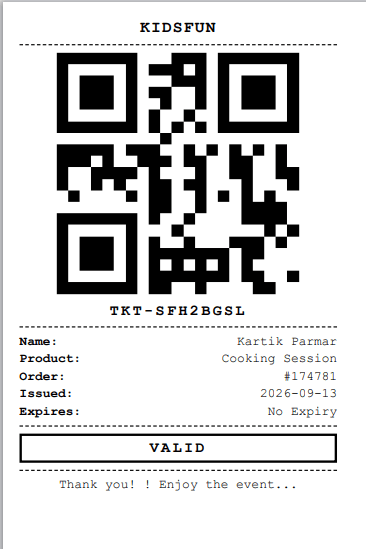
The plugin includes 12 hand-designed ticket templates, each crafted for a specific event type:
Plus a Custom Template option that lets you write your own HTML/CSS using merge codes like {{ticket_code}}, {{qr_code}}, {{customer_name}}, and {{site_logo}}. If you can design it in HTML, you can make it a ticket.
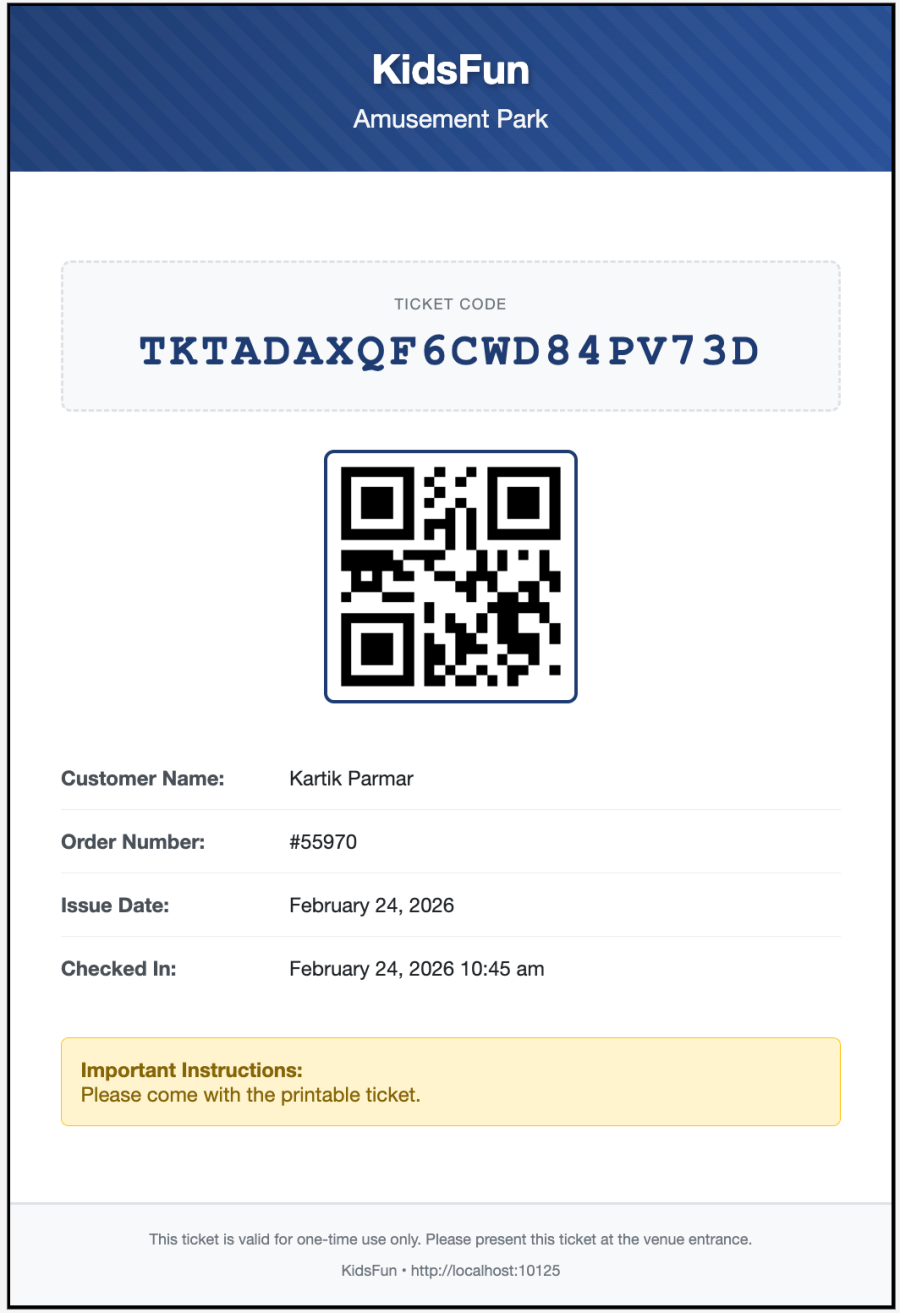
When an order completes, the plugin sends a branded HTML email with the QR code embedded directly in the email body — plus a downloadable PDF attached. Your customer can show the QR code on their phone at the door or print the PDF as a backup.
The email uses WooCommerce’s native email system, so it inherits your existing styling, header, and footer. If you want the email to use the same design as your printed tickets, enable the “Use Printed Template in Email” option — the email will render the exact same ticket design your attendees see when they print.
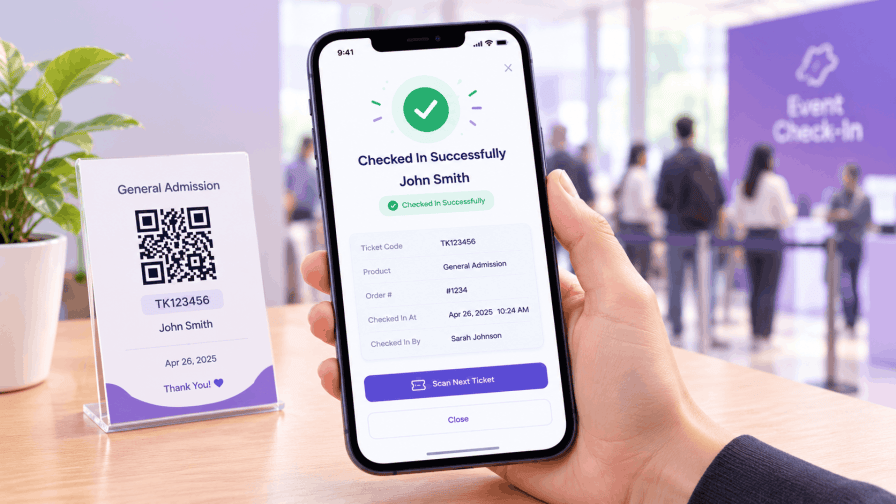
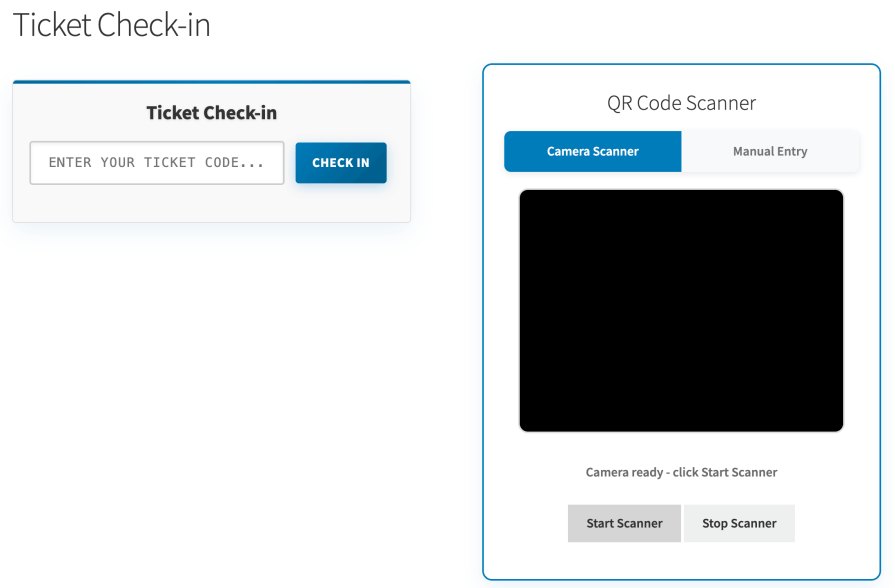
No dedicated hardware required. Any smartphone or tablet with a camera becomes a ticket scanner. Staff open a check-in page on their device, point the camera at a QR code, and the system validates the ticket in under 3 seconds.
The check-in interface shows:
Different events need different check-in workflows. The plugin supports four:
[ticket_checkin_form] or [ticket_scanner] shortcode to embed a check-in page anywhere on your site. Door staff can access it from a dedicated URL without any WordPress admin access.Sometimes a ticket needs to be issued outside the normal checkout flow. The “Create Manual Ticket” button opens a modal where you can:
Plans change. A customer buys a ticket, then can’t attend — but their friend can. Instead of forcing a refund, let them transfer the ticket.
From their My Account page, the customer clicks “Transfer Ticket,” enters the recipient’s name and email, and sends. The recipient gets an email with accept/decline links. Once accepted, the ticket is transferred and a new QR code is generated (optional) so the old code is invalidated.
You control the rules: max transfers per ticket, deadline before the event, which products allow transfers, and whether to regenerate the QR code on transfer.
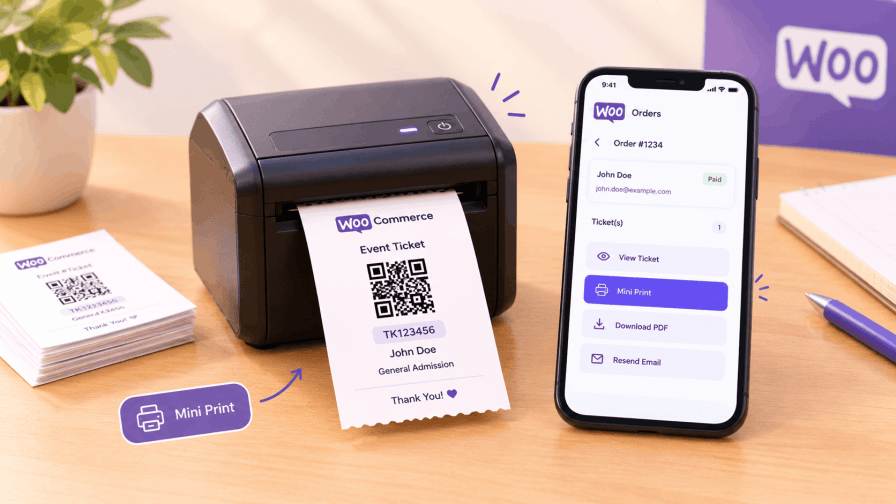
For on-site ticket printing at the box office, the plugin supports 58mm and 80mm thermal printers. Six mini-ticket layouts are available — Classic, Minimalist, Brand-Focused, Event-Focused, GST Invoice Style, and Sales Invoice with QR — so you can print walk-up tickets, receipts, and vouchers without a full-size printer.
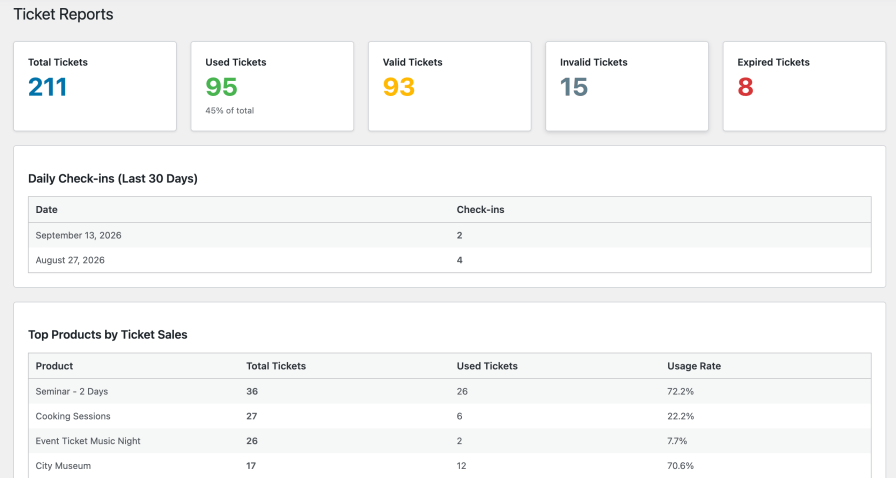
The Reports tab gives you a real-time view of your event:
Export any report to CSV for external analysis, or use the built-in dashboard widget for a quick overview.
Running 50 ticketed products? You don’t want to configure each one individually. The Bulk Settings tab lets you apply ticket settings across all products, specific categories, or hand-picked items. Choose only the settings you want to overwrite — everything else stays unchanged.
Every product can have its own ticket settings: check-in type, max entries, expiry mode, ticket code format, template, instructions, allowed check-in roles, and transfer permissions. This means a multi-day festival product can use “Multiple Entry” while a single-day workshop product uses “Single Entry” — all from the same plugin.
Staff who scan tickets don’t need — and shouldn’t have — admin access. The plugin includes a dedicated Ticket Checker role that can only access the check-in interface. No orders, no settings, no customer data.
You can further restrict check-in access per product by selecting specific WordPress roles. And every check-in action is logged with timestamp, staff name, IP address, and device — providing a complete audit trail.
The Management tab is the command center for every ticket in your store. It includes:
Every ticket action is logged: creation, check-in, check-out, email sent, transfer, edit, deletion, and invalidation. The Logs tab shows who did what, when, from which IP, and on which device. Filter by action type, user, or date range for full accountability.
For developers building on top of the plugin, the REST API exposes endpoints for:
Webhooks fire on ticket creation, check-in, and invalidation — perfect for triggering actions in Zapier, Make, or your own systems.
The plugin registers seven AI abilities through the WordPress Abilities API. AI assistants (Claude, ChatGPT, and others via MCP) can discover and execute these abilities to manage your ticketing system:
ticket-checkin/list-tickets — retrieve tickets with filtersticket-checkin/get-ticket — fetch full details of a specific ticketticket-checkin/ticket-stats — get overall statisticsticket-checkin/checkin-ticket — check in a ticketticket-checkin/today-activity — today’s check-in summaryticket-checkin/bulk-checkin — check in multiple ticketsticket-checkin/export-tickets — export ticket data as CSVEvery ability respects your existing permission model, so AI agents can only perform actions the current user is authorized for.
Sell General Admission, VIP, and Backstage Pass tickets. Use multiple-entry tickets for multi-day festivals. Deploy scanners at multiple gates and track attendance across stages in real time.
Recommended settings: Multiple Entry (max = number of days), Concert Night template, QR scanner shortcode on check-in page.
Sell day passes and full-conference passes. Use ticket categories for speakers, sponsors, and general attendees. Issue complimentary tickets manually for speakers and press. Track session attendance with different check-in stations.
Recommended settings: Single Entry or Multiple Entry, Professional template, Manual Ticket Creation for VIPs.
Sell tickets for recurring workshops. Use rolling expiry so tickets are valid for a set number of days after purchase. Allow multiple entries for multi-session courses. Issue certificates based on check-in data.
Recommended settings: Rolling expiry (30 days), Multiple Entry, Modern template.
Sell tickets for specific showtimes. Use fixed expiry dates so all tickets expire after the final performance. Print tickets at the box office with thermal printers. Track attendance by performance.
Recommended settings: Fixed Date expiry, Theatre template, Mini Printer enabled.
Sell timed-entry tickets for daily tours. Use rolling expiry so tickets are valid from purchase. Track visitor flow across exhibits with multiple check-in stations.
Recommended settings: Rolling expiry (1 day), Single Entry, Adventure template.
Sell membership blocks. Use multiple-entry tickets with max entries set to the number of sessions. Allow customers to transfer unused sessions. Track usage in real time.
Recommended settings: Multiple Entry (max = block size), Ticket Transfer enabled.
Sell voucher books for events. Use multiple-entry tickets for food and drink redemptions. Issue vouchers manually to speakers, volunteers, and staff. Track redemption counts in real time.
Recommended settings: Multiple Entry (max = voucher count), Hidden catalog visibility, Manual Ticket Creation.
Sell tickets for specific departure times. Use fixed expiry for each day’s tours. Issue guide passes manually. Track attendance per departure.
Recommended settings: Fixed Date expiry, Single Entry, Mini Printer for guide passes.
What is QR Code Tickets & Check-in for WooCommerce?
It’s a WooCommerce extension that turns any product into a ticketed event. It generates unique QR code tickets automatically, delivers them via email (with PDF attachment), and provides mobile check-in tools to validate tickets at the door.
Do I need a separate ticketing platform?
No. Everything runs inside your existing WooCommerce store. You use the same checkout, same payment gateways, and same customer accounts you already have.
Are there any commission fees?
No. You pay only for the plugin and your standard payment processor fees. Unlike Eventbrite or similar platforms, there are no per-ticket commissions.
Does it work with my theme?
Yes. The plugin uses WooCommerce’s native template system and works with all standard WooCommerce themes. Admin pages use standard WordPress UI.
Is it compatible with WooCommerce HPOS?
Yes. The plugin declares compatibility with WooCommerce’s High-Performance Order Storage (HPOS) system.
When are tickets generated?
Tickets are generated when an order reaches the status you configure in Settings — usually “Completed.” You can change this to “Processing” or any other status.
Can I generate one ticket per product and one per order?
Yes. The “Ticket Generation Mode” setting lets you choose between Per Product (each product gets its own ticket) or Per Order (one ticket covers the entire order).
What happens if a customer orders 3 tickets?
If “Ticket Per Quantity” is enabled, the customer receives 3 unique tickets, each with its own QR code and check-in status. If disabled, they receive 1 ticket covering all 3 entries.
Can I customize the ticket code format?
Yes. You can set the prefix, suffix, length (4–20 characters), character set (alphanumeric, letters, numbers, hex), and separator. You can also override these per product.
What devices can I use for check-in?
Any smartphone or tablet with a camera and a browser. No dedicated hardware or app installation required.
Can staff check in tickets without admin access?
Yes. The plugin includes a dedicated “Ticket Checker” role that can only access the check-in interface — no orders, no settings, no customer data. You can also embed the check-in form on a frontend page using a shortcode.
What happens if a ticket is scanned twice?
The system flags it as “Already Used” and shows a warning. The original ticket holder always gets in; the second scan is rejected.
Can I check in the same ticket multiple times?
Yes, if the ticket is configured as “Multiple Entry.” Set the max entries to the number of allowed check-ins (e.g., 3 for a 3-day festival).
Does the plugin support check-out tracking?
Yes. Use “Single Entry with Exit” or “Multiple Entry with Exit” to track who is currently inside the venue. The system shows “Inside” status and calculates time inside on check-out.
Can I issue tickets without a checkout?
Yes. The “Create Manual Ticket” button opens a modal where you can enter attendee details, select the product, set quantity and status, and generate tickets instantly. You can also email the ticket to the attendee.
Can I link a manual ticket to an existing order?
Yes. The “Link to Existing Order” checkbox lets you associate a manual ticket with an existing order ID for record-keeping.
Can I issue tickets for variable products?
Yes. When you select a variable product in the manual ticket modal, a variation dropdown appears so you can choose the specific variation.
Can I attach a PDF to the ticket email?
Yes. Enable “Attach PDF Ticket to Email” in the plugin settings. The PDF uses the same template as your printed tickets and is attached to order emails and ticket emails.
Can the email use the same design as the printed ticket?
Yes. Enable “Use Printed Template in Email” to make the email use the same template you’ve selected for print. Note: some templates use advanced CSS that may not render perfectly in all email clients.
Can I include the product featured image in the email?
Yes. This is included in the ticket email by default.
What statistics does the plugin track?
Total tickets, used tickets, valid tickets, expired tickets, invalid tickets, check-in rate, daily check-in activity, and top products by ticket sales.
Can I export ticket data?
Yes. Export to CSV, JSON, or XML with filters for status, date range, and product.
Can I see who checked in a ticket?
Yes. Every check-in is logged with the staff member’s name, timestamp, IP address, and device.
Is there a REST API?
Yes. The plugin exposes 30+ REST API endpoints covering tickets, check-in, statistics, orders, customers, email, export, webhooks, transfers, and system status.
Does it support webhooks?
Yes. Webhooks fire on ticket creation, check-in, and invalidation. They integrate with WooCommerce’s native webhook system.
What is the AI Abilities (MCP) feature?
It registers WordPress Abilities that let AI assistants and automation tools interact with your ticketing system — listing tickets, checking in attendees, viewing stats, and exporting data. This uses the WordPress Abilities API and is compatible with MCP (Model Context Protocol).
Can I extend the plugin?
Yes. The plugin uses standard WordPress and WooCommerce hooks, filters, and template overrides throughout. Developers can customize templates by copying them to their theme.
Every ticket you sell through a marketplace is a ticket you’re paying 5–10% commission on. Every event you run with manual check-in is an event where attendees queue longer than they should.
QR Code Tickets & Check-in for WooCommerce gives you back control — over your revenue, your customer data, your branding, and your check-in experience.
Whether you’re running your first workshop or your fiftieth festival, QR Code Tickets & Check-in scales with you. Configure it in 30 minutes. Sell tickets in an hour. Run your first event this weekend.

Need another reason to choose us? QR Code Tickets & Check-in is developed by Kartechify, a trusted WooCommerce extension developer known for delivering reliable solutions backed by dedicated customer support.
Check out our other best-selling and popular plugins on WooCommerce.
No! Everything runs on your WooCommerce Store. No external APIs, no monthly fees, no third-party dependencies.
Yes! Tickets are available as downloadable on the customer's account page. They can be printed at home or displayed on mobile devices.
Yes, Ticket can be configured at global as well as product level. The option that are present at the global level, same option are available to use at the product level as well.
Absolutely! You can modify templates, change colors, add your logo, and customize all text and fields.
Yes! The plugin works fine with the variable product type.
Yes! Set product price to $0 for free tickets. Customers still get QR codes for check-in.
No limits! Generate unlimited tickets for unlimited orders.
You control refund policies. The plugin marks tickets as used after check-in, but you decide whether to allow refunds.
Yes! The check-in interface works perfectly on smartphones and tablets. Customers can also view tickets on mobile.
Customers can always access their tickets from My Account → My Tickets. Admins can also resend tickets from the order page.
Extension information
Quality Checks
Countries