Pick a recent return and walk through the whole process, starting from the customer’s first message all the way to the refund. Now, compare that experience to your official, written policy. If they don’t line up, the real issue isn’t with your policy — and just updating the policy page won’t solve it.
Policy drift is something most growing merchants experience. Maybe you wrote rules that worked fine when things were smaller, but as your business evolves, your team starts creating workarounds. Before you know it, your website’s policy page no longer matches what’s really happening.
Audit your existing return policy for drift
↑ Back to topStart by examining how your returns work today and deciding what needs to change.
Some return policies are too strict. For example, a short, 7-day return window, coupled with a requirement that items are unopened, certainly lowers risk for you, but may put off potential customers.
Return policies can also overpromise and hurt the business. Offering returns for a full year with no questions asked, free shipping, and full refunds sounds great. But that kind of generous policy isn’t ideal for every store. Not every brand can have policies like Patagonia or IKEA.
The goal is to improve the return experience without making promises you can’t keep.
Essential return policy decisions
↑ Back to topA useful return policy starts with crucial questions about what your business can realistically support.
Some cover eligibility, including which products can be returned, in what condition, and within what timeframe. Others are operational. Who pays for return shipping? How do customers start the process, what resolution can they expect, and how long will it take?
Choose the right answer for your business and ideal experience. A short return window may reduce risk but make shoppers hesitate. Free return shipping can build confidence but may be prohibitive in categories with high return rates.
Use the table below as a working tool. Fill in your current answer for each question in the framework. Then compare it with the guidance in the next column. Pay particular attention to places where the written policy no longer matches what your team actually does. Add questions specific to your store, and answer each one before writing.
| Key question | Guidance |
| What items are ineligible for returns and why? | If an item can’t reasonably be resold, it’s a strong candidate for final sale. Make the reason obvious to customers. |
| What condition is acceptable for returns? | Use conditions your team can actually inspect. “Unworn with tags attached” is clearer than “original condition.” |
| What items qualify for exchanges? | Offer exchanges where customers are choosing between interchangeable variations, such as size or color. Treat replacements separately when the original item is defective, damaged, or incorrect. |
| What is your return window? | Give customers enough time to evaluate the product without creating inventory problems. Different categories may justify different windows. |
| How are refunds issued? | Use the original payment method for standard refunds. Offer store credit when it falls outside of set criteria or to mitigate fraud risk. Clearly describe how discounts, partial refunds, and gift purchases affect the amount or method of the refund. |
| How long does the return process take? | Promise the timeframe your team can consistently hit. Separate your internal processing time from whatever the bank or payment provider controls. |
| Who covers return shipping costs? | Free return shipping can improve shopper confidence, but it has to make financial sense. A common split is merchant-paid shipping for damaged or incorrect orders and customer-paid shipping for preference-based returns. |
| How do customers start the return process? | Tell customers exactly where to start and what information they’ll need to provide. Choose the most efficient option for your support team, whether that’s an account dashboard, returns portal, form, or customer service request. |
| How are return exceptions handled? | Identify situations where your standard rules may not apply, such as defective products, gifts, late deliveries, warranty claims, or high-value orders. Decide who has authority to approve exceptions. |
| Will there be restocking fees? | Restocking fees are typically not well-received, and should be reserved for products or situations that genuinely incur substantial costs. Made-to-order goods, bulk orders, electronics, and appliances are good examples of this. |
| Do you need a policy for international returns? | Use separate return rules where international shipping, duties, taxes, or transit times materially change the cost or process. Spell out who pays those costs so customers aren’t surprised. |
| Where can customers turn for more information about returns? | Give customers one clear place to get help, and make sure return status updates are sent automatically when possible. The goal is to keep customers from having to chase your team for basic information. |
Write a return policy people can understand
↑ Back to topNo one wants to wade through legalese just to find out if they can return a pair of shoes. Keep the language of your policy short and specific. Your goal is to be both concise and precise.
The copy in your return policy should not sound like this:
“Merchandise shall be eligible for return consideration provided that the purchaser initiates such return within thirty (30) calendar days of the original date of delivery and the merchandise remains in substantially the same condition in which it was received.”
The following much shorter line says the same thing without confusing customers:
“You can return items within 30 days of delivery as long as they are unused.”
Organize the content in a logical order and build it around the key questions you’ve already identified. Address any special circumstances affecting the exchange process, such as defective items or incorrectly fulfilled orders.
The WooCommerce store HomeWizard provides clear information about its return practices:
“If you’re not satisfied with the products you ordered, you can return them within 30 days from the delivery date. Within 14 days of receiving your returned items, HomeWizard will refund the complete order amount using the same payment method used for your purchase. Return shipping costs are at your own expense.
Do you have a defective product? Please get in touch with our support team first via the green button in the bottom right corner of this page.”
In those 2 paragraphs, HomeWizard covered the return window, resolution expectations, refund methods, return shipping, and how to contact them about product defects.
Use WooCommerce to put your policy into practice
↑ Back to topWooCommerce can connect refunds, order records, inventory, and the customer communications behind the return. For full control of the RMA (Return Merchandise Authorization) workflow, use Returns and Warranty Requests for WooCommerce.
Create a consistent return intake process
Build repeatable processes around returns that deliver a consistent experience. With Returns and Warranty Requests for WooCommerce, customers can initiate a return directly from the order history in their account.
The extension ties each request to the original order and product, uses configurable fields to collect reasons, images, and other details, and routes it into a shared RMA queue with statuses.
Your team can review requests, manage customer communications and shipping information, and add return labels that customers can access from their order details.
Process the right resolution
WooCommerce core can issue full or partial refunds from the order page. Automatic refunds send the money back through a compatible gateway. Manual refunds record the refund in WooCommerce but require the merchant to return the funds separately. This may be necessary for gateways that do not support automatic refunds or payment methods like cash on delivery.
When support needs to manage a return manually, Returns and Warranty Requests allows teammates with access to talk to customers by phone and start the process.
Additional return extensions can add exchanges, replacement products, or store credit when your policy calls for them.
Keep orders, inventory, and customers updated
When WooCommerce processes a refund, it records the items and amount on the original order, returns the items to inventory, and emails the customer confirming a full or partial refund.
Returns and Warranty Requests extends that visibility through the physical return. Custom statuses can trigger emails to customers or staff, while return and replacement tracking information stays connected to the request.
That gives your team and the customer a shared view of what has happened and what comes next.
Handle exceptions without rebuilding the process
Not every product or return should follow the same rules. Returns for WooCommerce is another RMA option that lets you set eligibility by product or category. Exclude sale items, allow partial returns, define return windows, and choose whether to approve requests automatically or review them manually.
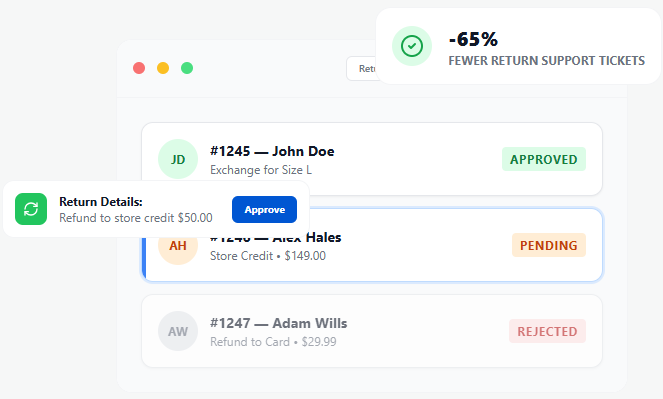
You can also collect specific return reasons and supporting information, which gives your team more context when a damaged item, high-value order, or other exception needs a closer look.
That flexibility lets you create stricter rules where the business needs them without adding unnecessary friction to every return.
Prevent return fraud without adding friction
Return fraud can include wardrobing, returning a different item, or repeatedly exploiting a generous policy. RMA rules help by setting product-specific return periods, requiring supporting details or images, excluding certain items, and routing higher-risk requests for manual approval.
If a customer repeatedly abuses the policy, look for WooCommerce extensions that enable customer and order blocklisting to prevent future purchases based on identifiers such as email address, phone number, or IP address.
Use those controls selectively. A high return rate can also point to product, sizing, or fulfillment problems rather than customer abuse.
Use returns data to inform future decisions
WooCommerce Analytics shows the financial impact of returns through refund data in Revenue and Orders reports. You can see refunded value over time and filter orders by refund activity.
Return extensions can add the missing context, including why products are coming back.
At mid-market volume, those patterns can expose sizing confusion, inaccurate product information, fulfillment mistakes, packaging problems, or recurring quality issues. That gives you evidence for improving both the return process and the policy behind it.
The first step to a better ecommerce return policy
↑ Back to topBegin by documenting and evaluating how your store handles returns today. Start with one recent return and follow it from the customer’s initial problem through the refund and resolution.
Who gets involved and what could be automated to improve efficiency? Is your team following the current policy or has it created unofficial workarounds because the written policy no longer matches the real process? What aspects of the return policy are too lenient or too strict and need to be updated?
As return volume grows, the process you wrote a year ago may no longer fit the way your team works or what your customers expect.


About