
Local Pickup in the Checkout block lets you offer one or more pickup locations to customers.
With block-based Local Pickup:
- Customers can select a pickup location without entering a shipping address
- You can add directions or pickup instructions for each location
- By default, taxes are based on the pickup location rather than the store address
- Customers can switch between the shipping and pickup methods you offer
Setup and configuration
↑ Back to top1. To enable and use Local Pickup, your checkout must be using the Checkout block. You can follow this guide to replace your old Checkout.
2. Once that’s done, you can navigate to WooCommerce -> Settings -> Shipping, there, you will see the new Local Pickup tab.
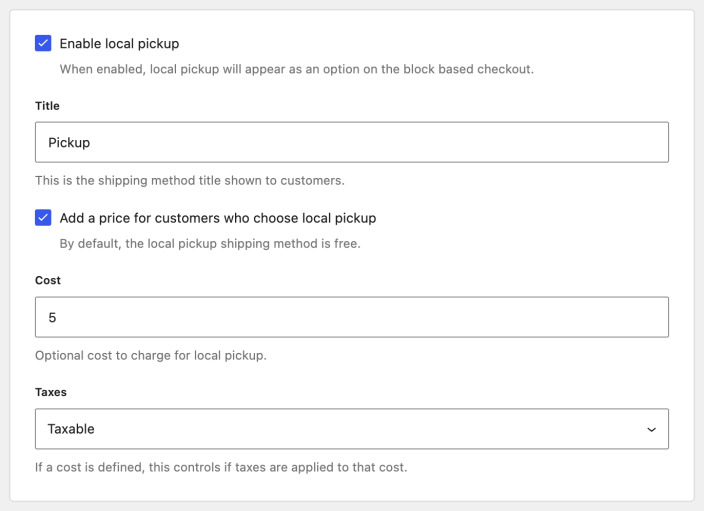
3. Enable local pickup by clicking the “Enable local pickup” checkbox.
4. (Optional) You can rename the method name from Local pickup to anything else in the Title input.
5. (Optional) Choose how much to charge for Local pickup by enabling the “Add a price for customers who choose local pickup” checkbox, this will show a cost and tax status inputs.
Note: Since Local Pickup is not set within shipping zones, it will be available at checkout regardless of customer location. To restrict local pickup to only some shipping zones, use the legacy local pickup shipping method.
Adding Locations
↑ Back to topIn order for Local Pickup to show up at checkout, you must add at least one location.
1. In the Local Pickup page, you can see the locations section below
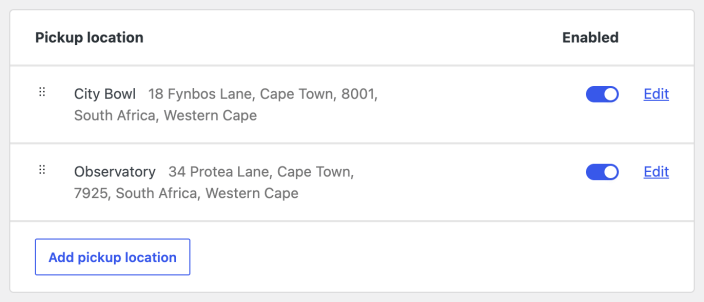
2. Click on “Add pickup location” to open the modal.
3. Enter a location name, address, and any pickup details customers need. By default, WooCommerce uses the selected pickup location’s address to calculate taxes.
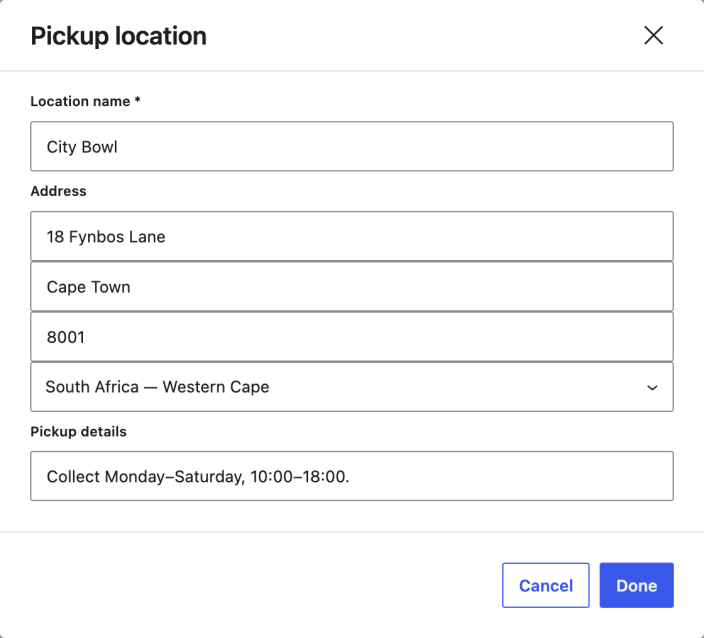
4. Select Done to add the location. When you have added your locations, select Save changes.
To check your setup, open a private browser window, add a shippable product to the cart, and go to checkout. Select Pickup and confirm your location appears.
Customizing the look of Local Pickup
↑ Back to topOnce Local Pickup is enabled, the Checkout block includes three related inner blocks under Checkout Fields:
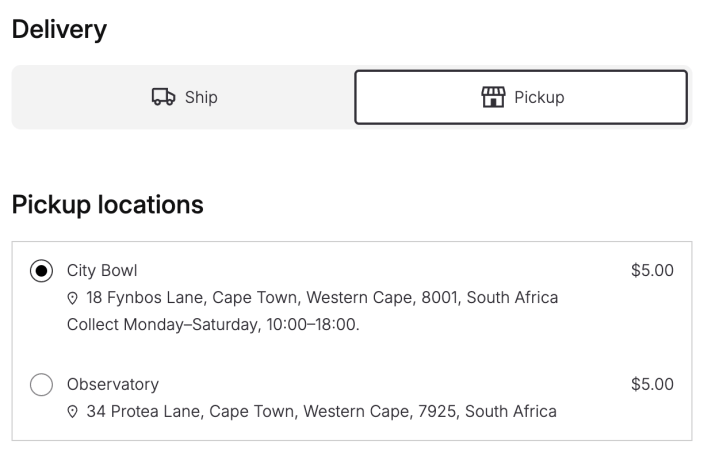
- Delivery — Lets customers choose between the Ship and Pickup options.
- Shipping Options — Displays available shipping methods and rates when the customer selects Ship.
- Pickup Method — Displays your configured pickup locations when the customer selects Pickup.
These are sibling inner blocks rather than different names for one block. The Delivery selection determines whether customers see Shipping Options or Pickup Method.

Select the Delivery block in the editor to preview and customize its Ship and Pickup choices. Customers use the same selector during checkout.
All block titles and descriptions are customizable, as well as having some additional settings in the block settings sidebar to control the block’s appearance:
- Show icon – Toggling this option shows an icon of a delivery van on the “Ship” button, and an icon of a storefront on the “Pickup” button.
- Show costs – When this option is enabled, dynamic subtitles will display that change depending on the cheapest shipping option a customer can select. When all options in that method are free, then “FREE” will show on the button.

The Pickup Method block supports adding text, separators, or images as inner blocks as well as adding a description and editing the title.
(Optional) You can also edit the delivery option labels, “Ship” and “Pickup” to any wording you prefer by clicking them and typing.
Difference from legacy local pickup
↑ Back to topLocal pickup in the Checkout block is separate from the legacy local pickup method added to shipping zones. Enabling both can confuse customers. WooCommerce shows a notice on the Local pickup settings page when both methods are enabled.
Local Pickup doesn’t require an address
↑ Back to topUnlike the shipping zones’ method, the new local pickup will always surface to customers even if they didn’t provide an address, and will not attempt to collect a shipping address.
Local Pickup has a dedicated section
↑ Back to topLocal pickup appears in the Pickup Method step of the Checkout block when a customer selects Pickup in the Delivery block. This provides more customization options and clearly separates pickup from shipped orders.
Local Pickup supports location-based taxes
↑ Back to topBy default, zone-based local pickup uses the store address for taxes. Block-based Local Pickup uses the selected pickup location’s address.
Caveats
↑ Back to topLocal Pickup has these limitations:
- When Hide shipping costs until an address is entered is enabled, delivery costs remain hidden until the customer enters a complete address. The Pickup option and your pickup locations remain available before an address is entered, but WooCommerce does not select pickup automatically. The customer must choose Pickup and select a location.
- If checkout contains multiple packages, pickup combines them visually so the same location applies to each package and the order uses one pickup address for tax.
- When you have multiple packages in which one of them isn’t collectible (doesn’t support local pickup), Local Pickup will be disabled.
Questions and support
↑ Back to topDo you still have questions and need assistance?
This documentation is about the free, core WooCommerce plugin, for which support is provided in our community forums on WordPress.org. By searching this forum, you’ll often find that your question has been asked and answered before.
If you haven’t created a WordPress.org account to use the forums, here’s how.
- If you’re looking to extend the core functionality shown here, we recommend reviewing available extensions in the WooCommerce Marketplace.
- Need ongoing advanced support or a customization built for WooCommerce? Hire a Woo Agency Partner.
- Are you a developer building your own WooCommerce integration or extension? Check our Developer Resources.
If you weren’t able to find the information you need, please use the feedback thumbs below to let us know.