




Your B2B buyers want the same convenience they find elsewhere when placing orders; the freedom to manage everything themselves, on their schedule, with negotiated pricing already in place.
When choosing a platform to build your B2B business, consider scalability so you’re ready to expand into new regions, diversify your customer base, or add a new product line.
Define the ecommerce experience your buyers need
↑ Back to topA wholesaler requires different ecommerce features than a custom manufacturer or a B2B/B2C operation. Before evaluating platforms, ensure you understand your specific needs and those of your buyers.
You might not need full ecommerce functionality. For example, you could build a website with product and category pages but no shopping cart. However, your customers likely expect to complete orders end to end directly on your site. For a B2B parts supplier, this could mean offering a customer portal where buyers can log in to view negotiated pricing, enter multiple SKUs at once, and create a purchase order.
If your organization serves both retailers and consumers, plan for variations in pricing, payment terms, and permissions by buyer type. Once you’ve defined the buying experience, identify the essential requirements for your B2B ecommerce platform.
Translate your buying model into ecommerce requirements
↑ Back to topNext, get granular. Ask yourself specific questions that reveal the capabilities you need.
How do buyers move from interest to order placement?
B2B experiences don’t always conclude with the traditional online checkout process. Instead of moving from product pages to carts, savvy buyers may want to configure options or request a custom quote. In some cases, they’ll have to upload specifications for review upfront.
WooCommerce core features enable direct online ordering. The Wholesale for WooCommerce extension can replace or complement the Add to Cart button with a quote basket for selected products, categories, or buyer roles.
For made-to-order products, the Product Add-Ons for WooCommerce extension allows customers to add text requests, choose unique selections and quantities, and upload files for a custom purchasing experience.
If your buyers need to assemble a configurable product from multiple inventoried components with conditional choices, consider using Composite Products for WooCommerce.
Ask your team: “What paths does our platform need to support as a buyer moves from awareness to placing an order?”
Can B2B and DTC share the same commerce operation?
Determine which products, inventory, and backend systems overlap and what adjustments you need to make based on the buyer.
An auto parts supplier may sell identical products to individual customers, dealers, and auto body shops. Although both audiences draw from the same inventory, dealers receive negotiated prices, order in larger quantities, pay on account, and access products or resources separately from consumers.
With WooCommerce extensions, you create tailored B2B and DTC experiences that suit your needs while keeping products, inventory, and store management integrated. For instance, WooCommerce B2B extensions can adjust product visibility, pricing, payment, and shipping options, as well as ordering rules based on each buyer’s role.
Ask your team: “What aspects of our B2B and DTC experiences should be shared, and what needs to change based on buyer type?”
What needs to change by customer or account?
Even within a strictly B2B organization, the ideal ecommerce experience can vary by customer or account.
A wholesale distributor serving a national account requires contract pricing and net-60 terms, while a smaller trade customer receives standard wholesale pricing and pays at checkout. A manufacturer may need to restrict access to specific parts or products to authorized dealers.
WooCommerce supports both account-level and employee-level rules through extensions. The Extend B2B option applies different pricing, product access, payment terms, and order rules by customer or role. It also enables company accounts with multiple buyers, purchasing limits, shared carts, and centralized order management.
Ask your team: “What should individual customers see, pay, and be allowed to do?”
What happens after the first purchase?
Many B2B customers return for the same products, renew agreements, or place recurring orders. Instead of forcing people to start over with every order, make those repeat purchases faster than the first transaction.
WooCommerce customer accounts include order history and an “Order again” option for completed purchases. For more advanced repeat-buying models, WooCommerce Subscriptions creates renewal orders and can manage recurring payments and physical-product replenishment. Wholesale for WooCommerce supports reusable requisition lists that update and add to the cart when it’s time to reorder.
Ask your team: “What will streamline repeat purchases for our returning customers?”
Ensure the platform connects to other systems
↑ Back to topA purchase should trigger automatic workflows across a business. When a customer logs in, the site needs to retrieve account pricing and payment terms. When an order is placed, inventory, tax, and shipping data needs to move into an ERP, accounting platform, warehouse system, or CRM.
A polished storefront doesn’t solve much if employees still have to manually move that information between systems.
The WooCommerce extension ecosystem includes prebuilt connections for business platforms such as NetSuite. If no extension is available, the WooCommerce REST API connects the store to external applications and sends automatic event notifications to another system.
For each workflow, document the data involved and ask:
- What’s the source of truth?
- Where does the data need to go?
- What triggers the data exchange?
- Which teams depend on this?
Evaluate platform control, cost, and scalability
↑ Back to topThe trade-off with a managed ecommerce platform is how much control you give the vendor in exchange for convenience. If you’re evaluating top options, you’re likely comparing WooCommerce, Shopify, and BigCommerce.
What does the business control?
WooCommerce, Shopify, and BigCommerce all support apps, APIs, and custom storefront experiences. But it’s important to know where the customization ends. On proprietary platforms, it depends on your subscription plan, the platform’s approved extension points, and whether the vendor supports it.
Shopify and BigCommerce control the hosting and core platform. You can make customizations, but the platform determines what you can change and which plan or product tier unlocks certain capabilities.
On Shopify, contextual checkout and storefront customization (giving B2B buyers a different experience from consumers) require the Advanced plan or above. Direct catalog assignment, deposits, and partial payments require the Plus plan.
BigCommerce places company accounts, buyer roles, and approval workflows within B2B Edition, which requires separate provisioning rather than appearing as a standard self-service plan.
As fully open-source software, WooCommerce gives you complete control over your commerce stack. You build your store in an environment you manage, from choosing the hosting provider to modifying the storefront, checkout, integrations, and underlying workflows. When you need something that doesn’t exist, your team creates it.
Ask your team: “Which parts of our commerce operation do we want to own or change without switching plans or waiting on a platform vendor?”
What gets more expensive as the business grows?
WooCommerce software is free to use, while SaaS platforms have monthly or annual fees. They can even automatically move stores between plans based on gross merchandise value (GMV).
BigCommerce pricing rises with sales volume. That’s like getting taxed on your success. Core allows up to $30,000 in GMV over the previous 12 months, while Growth allows up to $100,000. Exceed either rolling threshold and the store moves to the next tier.
The Scale plan starts at $299 per month and charges a 0.9% fee on monthly GMV above $33,333. There’s an additional Open Payment Provider Fee for revenue processed through an unapproved payment provider (between 0.6% and 2.0% depending on the plan).
Shopify includes foundational B2B features on lower plans. More advanced needs, like unlimited B2B catalogs and partial payments, require Shopify Plus, which starts at $2,300 per month on a three-year term.
The cost of WooCommerce depends on what you need for your store. Hosting and extensions can cost money, but you can shop around and switch when you’d like. In practice, most B2B stores need one B2B extension and sometimes a configurator. B2B for WooCommerce costs $179/year, Extend B2B is $99/year, Wholesale for WooCommerce is $129/year, and Composite Products is $149/year if you need configurable kits.
That’s around $100 to $350 a year in extensions, plus hosting you choose and a payment rate you can negotiate. Those numbers don’t change when your revenue does. Get an estimate for your specific business with our total cost of ownership calculator.
Ask your team: “Which costs on each platform increase with revenue, transaction volume, feature requirements, and operational complexity?”
What happens when the business gets more complex?
Shopify and BigCommerce can support complex B2B models, but some changes require a higher plan or a separate B2B product. WooCommerce gives you more ways to adapt through extensions, integrations, and an open-source foundation.
You can add regional payment and tax options, create new pricing and permissions for dealers, or replace ERP and fulfillment connections without forcing the rest of your stack to change with them.
That flexibility is vital during a platform migration. Moving product data, customer accounts, order history, URLs, and integrations takes planning, but you don’t need to do it all at once. You can introduce B2B ordering alongside an existing catalog site, phase in new customer groups or regions, or keep your ERP and fulfillment systems in place while the commerce layer changes.
Your platform must support your current model while also allowing you to evolve as that model changes.
Ask your team: “What changes are most likely over the next 3–5 years, and how easily can this platform support them?”
How can your platform support future AI initiatives?
Your audience is already using AI. Forrester found that 94% of business buyers use AI at some point in the shopping process, and generative AI is now their most-cited source for shopping research.
So, there’s a good chance that AI is reading your product pages before an actual buyer does. What happens if it can’t get the information it needs? Does it understand your products? Can it see pricing? And if it can’t, is it going to rely on whatever it can find about you somewhere else?
This gets especially messy in B2B because pricing often isn’t public. Google, OpenAI, and others are working on ways for AI agents to shop or transact, but most are built around products with publicly available prices. Of course, that doesn’t speak to what happens when a customer logs in and sees a price negotiated specifically for them.
Nobody really has that figured out yet. That’s actually why it’s worth discussing right now. Your goal is to find out whether your platform gives you the flexibility to handle this process later.
Ask your team: “When something reads our site on a buyer’s behalf, what can it see, and what tool or platform determines that?”
Build an ecommerce platform shortlist around your requirements
↑ Back to topTake the answers to the questions in this article and map out your requirements as you start comparing B2B ecommerce solutions.
| Evaluation area | Our requirements | WooCommerce | Option 1 | Option 2 |
| Buying path | Direct orders, quotes, configuration, or multiple paths | |||
| Account rules | Pricing, catalogs, terms, roles, approvals | |||
| Integrations | ERP, CRM, inventory, fulfillment, accounting | |||
| Adaptability | New regions, buyer types, systems, or selling models | |||
| Three-year costs | Platform, payments, apps, hosting, integration, support |
See real B2B ecommerce examples in WooCommerce
↑ Back to topHere’s how WooCommerce helps B2B businesses guide buyers through large catalogs, process complex purchases, and set up unique quote and invoicing systems.
Kellox and a massive catalog of parts

Kellox is Norway’s largest importer of motorcycles, ATVs, boats, outboard motors, equipment, and parts. Its ecommerce operation serves both consumers and a large dealer network, with each dealer working from its own contract, product access, pricing, and account information.
WooCommerce acts as the commerce layer connecting Kellox’s website with Microsoft Dynamics NAV and its product information management system.
Dealers can log in to see relevant products, personalized pricing, availability, order history, and other account-specific information. Custom caching and data handling also help Kellox manage more than 800,000 SKUs while keeping page loads under two seconds.
Boost Oxygen and a more connected way to sell
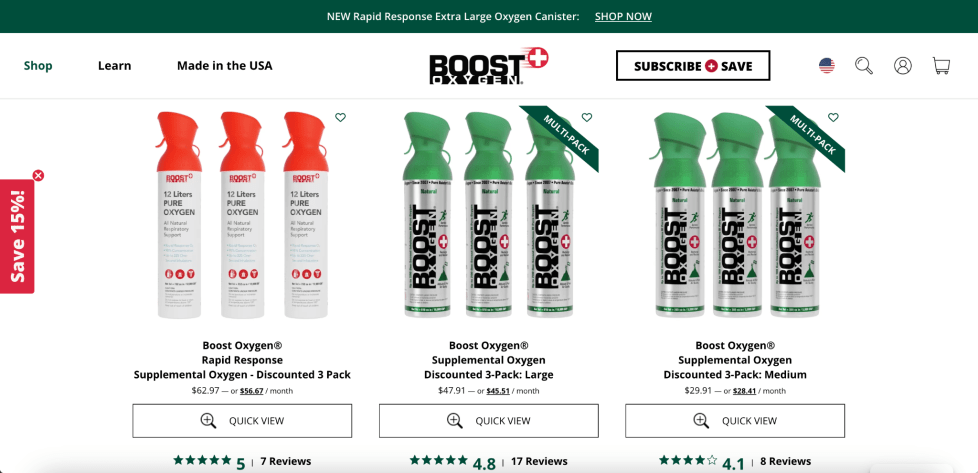
Boost Oxygen sells portable oxygen canisters through DTC, wholesale, retail, subscriptions, and marketplaces like Amazon. Its website is primarily a consumer sales channel, but the company has supported both wholesale and DTC customers since the beginning.
WooCommerce helps Boost Oxygen manage different purchasing models without separating them into different commerce systems. Customer-specific pricing supports wholesale customers with negotiated pricing, while WooCommerce orders connect to NetSuite through FarApp so the operations team can approve them before fulfillment.
That connection is especially important for Boost Oxygen because manufacturing, warehousing, and fulfillment all happen in-house.
Luna Glamping and a customizable product experience
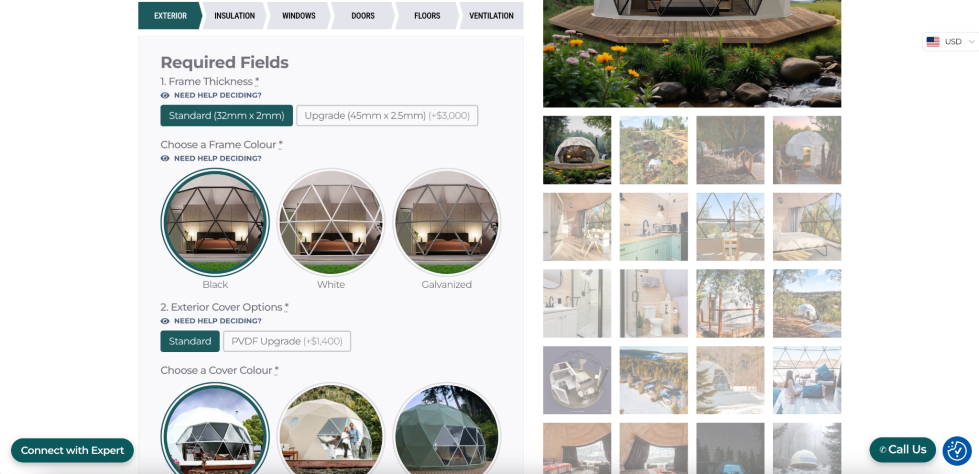
Luna Glamping designs and manufactures luxury domes and tents, selling to resort operators and event businesses as well as individual buyers. After moving from Shopify to WooCommerce, Luna built a product configurator that lets buyers choose from 18 upgrades and add-ons for each dome size. Its customized checkout supports 2 paths: customers can purchase immediately or submit their cart for a consultation before committing.
That combination lets Luna Glamping sell complex, high-value products online without forcing every buyer through the same workflow.
ISC Sales supports direct orders and quote requests
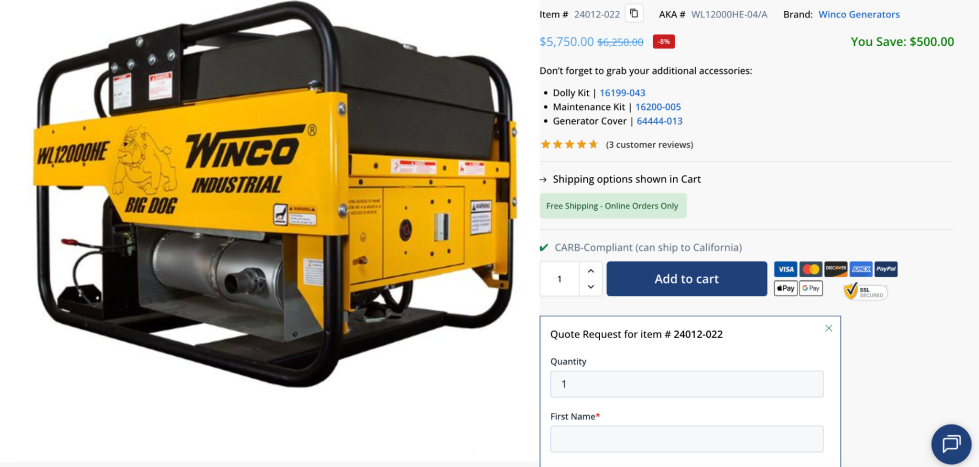
ISC Sales supplies industrial equipment, including climate control products. Product selectors, structured categories, search, filtering, and detailed specifications help customers narrow down more than 17,000 products to the equipment that fits their requirements.
WooCommerce lets ISC deliver different paths to purchase within the same catalog. Buyers can add products with published prices directly to their carts, while shoppers with custom needs or large orders can request a quote from the product page.
Learn more about WooCommerce
↑ Back to topUse the WooCommerce total cost of ownership calculator to model expenditures, then compare platform pricing and capabilities against the requirements you’ve documented. Rather than looking for the longest list of features, your goal is to build a shortlist of platforms that can support how your business sells now and where it’s likely to go next.


About




Thanks so much for putting up that blog. It has a lot of information that will help me open my own store. I really appreciate your efforts. May God bless you.
Thanks so much, Emma! Glad you found it helpful!