
WooCommerce and the Site Editor give you full control over your store’s layout. With block templates, template parts, and patterns, you can visually customize every part of your store, from product pages to cart and checkout, while keeping your design consistent and reusable.
In this guide, you’ll learn how to customize WooCommerce templates using the Site Editor.
Templates
↑ Back to topTemplates are arrangements of blocks that determine the appearance and layout of multiple posts, pages, and products. Unlike a theme, which sets the design of your entire site, a template only controls the structure and layout. Templates can be:
- Provided by your theme or plugins (like WooCommerce)
- Created or customized by you using the Site Editor.
When you edit a template, you’re changing the layout for every page, post, or product page that uses it. For example, editing the Single Product template updates the layout for all product pages using that template.
Adding and Managing Templates
↑ Back to topTo learn about adding and managing templates using the Template Editor, please follow the guides below:
- What you need to use the Template Editor
- How to access the Template Editor
- How to use the Template Editor via the Site Editor
- How to create a custom template
- How to assign a custom template to a post or page
- How to delete a template
- How to clear template customizations
Access WooCommerce Templates
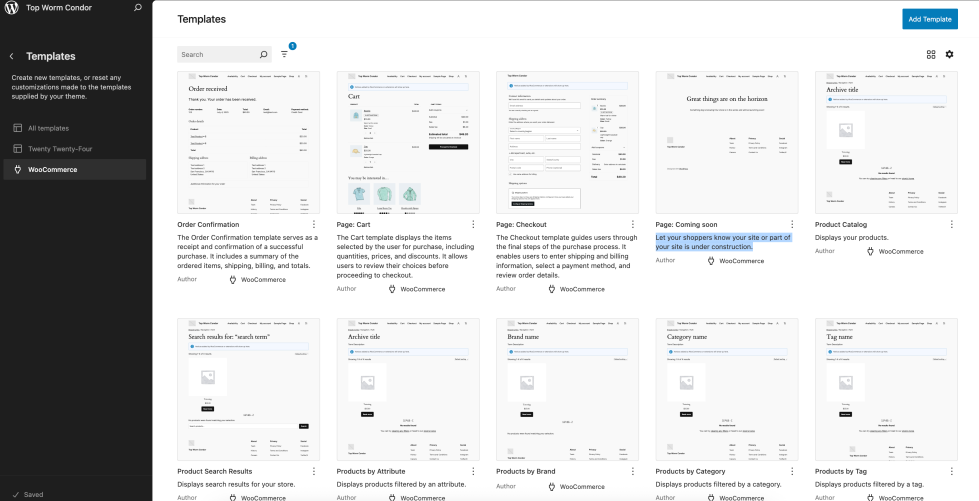
↑ Back to topWooCommerce provides a collection of templates that define your store’s appearance. To view all available WooCommerce templates:
- From your WP Admin dashboard, navigate to Appearance > Editor.
- Click Templates.
- In the left sidebar, click WooCommerce.
Quick Access via Command Palette
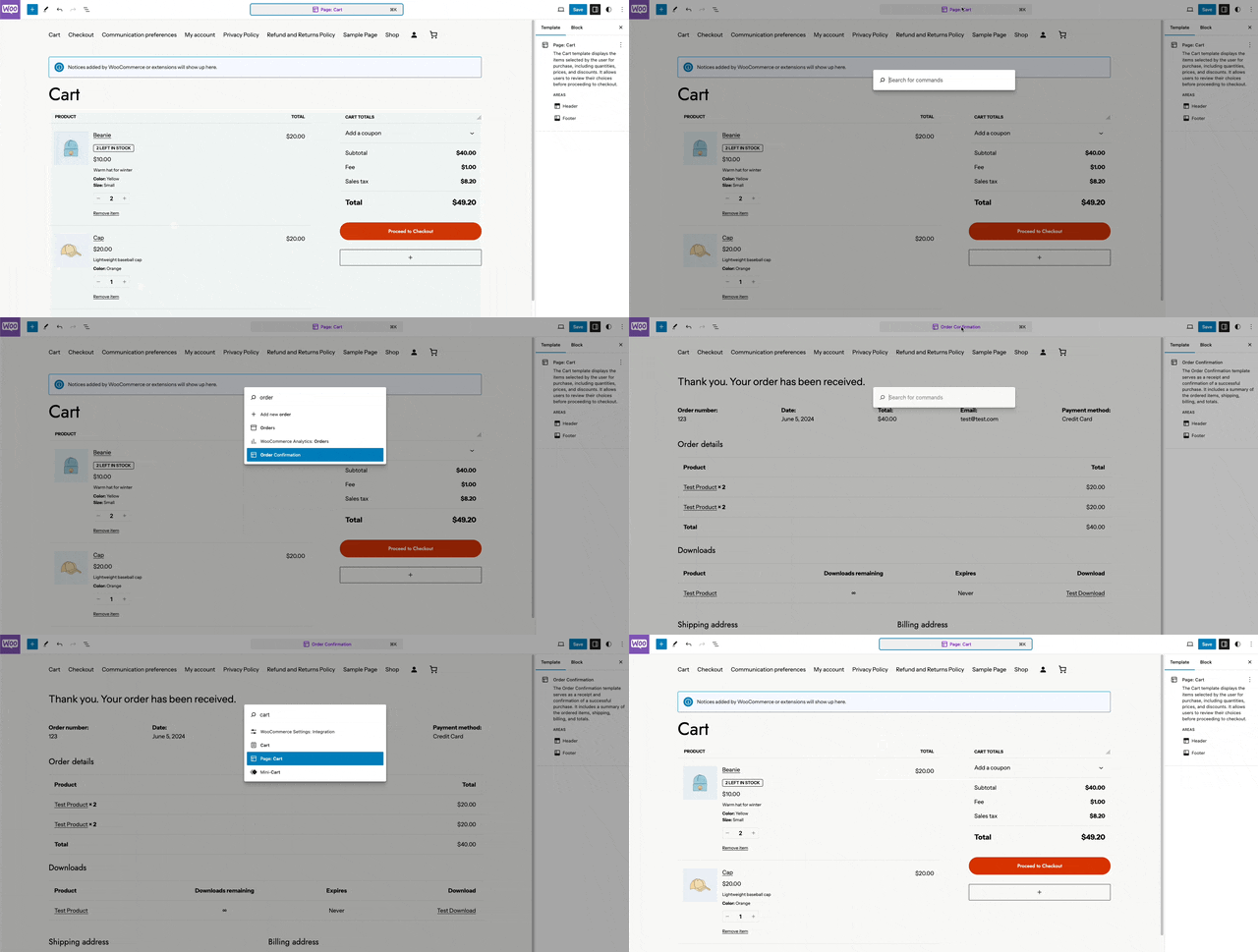
↑ Back to topAlternatively, you can access any template directly via the Editor Command Palette:
- From your WP Admin dashboard, navigate to Appearance > Editor.
- On your keyboard, press Cmd+K (MacOS) or Ctrl+K (Windows).
- Alternatively, if you’re already editing a template or template part, you can click the template title to search for commands:
Default WooCommerce Templates
↑ Back to topWooCommerce includes a collection of customizable templates out of the box:
| Template | Purpose |
|---|---|
| Single Product | Defines the layout of individual product pages |
| Product Catalog | Defines the layout of the Shop page or product listings |
| Products by Category, Tag, Attribute, or Brand | Defines the layout of archive pages by attributes, category, tag, or brand. |
| Product Search Results | Defines the layout for product search results |
| Coming Soon | Defines the layout of the coming soon page |
| Order Confirmation | Defines the layout of the post-checkout thank you/order confirmation |
| Cart | Defines the layout of the cart page |
| Checkout | Defines the layout of the checkout page |
These templates are customizable. You can move blocks around and add additional blocks to extend and customize the template. If your theme includes any of the above templates, they will automatically override WooCommerce’s default ones.
Developers: If you’d like to override the default WooCommerce block templates in your custom block theme, please place your customized versions of these templates within your theme’s /templates directory. Review the WooCommerce block template files in GitHub.
Creating Custom Templates
↑ Back to topYou can also create custom templates for any post, page, product, or category. To learn more, please refer to the guides below:
Clearing Template Customizations
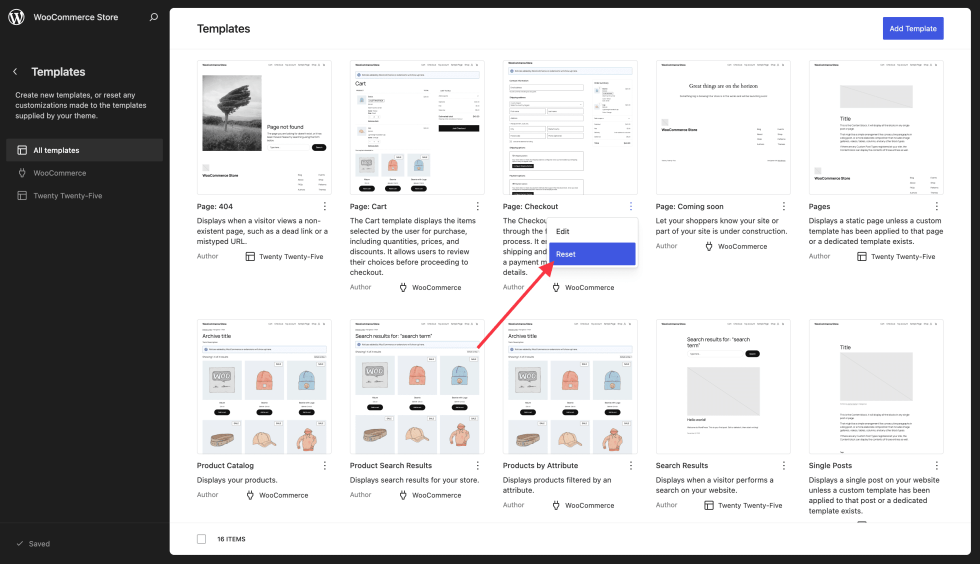
↑ Back to topSometimes, the easiest way to continue customizing is to reset a template back to its default state by clearing all previous changes. Clearing the customizations you’ve made to a template returns the template to its default state. Follow the steps below to reset template customizations:
- In your WordPress dashboard, go to Appearance > Editor
- Select Templates
- Find the template you want to reset and click the three-dot (ellipsis) menu in the bottom-right corner.
- Choose Reset.
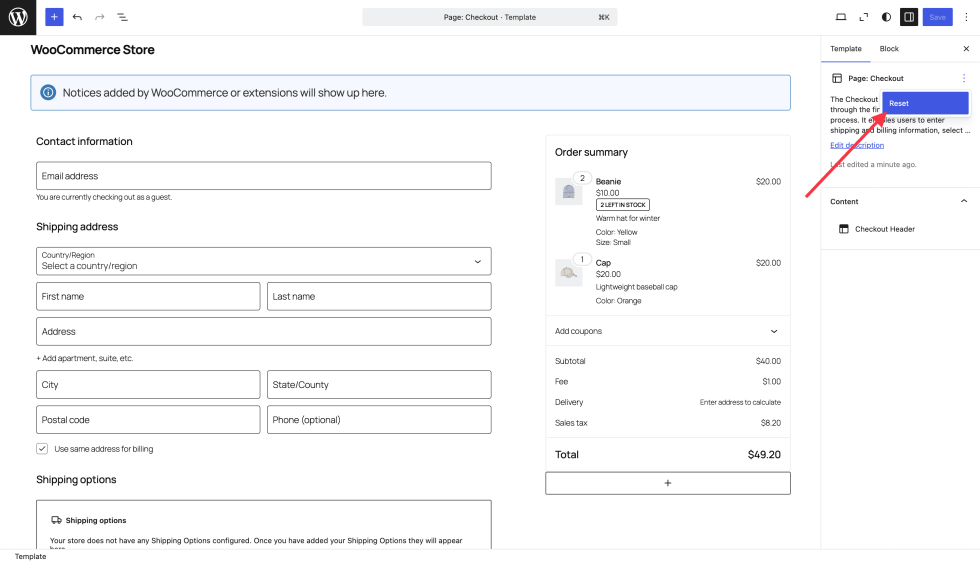
Alternatively, you can also:
- Open the Editor via Appearance > Editor.
- Click Templates.
- Select/open the template containing the customizations you wish to clear.
- Click the three-dot kebab menu icon (⁝) next to the template name.
- Click Reset.
Note: This action will permanently clear all template customizations and cannot be reversed.
Template Parts & Patterns
↑ Back to topTo build more flexible and reusable layouts, check out these related guides:
- Using Template Parts in WooCommerce – Learn how to manage headers, footers, and other reusable layout sections across your store.
- Using Patterns in WooCommerce – Discover how to use synced and unsynced block patterns to speed up design and maintain visual consistency.
Questions and support
↑ Back to topDo you still have questions and need assistance?
This documentation is about the free, core WooCommerce plugin, for which support is provided in our community forums on WordPress.org. By searching this forum, you’ll often find that your question has been asked and answered before.
If you haven’t created a WordPress.org account to use the forums, here’s how.
- If you’re looking to extend the core functionality shown here, we recommend reviewing available extensions in the WooCommerce Marketplace.
- Need ongoing advanced support or a customization built for WooCommerce? Hire a Woo Agency Partner.
- Are you a developer building your own WooCommerce integration or extension? Check our Developer Resources.
If you weren’t able to find the information you need, please use the feedback thumbs below to let us know.