Affiliate for WooCommerce plugin helps you to add, manage affiliates, and track performance from a single place – commissions, sales, payouts, leaderboard, etc. Earn money without hard work. Increase your brand outreach, and get potential customers.
Performance-based commissions allow you to automatically increase an affiliate’s pay rate as they reach specific milestones. By rewarding top performers with higher percentages, you incentivize affiliates to drive more volume and grow with your brand.
You can configure these milestones based on Total Revenue, Order Count, Customer Acquisition, or Recent Activity.
Note: This doc covers the configuration logic for specific rules. For general instructions on creating and assigning plans, refer to: How to create affiliate commission plans.
Available rules for volume-based tiered commissions
↑ Back to top| Rule | Purpose | Operator(s) | Input example |
|---|---|---|---|
| Affiliate – Revenue | Checks the total referred sales value by the affiliate. | >, >=, <, <=, =, != | Enter revenue amount (e.g., 10000). |
| Affiliate – Valid Referral Orders | Checks the number of successful referral orders by the affiliate. | >, >=, <, <=, =, != | Enter referral order count (e.g., 50). |
| Affiliate – Customers | Checks the number of unique customers referred by the affiliate. | >, >=, <, <=, =, != | Enter customer’s count (e.g., 100). |
| Affiliate – Last Referral (Days) | Checks how recently the affiliate made a referral – supports activity. | in last, not in last, older than | Enter number in days (e.g., 30, 90). |
Revenue-based tiers – the High-value strategy
↑ Back to topThis is the most common structure. It rewards affiliates based on the total sales amount (revenue) they have generated for your store.
Example:
Commission plan 1: Silver.
- Strategy: Earn 10% on sales up to $1,000.
- Config:
- Commission rate: 10 Percentage (%)
- Rule: Affiliate – Revenue < 1000

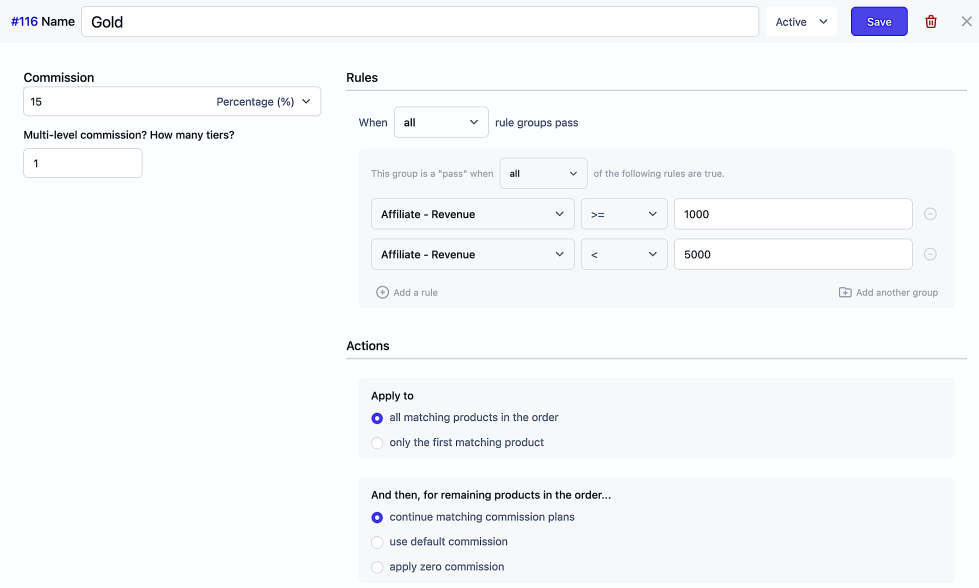
Commission plan 2: Gold.
- Strategy: Earn 15% on sales between $1,000 to 5,000.
- Config:
- Commission rate: 15 Percentage (%)
- Rules:
- Rule A: Affiliate – Revenue >= 1000 AND
- Rule B: Affiliate – Revenue < 5000
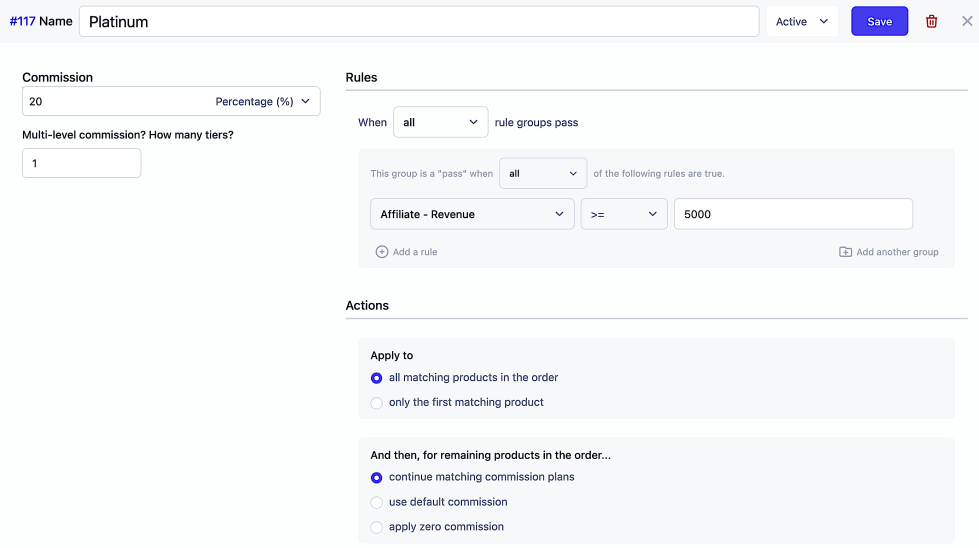
Commission plan 3: Platinum.
- Strategy: Earn 20% once sales are over $5,000.
- Config:
- Commission rate: 20 Percentage (%)
- Rule: Affiliate – Revenue >= 5000
How it works:
- Affiliates start in the Silver tier if their total referred revenue is below 1000.
- They move to the Gold tier once they reach 1000 and stay there until they are below 5000.
- They enter the Platinum tier after exceeding 5000 and earn 20% on new referrals.
Order volume tiers – the Quantity strategy
↑ Back to topThis is ideal where you want to drive a high volume of transactions (the number of orders) rather than high cart value.
Example:
Commission plan 1: Starter.
- Strategy: Earn 10% for the first 10 orders.
- Config:
- Commission rate: 10 Percentage (%)
- Rule: Affiliate – Valid Referral Orders <= 10
Commission plan 2: Pro.
- Strategy: Earn 20% for orders 11–49.
- Config:
- Commission rate: 20 Percentage (%)
- Rules:
- Affiliate – Valid Referral Orders >= 11 AND
- Affiliate – Valid Referral Orders <= 49
Commission plan 3: Elite.
- Strategy: Earn 30% for 50+ orders.
- Config:
- Commission rate: 30 Percentage (%)
- Rule: Affiliate – Valid Referral Orders >= 50
How it works:
- Affiliates start in the Starter tier until they reach 10 referral orders.
- After reaching 10 orders, they move to the Pro tier and earn 20 percent.
- When they achieve 50 or more total referral orders, they move to the Elite tier and earn 30 percent going forward.
Customer acquisition tiers – the New-user strategy
↑ Back to topThis strategy focuses on growth. It counts unique customers, not total orders. If one customer buys five times, they only count as “1” for this metric.
Example:
Commission plan 1: New Referrer.
- Strategy: Earn 10% for the first 25 customers referred.
- Config:
- Commission rate: 10 Percentage (%)
- Rule: Affiliate – Customers <= 25
Commission plan 2: Consistent Referrer.
- Strategy: Earn 12% for 26–49 customers.
- Config:
- Commission rate: 12 Percentage (%)
- Rules:
- Affiliate – Customers greater than or equal to >= 26 AND
- Affiliate – Customers <= 49
Commission plan 3: Power Referrer:
- Strategy: Earn 15% for 50+ customers.
- Config:
- Commission rate: 15 Percentage (%)
- Rule: Affiliate – Customers >= 50
How it works:
- Affiliates begin at the New referrer tier upto 25 referred customers.
- They move to the Consistent referrer when they have referred between 26 and 49 customers.
- They become Power referrers after 50 customers and earn 15%.
Activity-based tiers – The Recency strategy
↑ Back to topThis is a powerful way to wake up dormant affiliates. You can offer a higher commission rate only if the affiliate has been active recently.
Example:
Commission plan 1: Active.
- Earn 20% if the last sale was within 30 days.
- Config:
- Commission rate: 20 Percentage (%)
- Rule: Affiliate – Last Referral (days) → in last → 30.
Commission plan 2: Standard.
- Earn 10% if the last sale was over 30 days ago.
- Config:
- Commission rate: 10 Percentage (%)
- Rule: Affiliate – Last Referral (days) → not in last → 30
How it works:
- Affiliates who have made at least one referral within the last 30 days automatically qualify as Active and earn 20 percent commission on new referrals.
- Affiliates who haven’t referred any sales in the last 30 days fall to the Standard tier and earns 10%.
- This structure rewards ongoing engagement and motivates affiliates to promote consistently.
Hybrid tiers (combined rules)
↑ Back to topHybrid tiers allow you to set strict gates for higher commissions. An affiliate must meet all conditions in a rule set to unlock that specific rate.
The Profitable-growth partner (Revenue + New Customers)
↑ Back to topUse this if you want to prevent affiliates from earning high commissions just by referring the same few customers over and over. They must bring in new people to get the bonus.
Set up:
- Commission rate: 25 Percentage (%)
- Rules:
- Affiliate – Revenue >= 10000 AND
- Affiliate – Customers >= 50
The Active-Elite (Volume + Recency)
↑ Back to topYou have affiliates with high lifetime stats, but they stopped promoting you. This tier ensures the highest rate (30%) only goes to legacy affiliates who are currently active (made a sale in the last week).
Set up:
- Commission rate: 30 Percentage (%)
- Rules:
- Affiliate – Valid Referral Orders >= 500 AND
- Affiliate – Last Referral (days) <= 7
The VIP-performance tier (Tag + Revenue)
↑ Back to topYou want to offer a special tiered structure only to a specific group (e.g., “Influencers”), while regular users stay on a flat rate regardless of their revenue.
Set up:
- Commission rate: 20 Percentage (%)
- Rules:
- Affiliate – Tags → any of → Influencer AND
- Affiliate – Revenue >= 2000
The Trial-to-Pro converter (Order count + Customer count)
↑ Back to topUseful for subscription businesses. You want to reward affiliates who don’t just get signups (Orders), but get different people to sign up (Customers), ensuring they aren’t gaming the system with fake repeat orders.
Set up:
- Commission rate: 15 Percentage (%)
- Rules:
- Affiliate – Valid Referral Orders >= 20 AND
- Affiliate – Customers >= 20
Tips for Success
↑ Back to top- Don’t overcomplicate: Start with 3 tiers (Bronze, Silver, Gold). Too many levels can be confusing.
- Use Affiliate tags: If you want these tiers to apply only to Influencers and not general customers, use Affiliate tags to filter who this plan applies to.
- Check your gaps: When using Less than (<) and Greater than (>), ensure you don’t leave a gap.
- Incorrect: Tier A (< 10), Tier B (> 10). Problem: What happens exactly at 10?
- Correct: Tier A (< 10), Tier B (>= 10).
Real-world use cases & examples
↑ Back to topNot sure which structure fits your business? Here are common scenarios where volume tiers solve specific problems:
1. Reward high performers
↑ Back to topThe goal: You want top-performing affiliates to earn higher commissions once they hit specific revenue milestones.
Industry example (SaaS/Software): Since software margins are high, companies often pay a standard 20%, but bump it to 30% for affiliates who drive over $10,000 in sales. This gamifies the process and keeps Super Affiliates loyal to your brand.
Recommended strategy: Revenue-Based Tiers.
2. Encourage consistent sales
↑ Back to topThe goal: You want affiliates to earn gradually increasing commissions as they bring in more sales volume over time, regardless of the order value.
Industry example (Fashion/Retail): A clothing brand wants influencers to post consistently. They don’t care if the cart size is small ($20 t-shirt) or large ($200 coat); they just want traffic. They reward influencers based on the number of orders generated.
Recommended strategy: Order Volume Tiers.
3. Motivate customer acquisition
↑ Back to topThe goal: You want to give better rates to affiliates who bring new customers, rather than just earning commissions on repeat purchases from the same users.
Industry example (Online courses/Education): Course creators care about getting new students into their ecosystem. They might pay a low rate for repeat buyers but a premium rate (e.g., 25%) if you bring a certain number of unique students.
Recommended strategy: Customer Acquisition Tiers.
4. Give affiliates multiple ways to qualify
↑ Back to topThe goal: Your program has different types of affiliates: some bring high-value orders (Review sites), while others bring high volume (Social media influencers). You want a flexible tier that rewards both.
Industry example (Lifestyle brands): A home decor brand might offer VIP status (20% commission) if an affiliate generates either $5,000 in revenue (High Value) OR 50 separate orders (High Volume).
Recommended strategy: Create two different rules in your VIP plan, and for the rule group, select This group is a “pass” when > at least one > of the following rules are true (learn more) to validate the commission plan when at least one rule inside the rule group is true.
5. Reward overall quality, not just quantity
↑ Back to topThe goal: You want to ensure affiliates aren’t gaming the system with low-quality traffic. You use a combination of sales amount and referral count to determine true value.
Industry Example (B2B services/Subscription boxes): A subscription box company wants to ensure affiliates aren’t just referring their friends for a quick discount. They require affiliates to hit a minimum revenue threshold and a minimum customer count before unlocking the Partner tier.
Recommended Strategy: Hybrid Tiers (Revenue + Order Count).
Feature request
↑ Back to topHave a feature request or enhancement suggestion for Affiliate For WooCommerce? Submit a request or send it to us from here.