
The Multipliers page has 3 sections:
- Roles & Multipliers Options
- Role Multipliers
- Reset Settings
Roles & Multipliers Options
↑ Back to top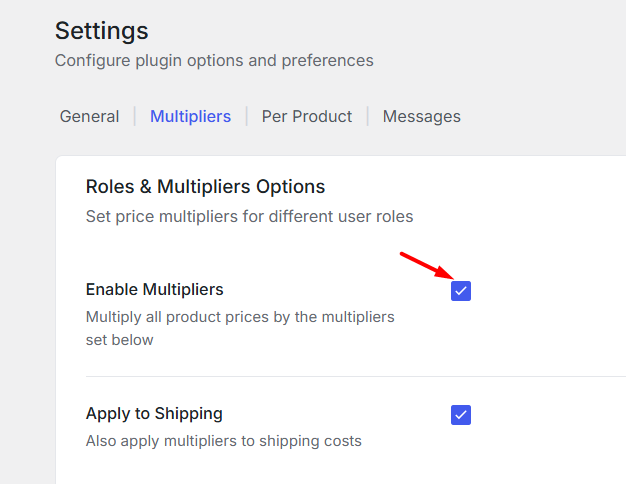
Roles & Multipliers Options section
Enable multipliers
↑ Back to topWhen enabled, the multiplier values configured for each user role under the Role Multipliers section are applied to product prices throughout the store.
Shipping
↑ Back to topWhen enabled, the same multiplier used for product prices is also applied to shipping charges during checkout.
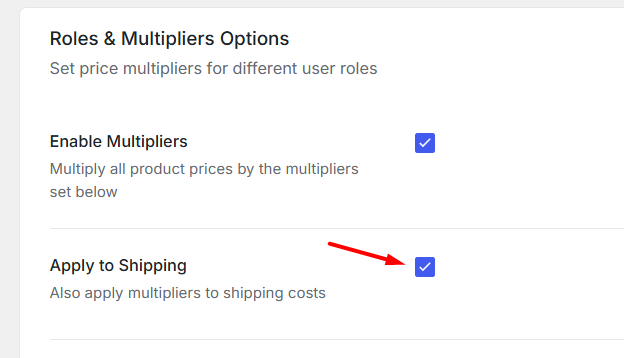
To understand this in detail, let us take an instance and add multipliers to user roles under Multipliers section.
Role Multipliers
↑ Back to topThe Role Multipliers section allows you to define a multiplier value for each user role available on your store.
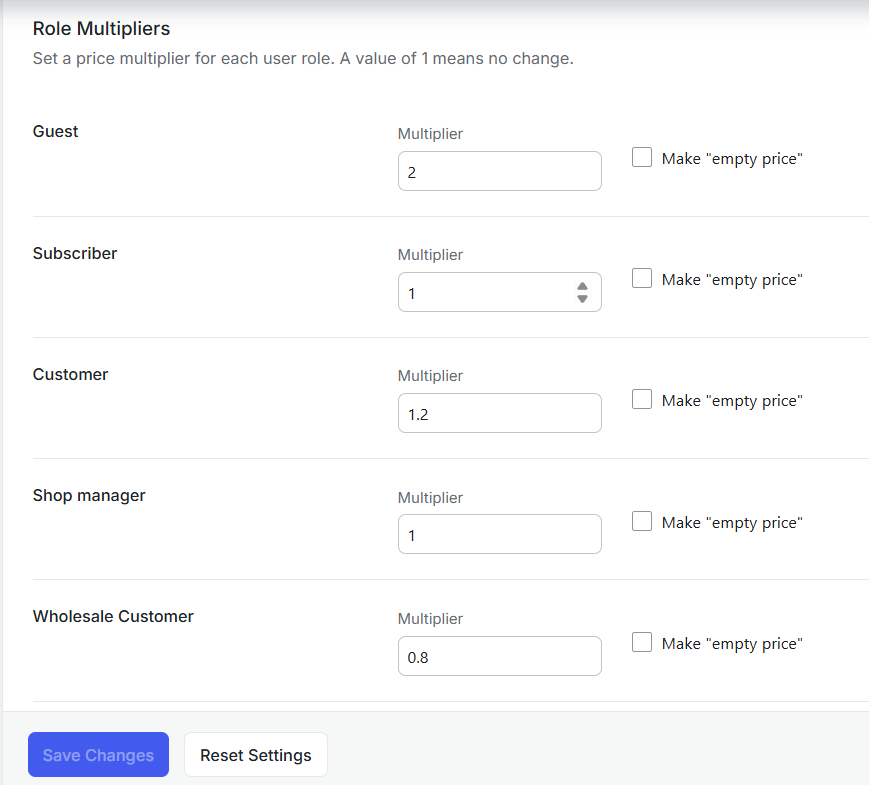
A multiplier determines how product prices are adjusted for a specific role:
- A value of 1 displays the original product price.
- A value greater than 1 increases the price.
- A value less than 1 decreases the price.
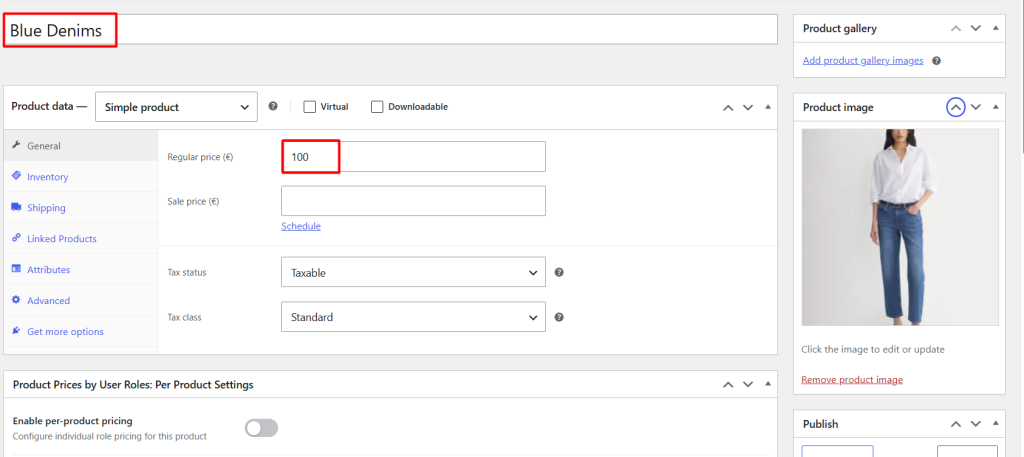
For the examples below, assume the product Blue Denims has a base price of $100.
Increasing prices for a user role
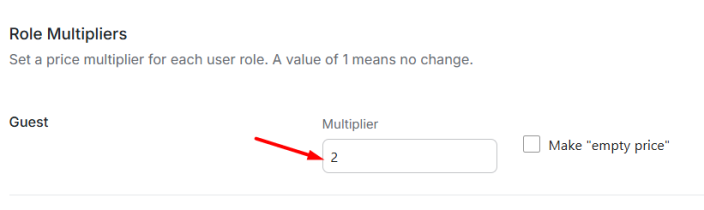
↑ Back to topSuppose you want Guest users to see prices that are twice the normal product price. Set the Guest role multiplier to 2.
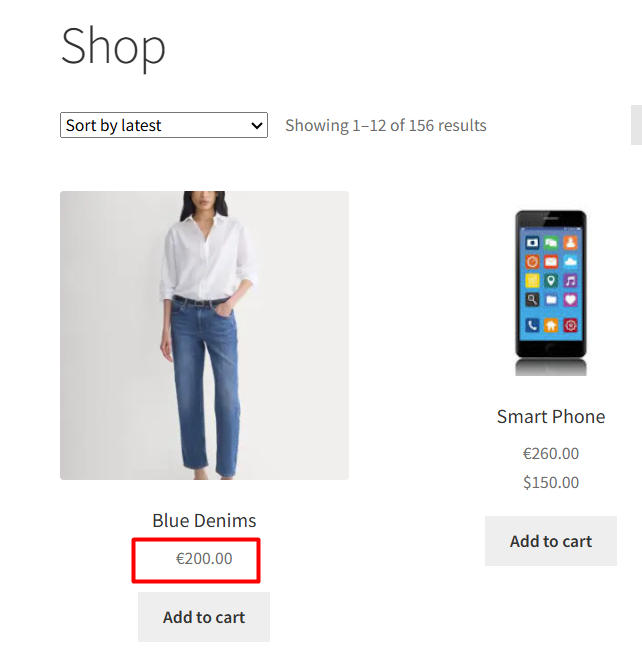
When Guest users view Blue Denims on the storefront, the product price will be displayed as $200 instead of the original $100.
Offering discounted prices
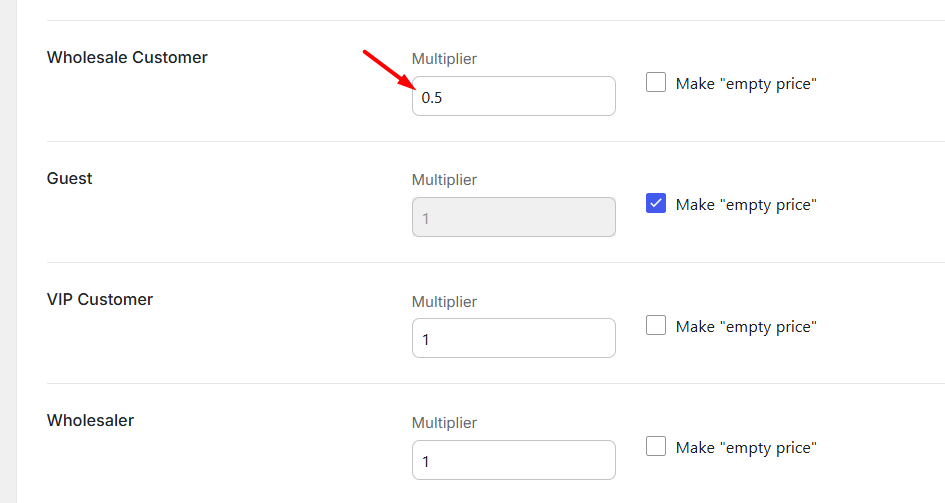
↑ Back to topYou can also use multipliers to offer discounted pricing to wholesale buyers. For example, set the Wholesale Customer multiplier to 0.5.
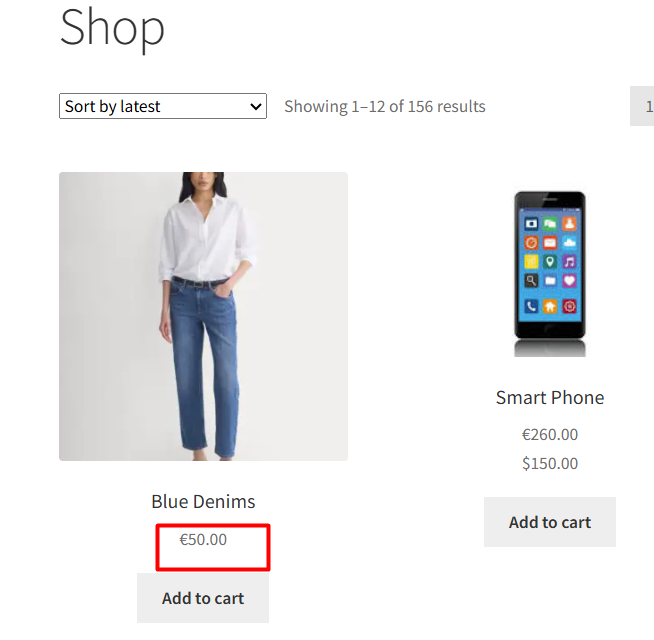
When Wholesale Customers view Blue Denims, the product price will be displayed as $50 instead of the standard $100 price.
This allows you to offer role-specific pricing across your entire store without editing individual products.
Note: Multipliers are applied to both Regular Prices and Sale Prices.
Empty multiplier values
↑ Back to topIf a multiplier field is left blank for a user role, product prices will appear as $0 for users assigned to that role.
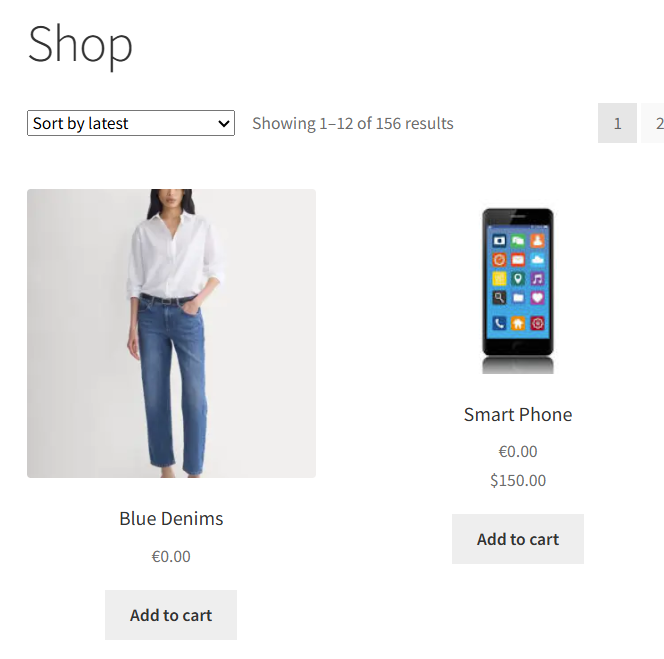
If the multiplier is set to 1, the original WooCommerce product price will be displayed.
Make “empty price”
↑ Back to topThe Make “empty price” option allows you to hide product prices completely for specific user roles.
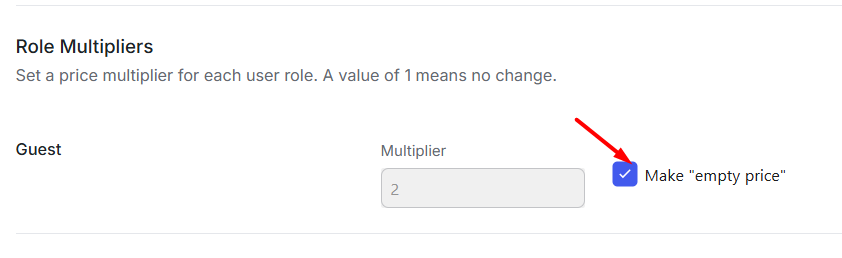
When enabled for a role:
- Product prices are hidden.
- The Add to Cart button is removed.
- Customers with that role cannot purchase products.
For example, if you enable Make “empty price” for the Guest role and when an Guest user visits the Blue Denims product page, neither the product price nor the Add to Cart button will be displayed.
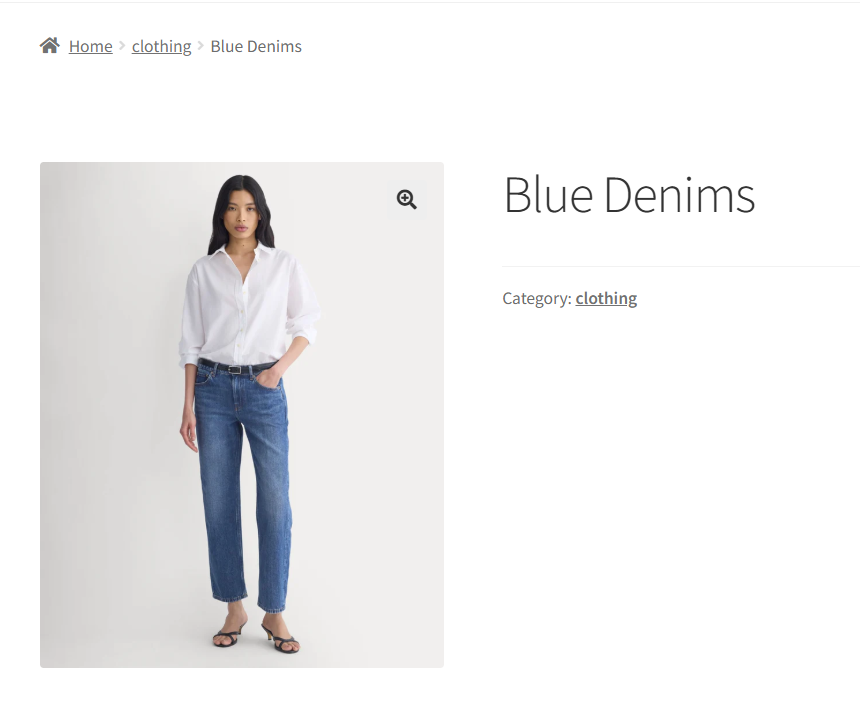
This setting can be useful when you want certain users to browse products without viewing prices or placing orders.
Apply to Shipping
↑ Back to topWhen Apply to Shipping is enabled, the multiplier assigned to a user role is also applied to shipping charges.
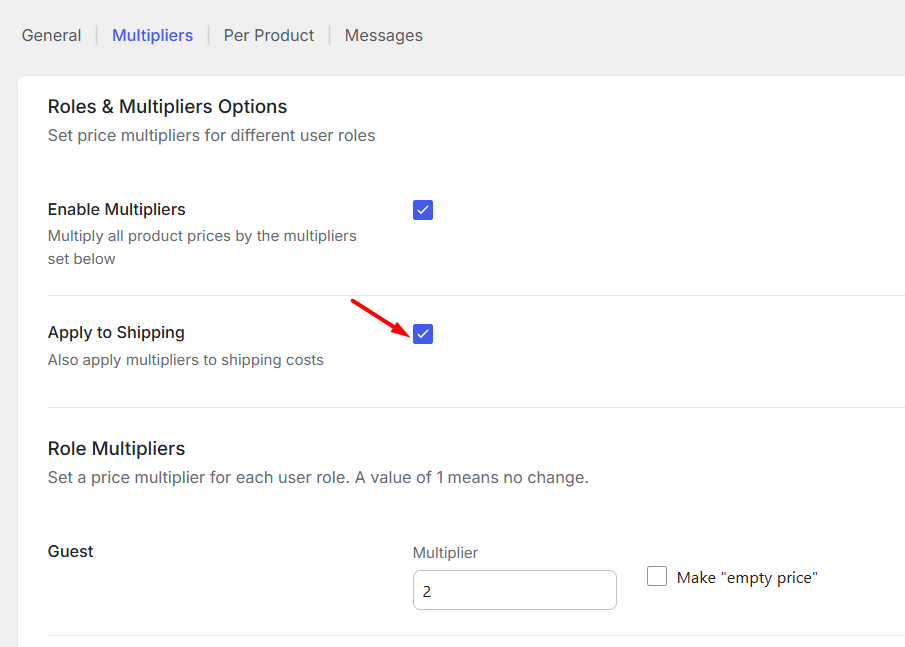
Assume the shipping charge for Local Pickup is $10 in WooCommerce Shipping settings.
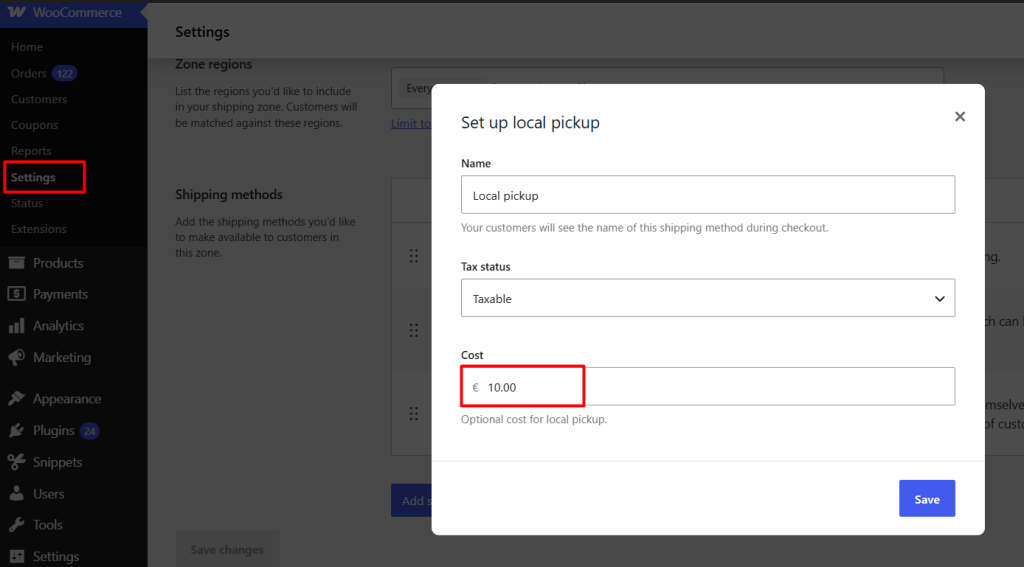
If the Guest role multiplier is 2, the shipping charge shown during checkout will become $20.
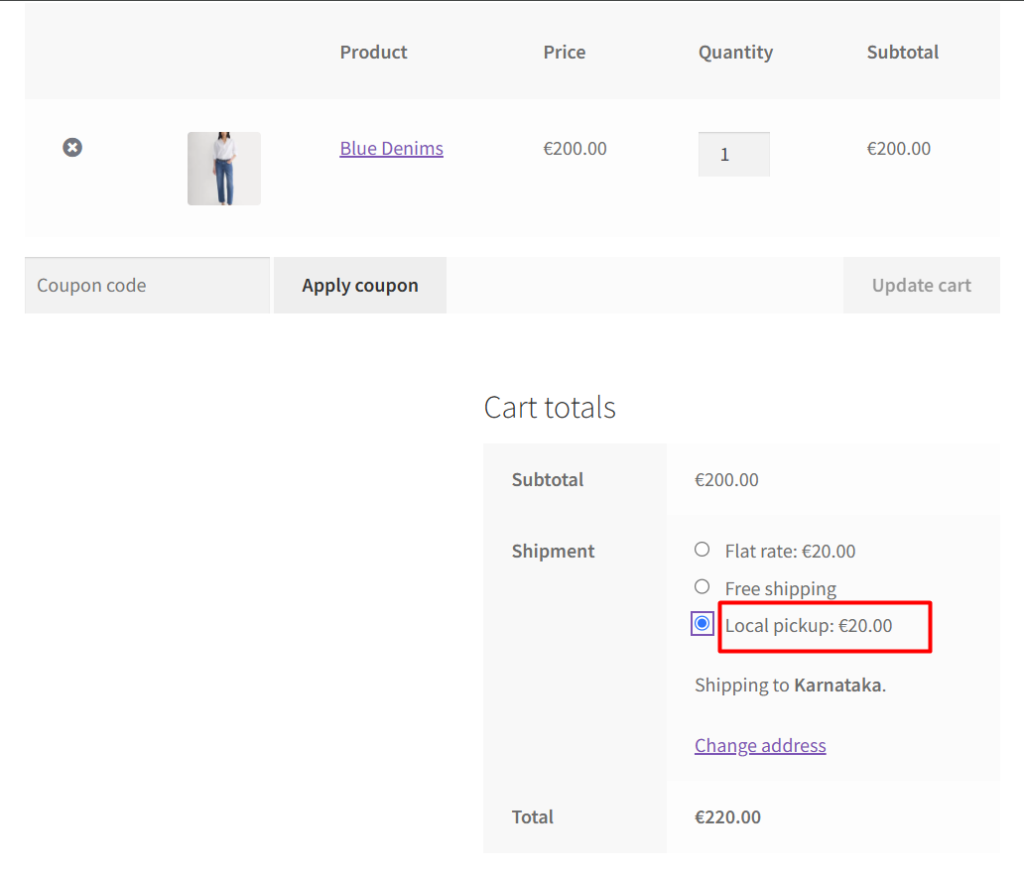
If the Wholesale Customer role has a multiplier of 0.5, the shipping charge will be reduced to $5, allowing you to offer discounted shipping rates to wholesale buyers.
When the multiplier is set to 1, the standard shipping charge of $10 is used.
If the multiplier field is left blank, no shipping charge is applied for that user role.
Note: Separate multipliers cannot be configured for product prices and shipping charges. The same multiplier value is applied to both.
Save Changes and Reset Settings
↑ Back to topAt the bottom of the page, you will find the Save Changes and Reset Settings buttons.
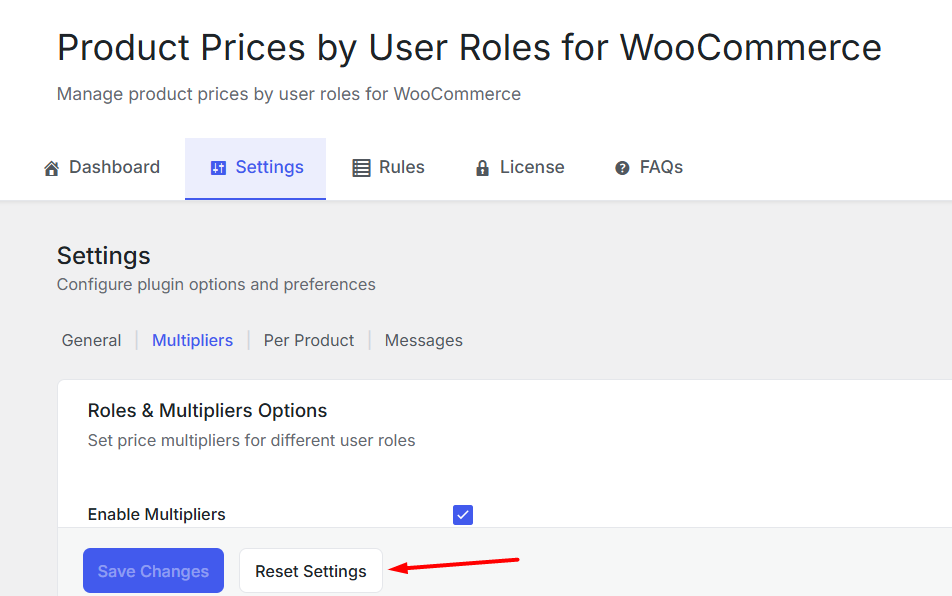
Save Changes
↑ Back to topClick Save Changes to apply any updates made to the Multipliers settings.
Reset Settings
↑ Back to topClick Reset Settings to restore the default Multipliers configuration.
When reset:
- Enable Multipliers remains enabled.
- All multiplier values are restored to 1.
- All Make “empty price” checkboxes are cleared.
This allows you to quickly return the Multipliers settings to their default state.
The Multipliers setting makes it easy to create different pricing and shipping strategies for retail customers, wholesale buyers, members, or other customer groups without manually updating individual products.