Improve the WooCommerce user registration experience for customers by displaying custom fields to customers based on conditions.
Installation
↑ Back to top- Download the WooCommerce registration fields plugin and have your .zip file
- At the WordPress admin panel, go to the Plugins section and click ‘Add New’ to upload and install the plugin you just downloaded from WooCommerce.
- Upload the .zip file to proceed with the installation.
- Wait until the plugin installs. After successful installation, activate the plugin and move on to configuration settings.
Configuration
↑ Back to topTo configure the extension, go to WooCommerce > Settings within the WordPress admin panel and click on the Registration Fields tab. You will find the following tabs: General Settings, Custom Fields, Forms, Default Fields, Manage Roles, New User Settings, Email Settings, Google Login, and WhatsApp Meta Settings.
General Settings
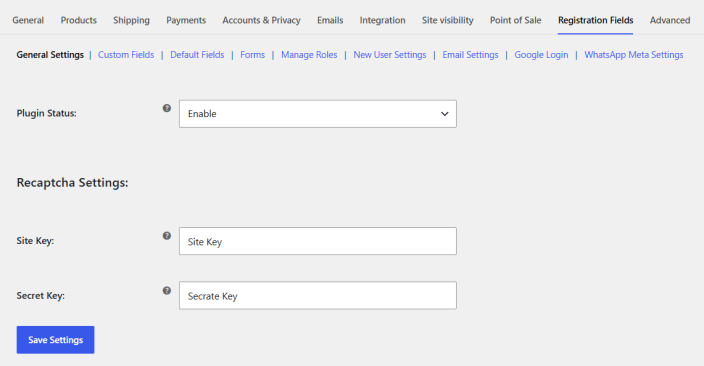
↑ Back to topPlugin Status: Option to enable or disable the plugin.
ReCaptcha Settings
- Site Key: Insert site key
- Secret Key: Insert the provided secret key
Custom Fields
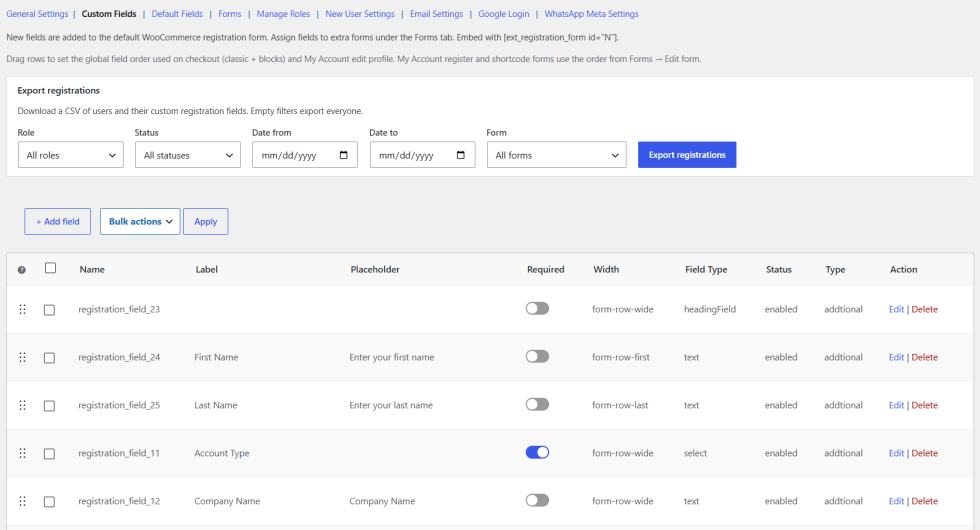
↑ Back to topIn this tab, you can add, edit, and manage custom user registration fields for WooCommerce. It also lets you organize field order through sorting and supports 18 different field types.
Download a CSV of your registered users and their custom registration field values. Leave the filters empty to export everyone.
- Role: Filter the export by a specific user role.
- Status: Filter the export by approval status.
- Date From / Date To: Filter the export by registration date range.
- Form: Filter the export by the registration form used.
- Export Registrations: Click to download the CSV file.
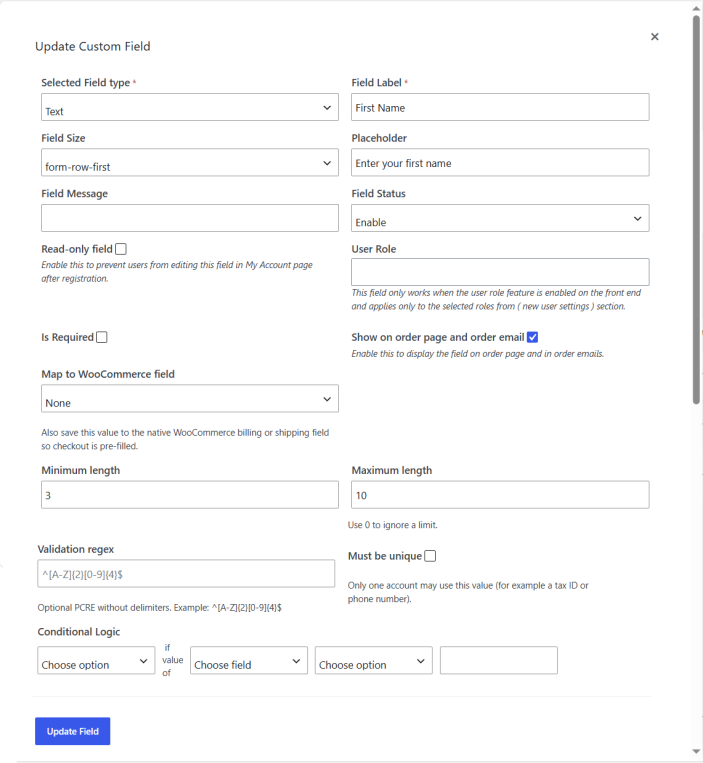
Click the Add Field button to create a new field. A popup will appear with the following options:
- Selected Field Type: Choose the type of field you want to add, such as text, checkbox, select box, and more.
- Field Label: Enter the label that will be displayed to the customer on the registration form.
- Field Size: Set the width of the field on the form, such as full-width or half-width.
- Placeholder: Add placeholder text to guide customers on what to enter in the field.
- Field Message: Enter a helper message to provide additional context below the field.
- Field Status: Enable or disable the field from displaying on the registration form.
- Read-Only Field: Check this option to prevent customers from editing the field after registration in the My Account page.
- User Role: Restrict the field to specific user roles, so it only appears for selected roles on the registration form.
- Is Required: Check this option to make the field mandatory before the form can be submitted.
- Show on Order Page and Order Email: Enable this to display the field’s data on the admin order page and in order emails.
- Map to WooCommerce Field: Save the field’s value to a native WooCommerce billing or shipping field as well, so checkout is pre-filled.
- Minimum Length: Set the fewest characters the field accepts. Use 0 to ignore the limit.
- Maximum Length: Set the most characters the field accepts. Use 0 to ignore the limit.
- Validation Regex: Add an optional pattern the field’s value must match.
- Must Be Unique: Check this option so only one account can use this value, such as a tax ID or phone number.
- Conditional Logic: Set conditions to show or hide the field based on the value of another field.
Once configured, click Save Field to add it to your registration form.
Default Fields
This tab includes the default fields provided by WooCommerce. With the WooCommerce User Registration Plugin, you can easily edit these fields and manage their order using a simple drag-and-drop interface.
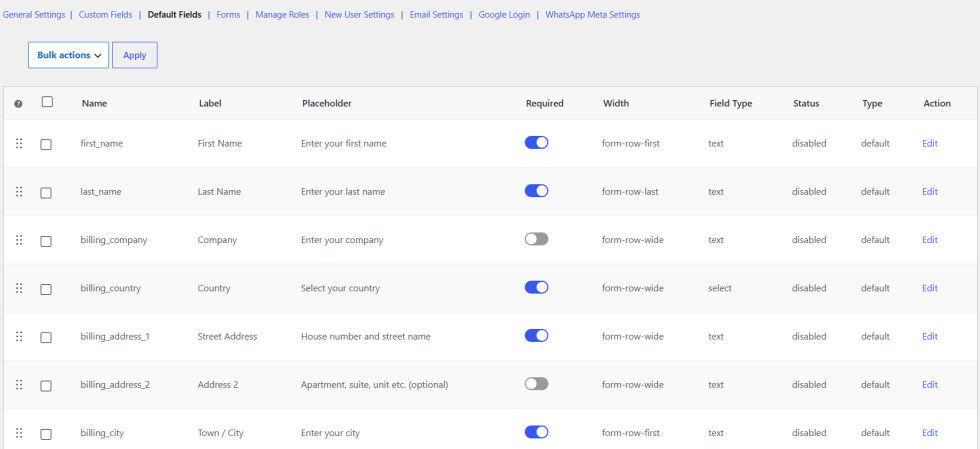
Forms
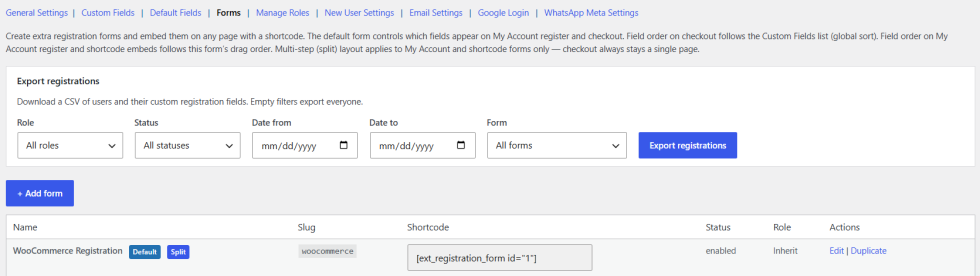
↑ Back to topCreate extra registration forms and embed them on any page with a shortcode. You can create multiple forms and assign it to multiple users. Click Add From to create a new form or edit the existing.
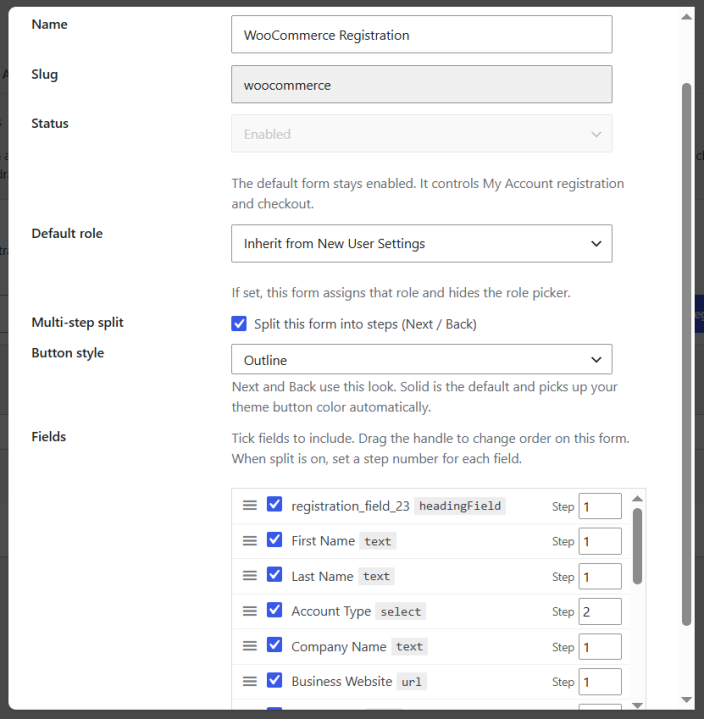
- Name: Set the form’s name.
- Slug: Set the form’s URL slug.
- Status: The default form always stays enabled, since it controls My Account registration and checkout.
- Default Role: Choose the role assigned to the form such as editor, customer, Manager etc.
- Multi-Step Split: Split the form into steps with Next and Back buttons.
- Button Style: Choose Outline or Solid and more for the Next and Back buttons. Solid is the default and uses your theme’s button color.
- Fields: Select which fields to include on the form, and drag to reorder them. When split is on, set a step number for each field.
Manage Roles
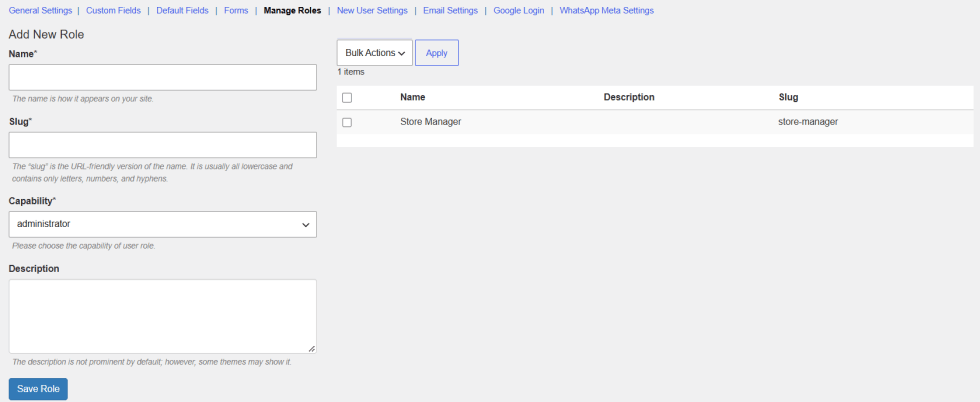
It allows you to add a new role by using your store capabilities or delete the existing one.
New User Settings
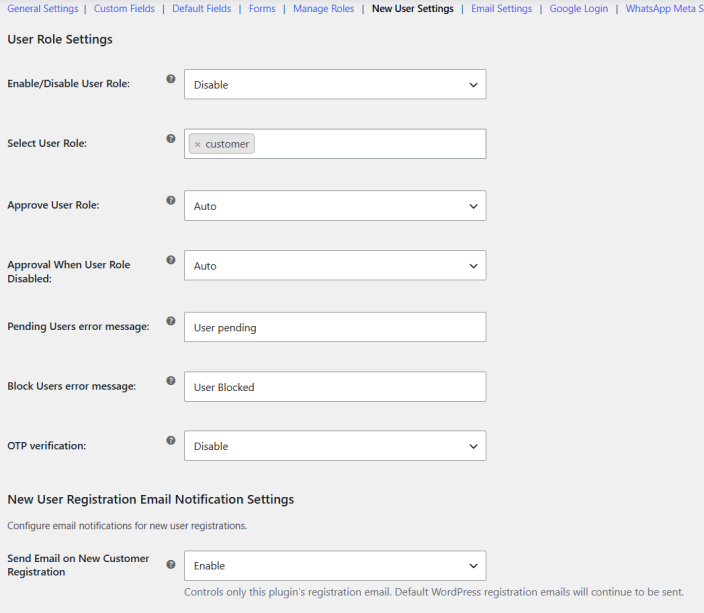
↑ Back to topThis tab lets you configure user role settings and approval behavior for newly registered customers on your WooCommerce store.
User Role Settings
- Enable/Disable User Role: Enable or disable the user role selection on the registration form.
- Select User Role: Choose which user roles will be available for customers to select during registration.
- Approve User Role: Set the approval method for user roles to either Auto or Manual.
- Approval When User Role Disabled: Define the default approval method when the user role feature is disabled.
- Pending Users Error Message: Enter the message displayed to users whose accounts are still pending approval.
- Block Users Error Message: Enter the message displayed to users whose accounts have been blocked.
- OTP Verification: Enable or disable OTP verification during registration to ensure only valid contact details are accepted.
- Verification Method: Choose whether the OTP is sent by Email or WhatsApp.
- Send Email on New Customer Registration: Enable or disable this plugin’s own new user registration email. Default WordPress registration emails continue to be sent regardless of this setting.
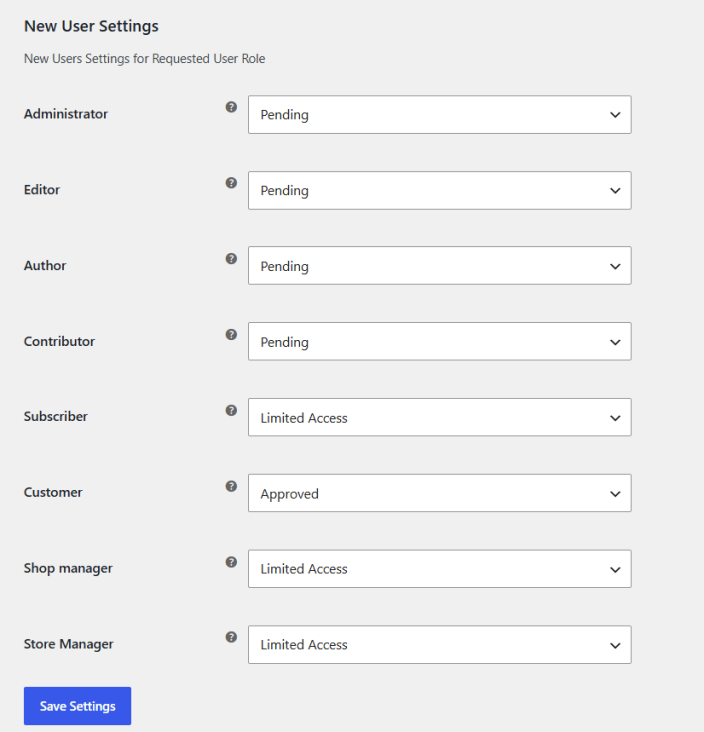
New User Settings
This section lets you define the default approval status for each user role when a new user registers and requests that role. You can set each role to Auto-approved or Pending, giving you full control over who gets access and when.
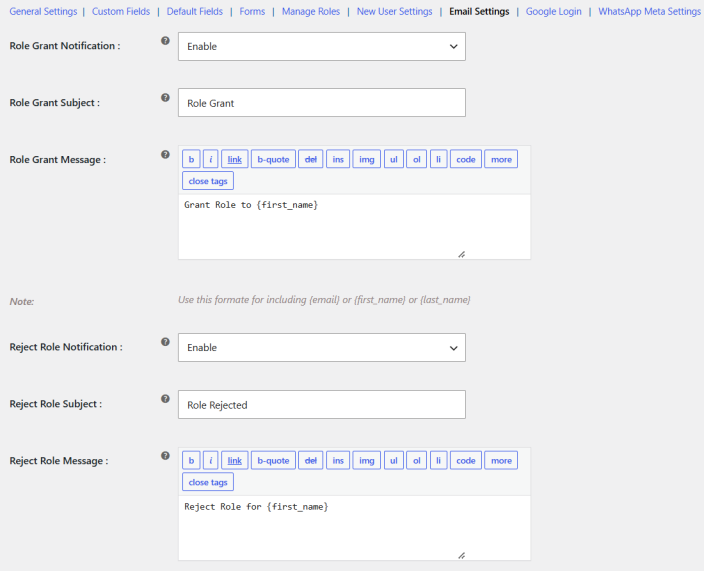
Email Settings
With the WooCommerce User Registration plugin, you can set up automated email notifications for actions such as Role Grant, Role Rejection, User Approval, User Blocking, and Limited Access. You can also customize the email subject and message content to match your store’s communication style.
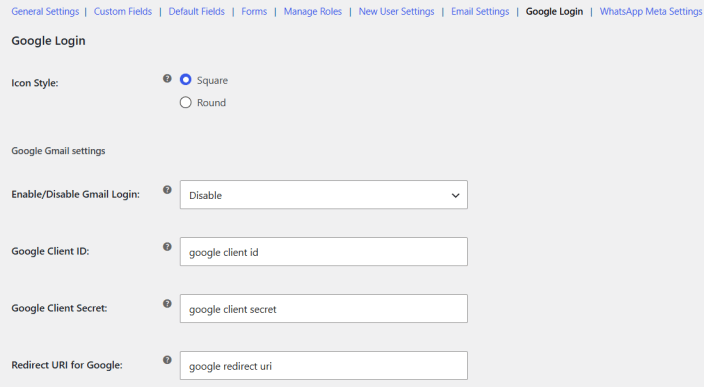
Google Login
- Icon Style: Set the icon style for the social icon. Choose from square or round.
Google Gmail Settings:
- Enable / Disable Gmail Login: Enable Disable Gmail login.
- Google Client ID: Add Google Client ID.
- Google Client Secret: Add Secret Key
- Redirect URI for Google: Add Redirect URI for Google.
WhatsApp Meta Settings
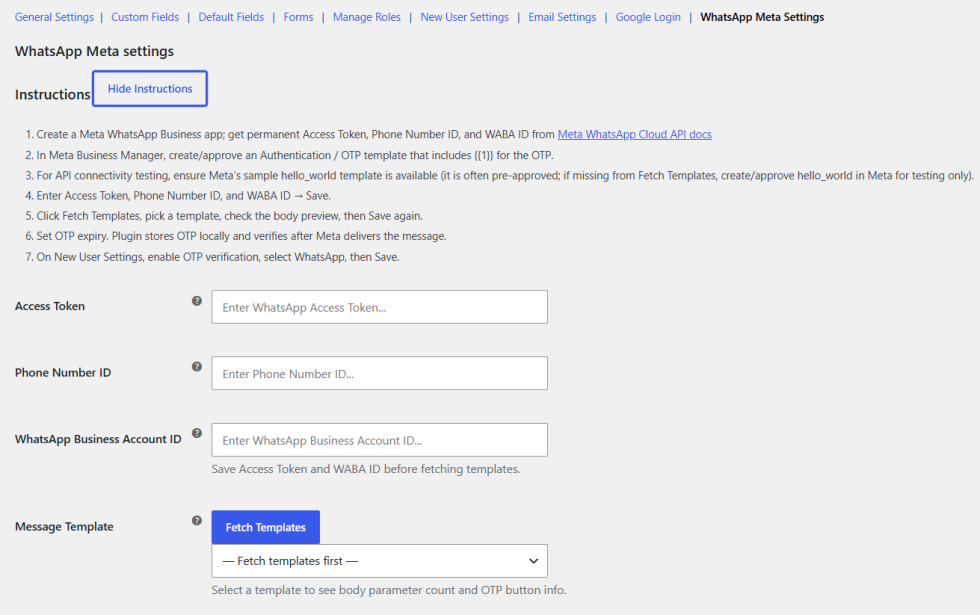
↑ Back to topConnect a Meta WhatsApp Business account to send the registration OTP over WhatsApp instead of email.
- Access Token: Enter the permanent access token from your Meta WhatsApp Business app.
- Phone Number ID: Enter the phone number ID from the Meta WhatsApp Cloud API.
- WhatsApp Business Account ID: Enter your WABA ID.
- Message Template: Click Fetch Templates, then select an approved template to use for the OTP message. Save the Access Token and WABA ID first.
Create and approve an Authentication template in Meta Business Manager before fetching templates, then enable OTP verification and select WhatsApp under New User Settings to go live.