
The Flexi Deposits for WooCommerce plugin lets you collect a partial payment instead of requiring customers to pay the full order amount upfront. You can set deposit rules for your entire store or individual products, create payment plans for future instalments, and optionally charge scheduled payments automatically through Stripe.
Installation
↑ Back to top- Download the .zip file from your WooCommerce account.
- Go to: WordPress Admin > Plugins > Add New and Upload Plugin with the file you downloaded with Choose File.
- Install Now and Activate the extension.
- After activating the plugin, you’ll be redirected to the License page. On this page, you will find the License Options. In the License Key field, enter the license key provided in the email. Upon activating the license, Discount Rules, Settings, Ready-to-Use Rule Templates, and Tools pages will be added.
More information at Install and Activate Plugins/Extensions.
Global deposit settings let you configure how deposits work across your WooCommerce store. These settings apply to products using Use Global Settings and to deposits enabled at checkout for the entire cart.
To configure the global deposit settings, go to WooCommerce > Settings > Deposits > General.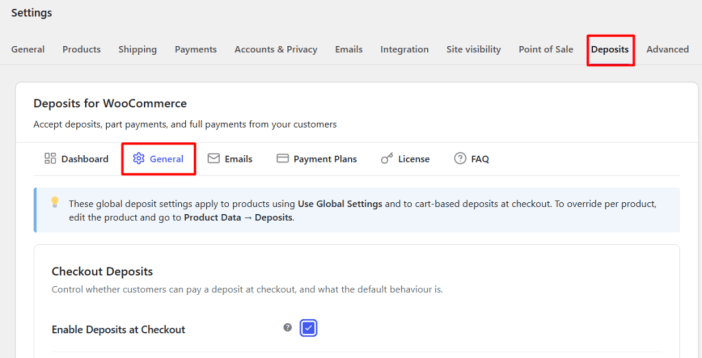
Note: To use different deposit settings for an individual product, edit the product and go to Product Data > Deposits. See Product-Level Deposits for more information.
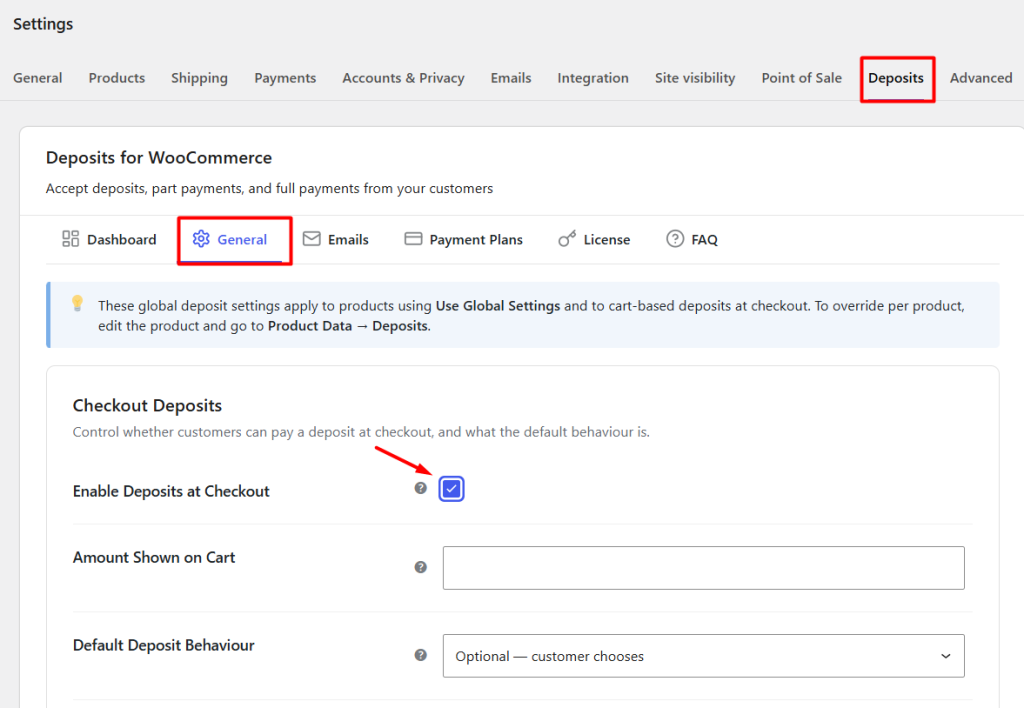
Enable Deposits at Checkout
↑ Back to topEnable this option to offer deposits for the entire cart at checkout instead of configuring deposits separately for individual products.
When enabled, customers see the available deposit options on the Checkout page and can choose how they want to pay for the order. The deposit settings configured globally, such as the Deposit Behaviour, Deposit Type, and Deposit Amount, are used for the checkout deposit.
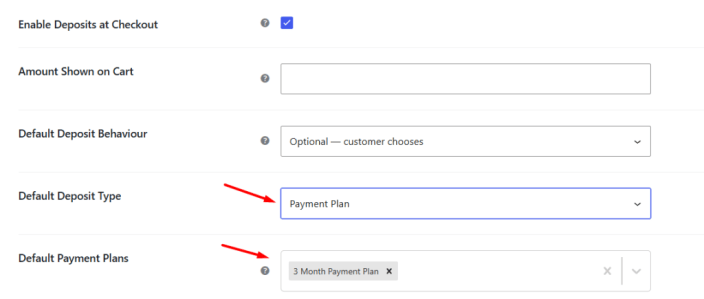
For example, if the default deposit type is Payment Plan, the checkout displays the selected payment plan and the amount payable today along with the remaining scheduled payments.
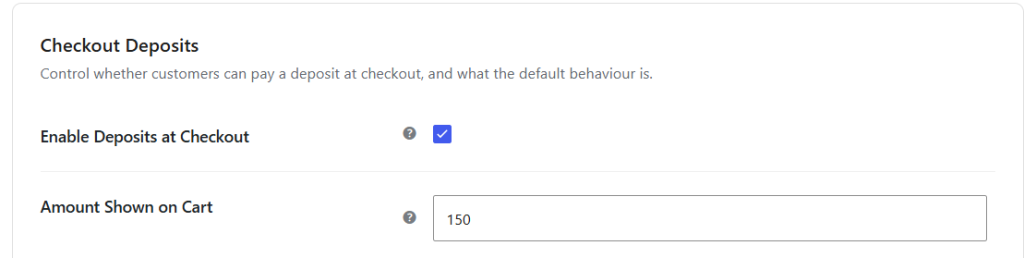
Amount Shown on Cart
↑ Back to topEnter the minimum cart amount required for the deposit options to be available at checkout. The deposit options will be shown only when the cart total is above the amount entered here.
Leave this field blank to use the product’s default deposit settings without applying a minimum cart amount.
Default Deposit Behaviour
↑ Back to topUse Default Deposit Behaviour to decide whether customers can choose a deposit or whether they must pay one.
You can choose from the following options:
- Optional: Customers can choose between paying the deposit and paying the full amount.
- Force: Customers must pay the deposit instead of the full amount.
- Disabled: Deposits are not available for products using the global settings.
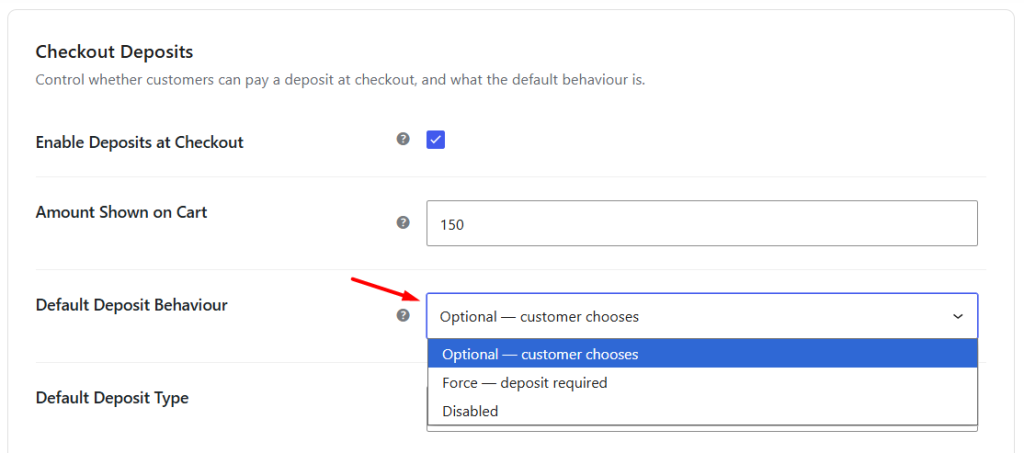
For example, select Optional if you want customers to choose between paying the full amount upfront or paying a deposit. Select Force if you want all eligible orders to be placed using a deposit.
Default Deposit Type
↑ Back to topThe Default Deposit Type determines how the deposit amount is calculated. You can choose Percentage, Fixed Amount, or Payment Plan.
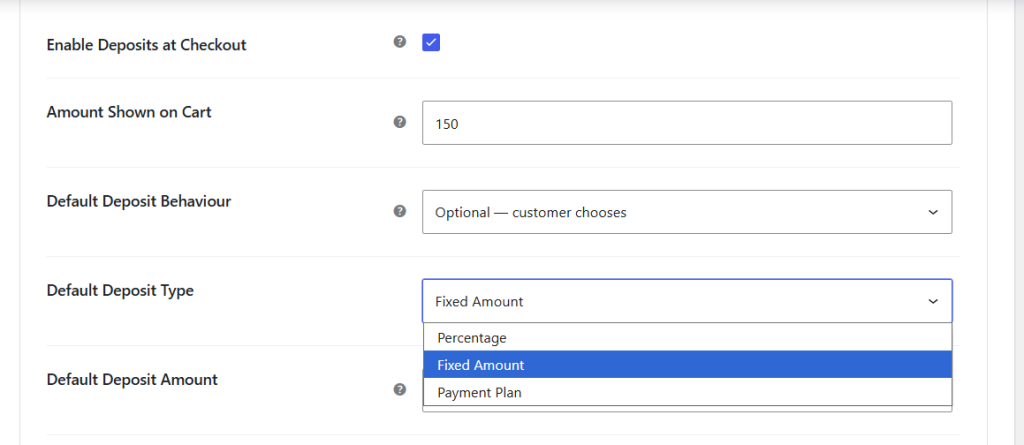
- Percentage: Set the deposit as a percentage of the applicable product or order amount.
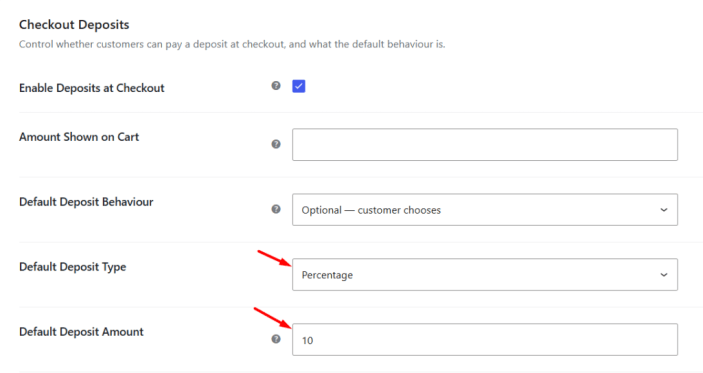
If this is set globally the checkout page will display a message to let the users know the percentage of deposit they can pay on the product.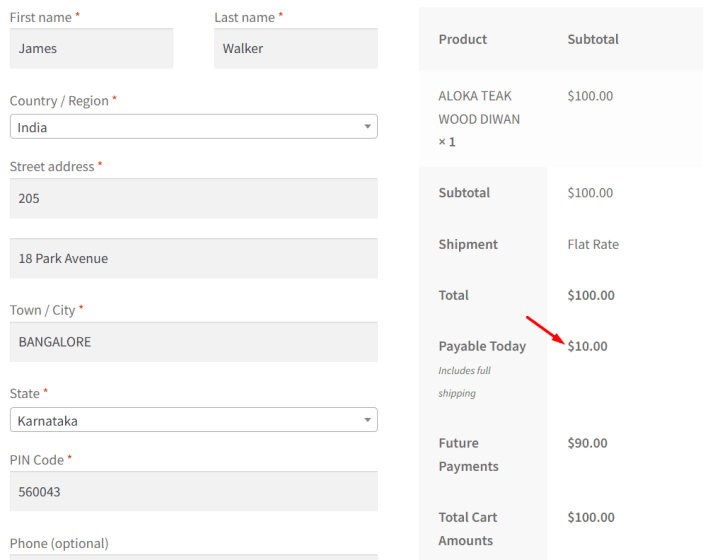
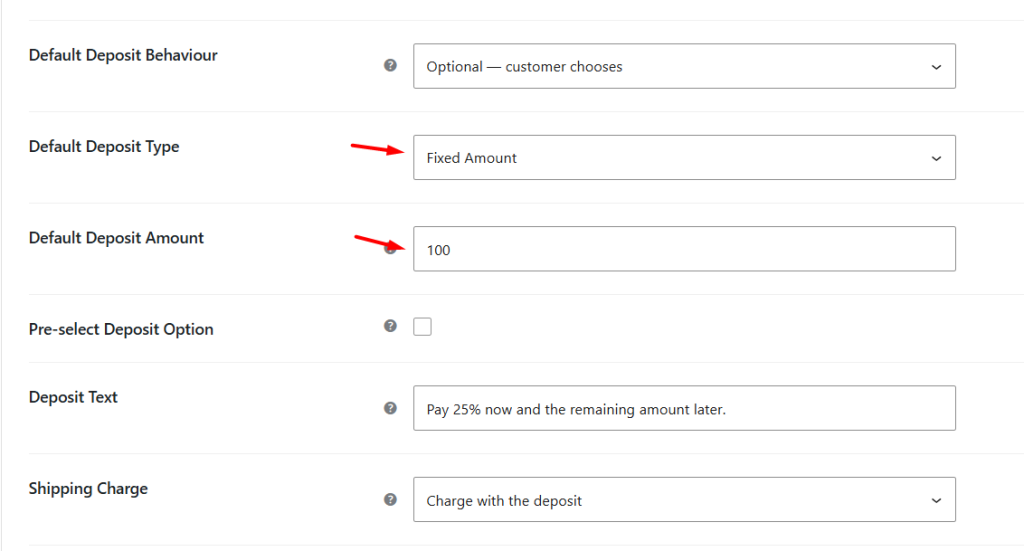
- Fixed Amount: Select Fixed Amount under Default Deposit Type and enter the amount you want customers to pay as the deposit.
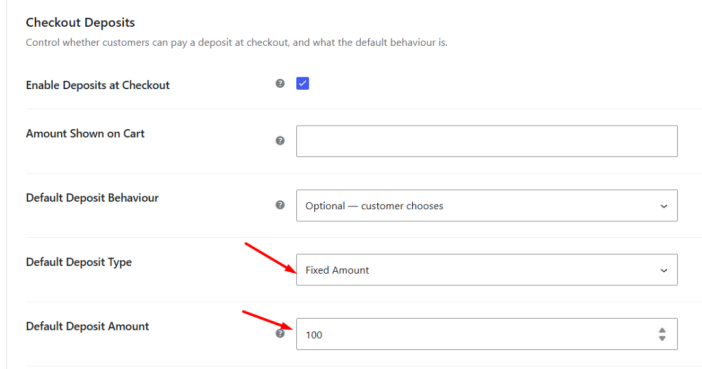
With these settings, the checkout page displays the $100 deposit amount that the customer needs to pay, while the remaining $400 is payable later.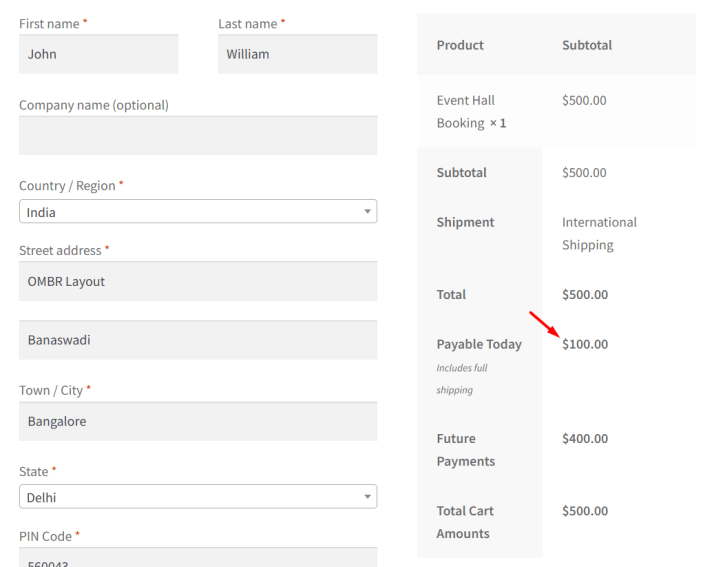
- Payment Plan: Select Payment Plan under Default Deposit Type and choose the payment plan you want to apply.
On the checkout page shows the customer how the $1,999 total is split across the payment schedule. The customer pays $999 initially, followed by $500 after 1 week and the remaining $500 after 1 month.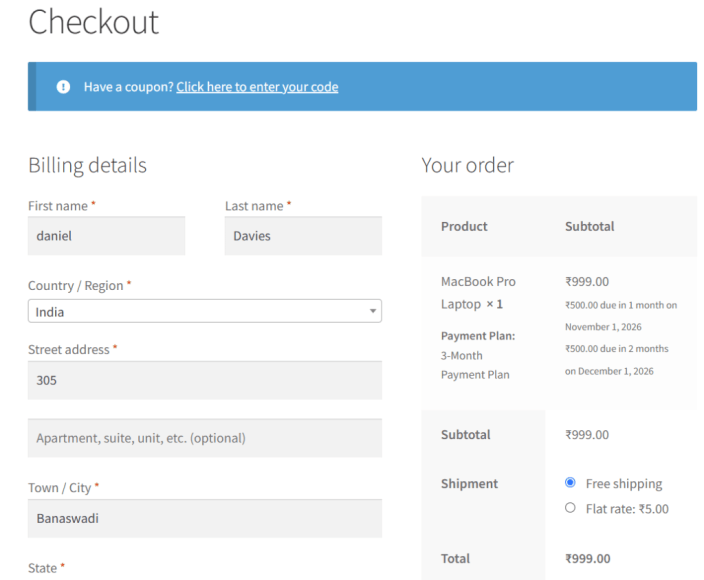
Default Deposit Amount
↑ Back to topEnter the amount to be collected as the deposit based on the Default Deposit Type you selected.
For a percentage deposit, enter the percentage you want to collect. For a fixed deposit, enter the actual amount.
For example, if you select Percentage and enter 25, a $400 product will have a $100 deposit. If you select Fixed Amount and enter 100, the deposit will be $100.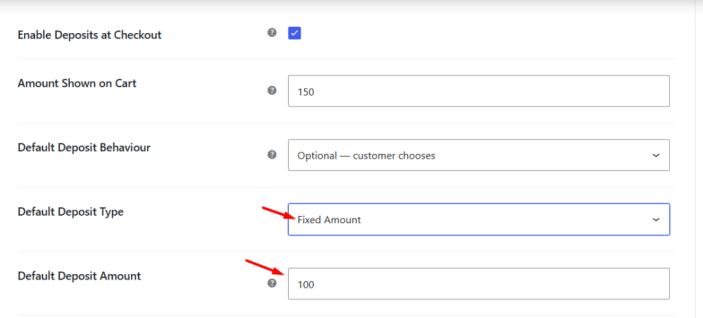
When the customer selects the Deposit option at checkout, $100 will be applied as the deposit amount for the order, and the remaining balance will be due later.
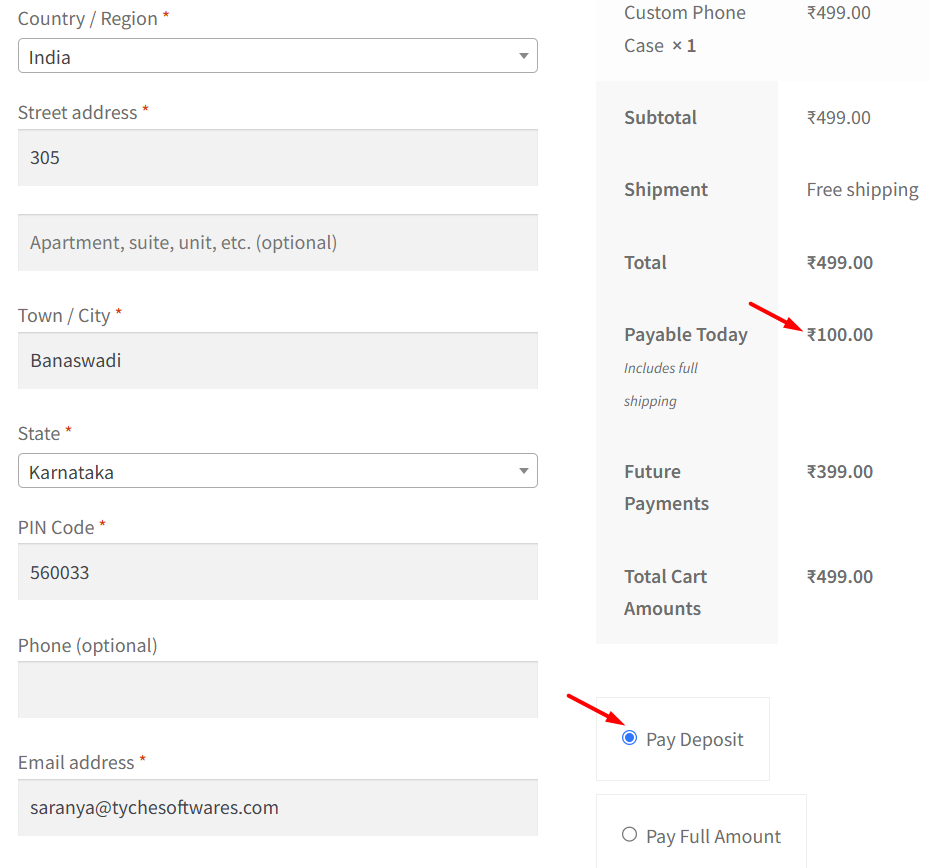
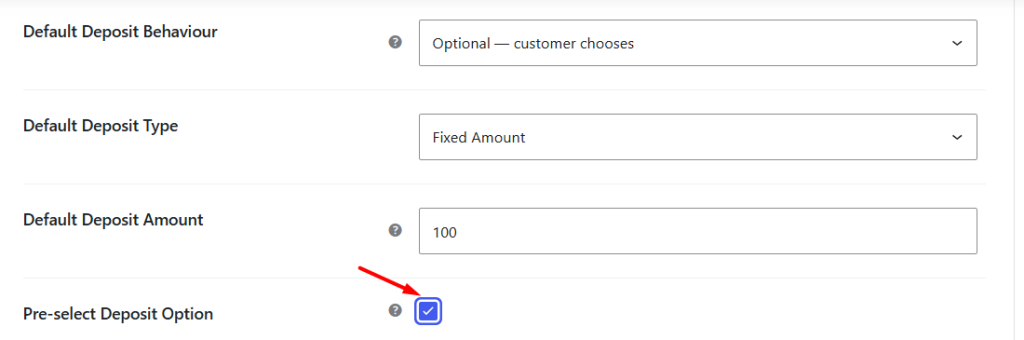
Pre-select Deposit Option
↑ Back to topEnable Pre-select Deposit Option if you want the deposit option to be selected automatically when the customer reaches checkout.
Deposit Text
↑ Back to topUse Deposit Text to add a message alongside the deposit option shown to customers on the product page.
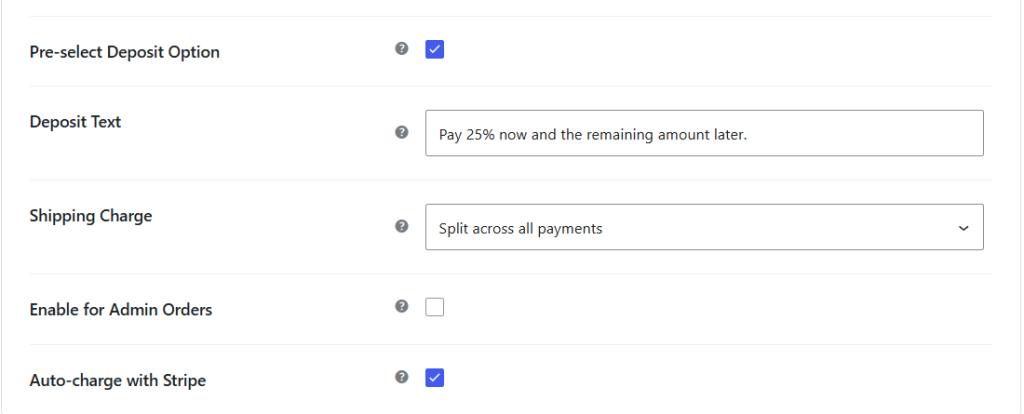
You can use this field to explain how much the customer needs to pay upfront and what happens to the remaining balance.
For example, if you enter “Pay 25% now and the remaining amount later”, the message will be displayed alongside the deposit option on the product page.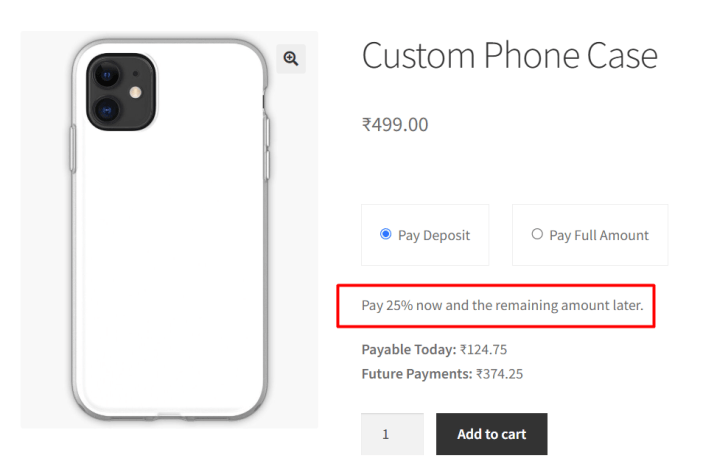
Shipping Charge
↑ Back to topYou can choose any of the following options in the shipping charge setting that allows you to choose when you want the shipping charge to be collected for an order paid using a deposit.
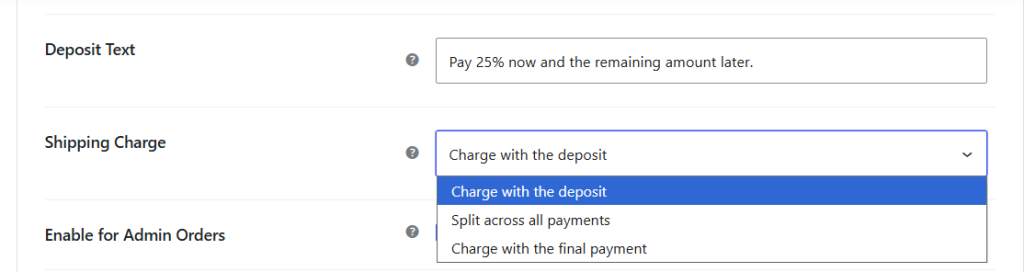
Charge with the deposit – Select this option if you want the shipping charge to be collected along with the initial deposit.
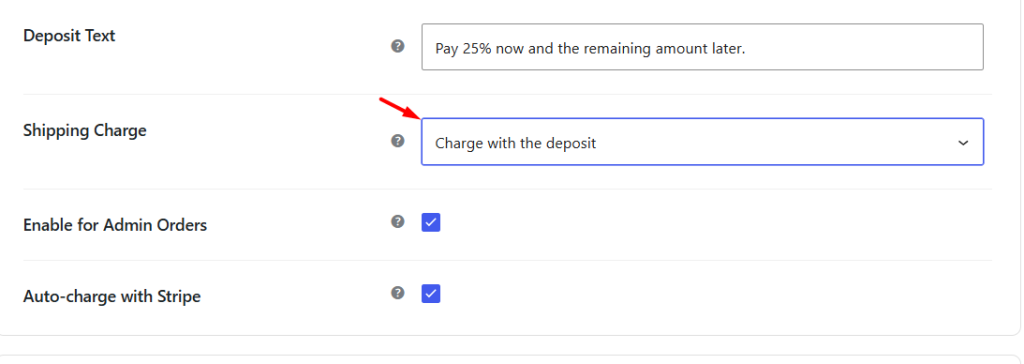
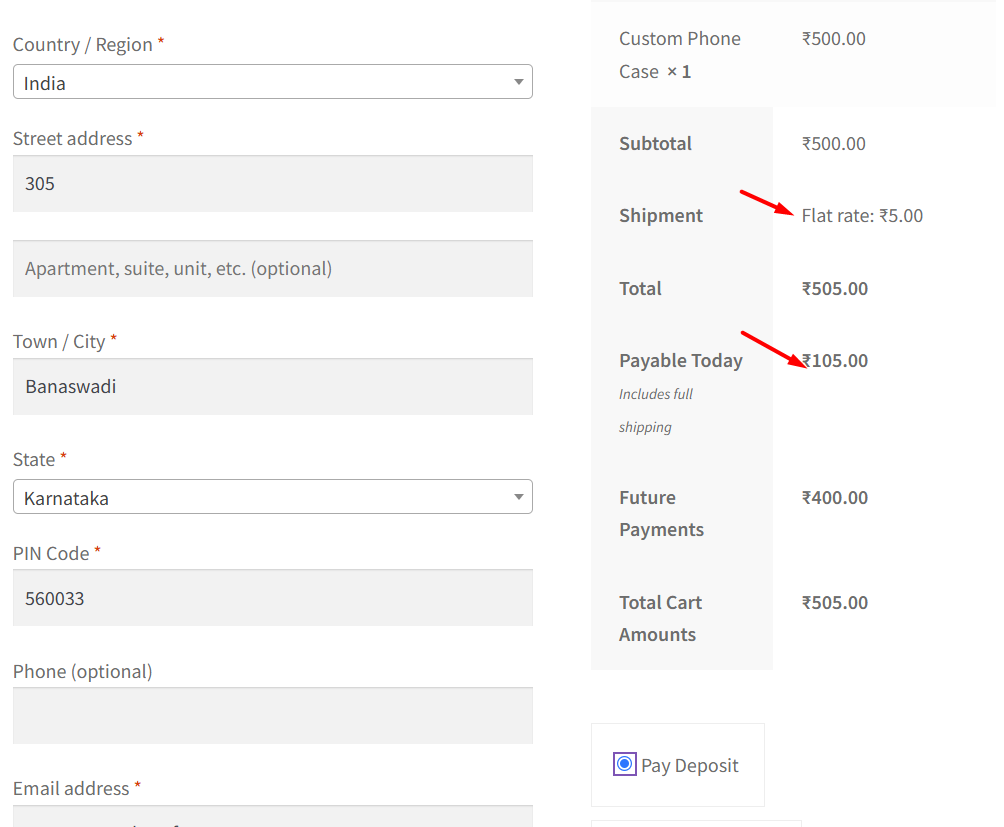
For example, suppose the product price is $500, the deposit amount is $100, and the shipping charge is $5.
If you select Charge with the deposit, the customer will pay $105 at checkout, which includes the $100 deposit + $5 shipping charge. The remaining $400 will be paid later.
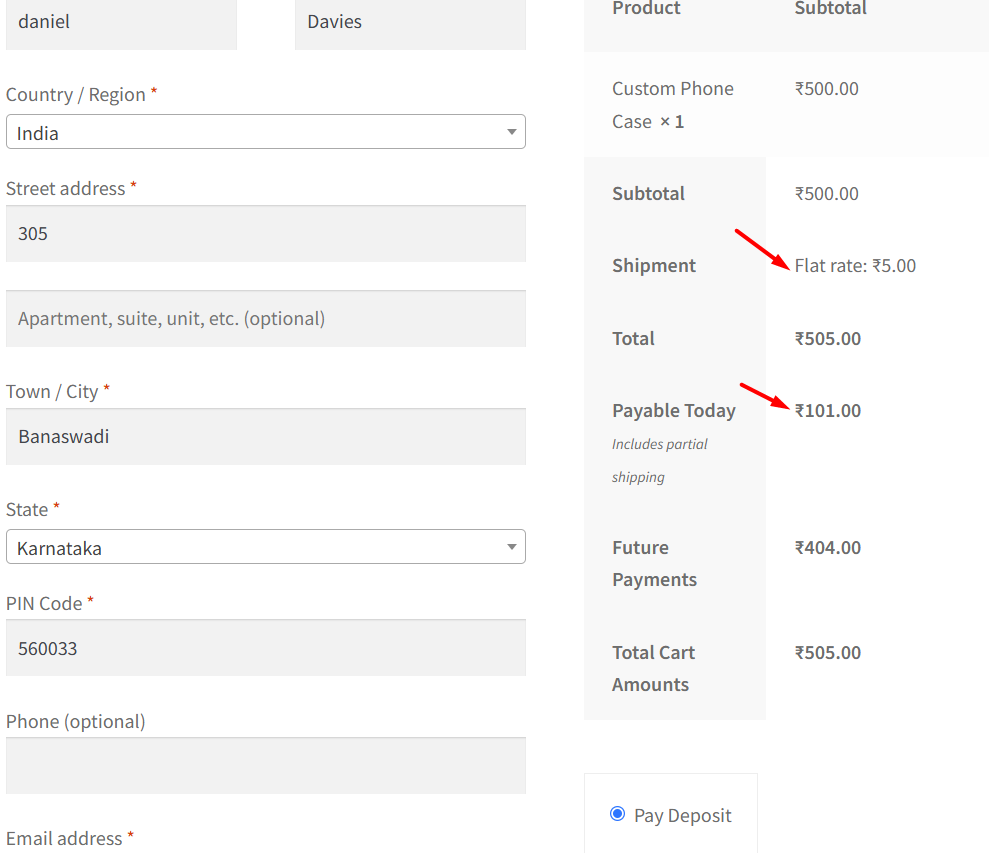
Split across all payments – Select this option if you want the shipping charge to be divided between the deposit and the future payments.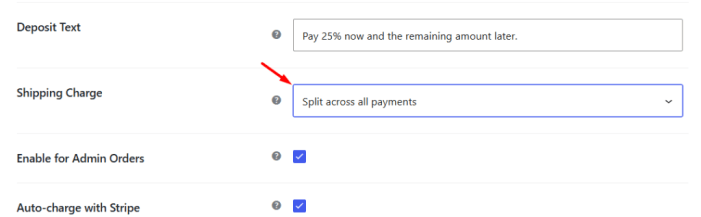
For example, if the product price is $500, the deposit is $100, and the shipping charge is $5, the shipping amount will be distributed between the initial and future payments. The amount payable today and the remaining payment will be updated accordingly.
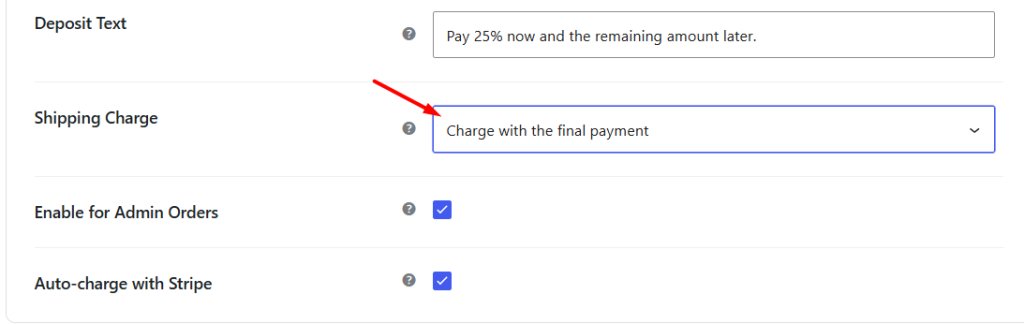
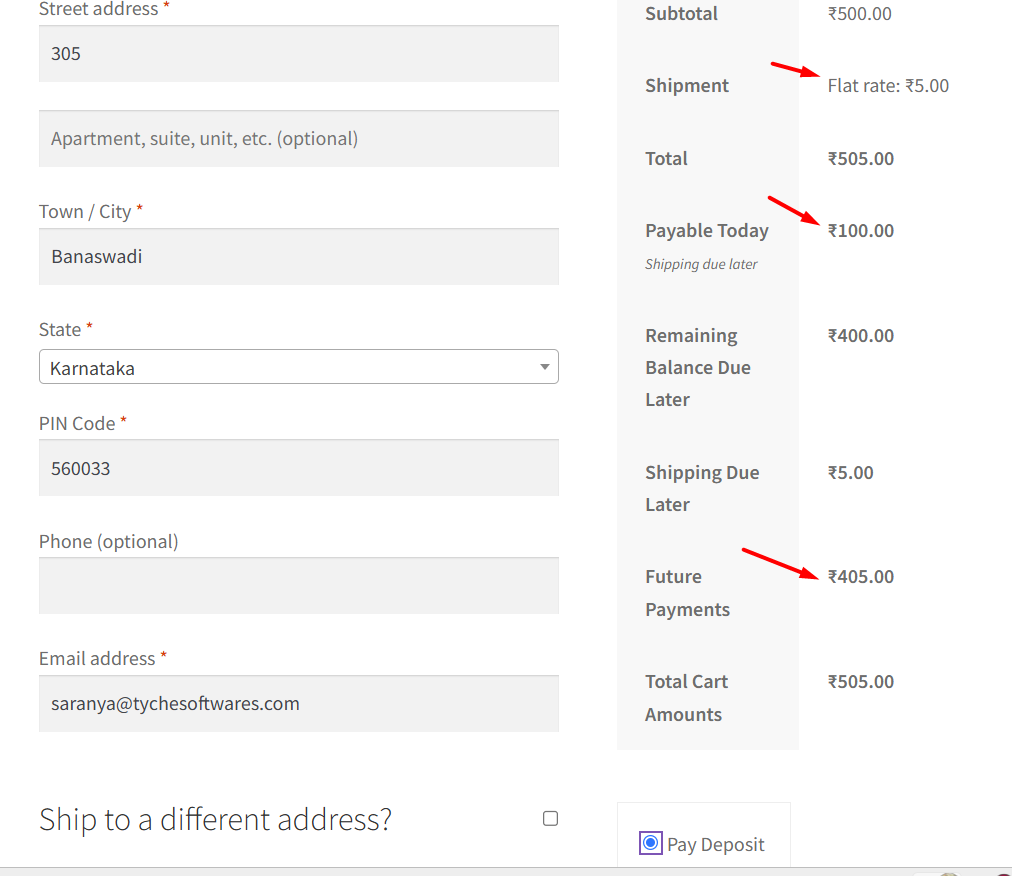
Charge with the final payment – Select this option if you want the shipping charge to be collected along with the final payment.
For example, if the product price is $500, the deposit is $100, and the shipping charge is $5, the customer will pay $100 as the deposit at checkout. The remaining $405, which includes the $400 balance and $5 shipping charge, will be collected with the final payment.
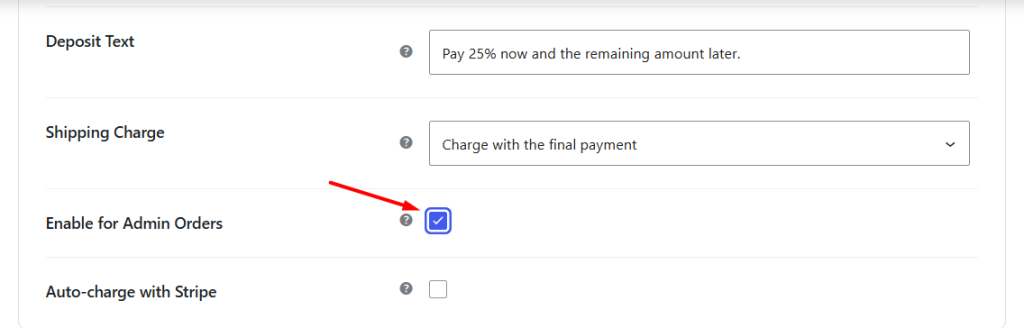
Enable for Admin Orders
↑ Back to topEnable the option Enable for Admin Orders, if you also want to offer deposits when creating an order manually from the WooCommerce admin area. This allows the same deposit functionality to be used for orders that are created by your store staff rather than placed directly by the customer.
When a store staff member creates a new order from the WooCommerce admin area, they can add products to the order and select Apply Deposit.
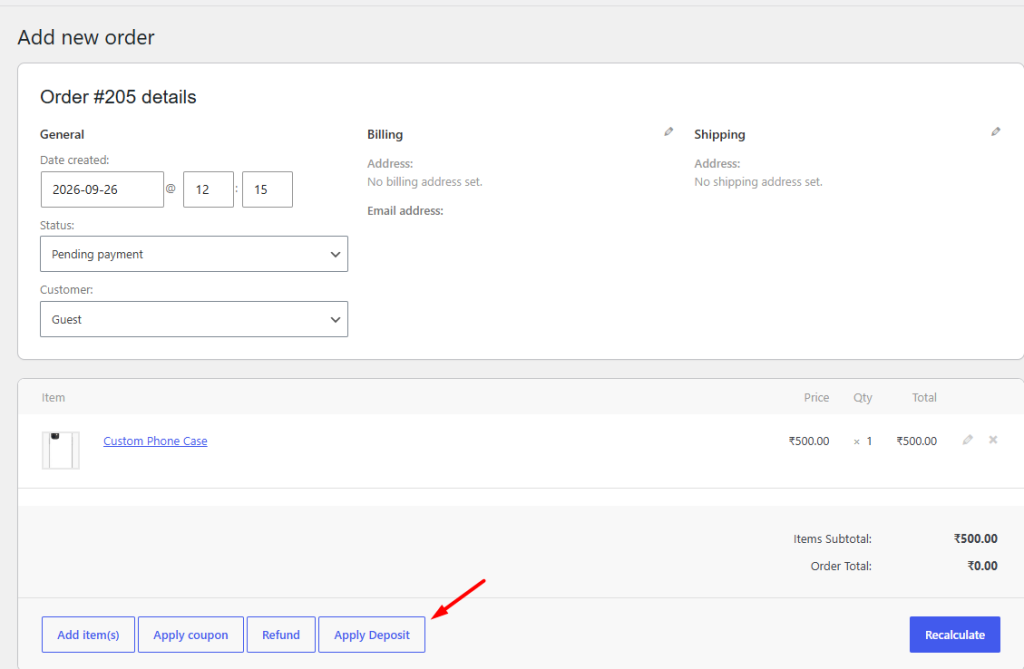
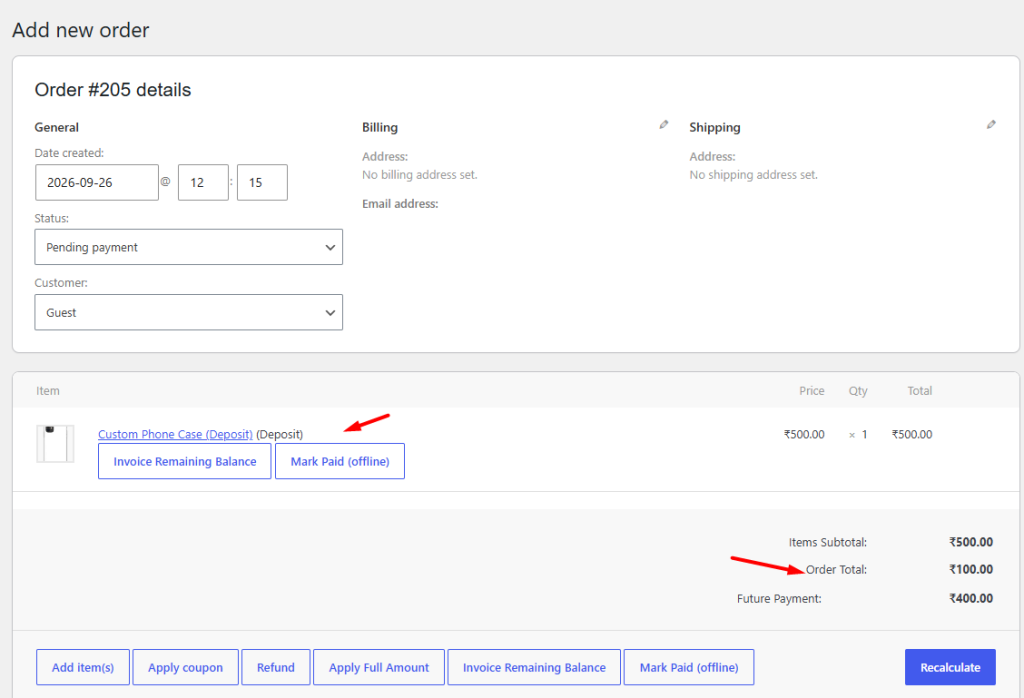
For example, if the order contains a Custom Phone Case priced at ₹500, selecting Apply Deposit applies the configured deposit to the order. The order details then show the amount that needs to be paid now and the remaining amount that will be paid later.
Auto-charge with Stripe
↑ Back to topEnable Auto-charge with Stripe if you want scheduled future payments to be charged automatically through Stripe when they become due.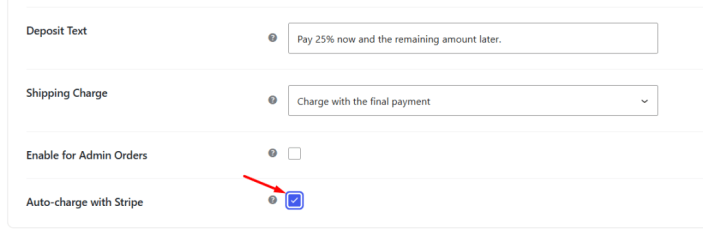
This is useful for payment plans where the customer makes an initial payment and the remaining instalments are collected automatically according to the payment schedule.
See Automatically Charge Future Instalments with Stripe for more information.
Coupons & Gateways
↑ Back to topThe Coupons & Gateways settings give you control over which discounts and payment methods customers can use when paying a deposit.
Disable Coupons on Deposits
↑ Back to topEnable Disable Coupons on Deposits if you do not want customers to use coupons when placing an order with a deposit. When enabled, the coupon code field is removed from the Cart and checkout page when a deposit is applied.
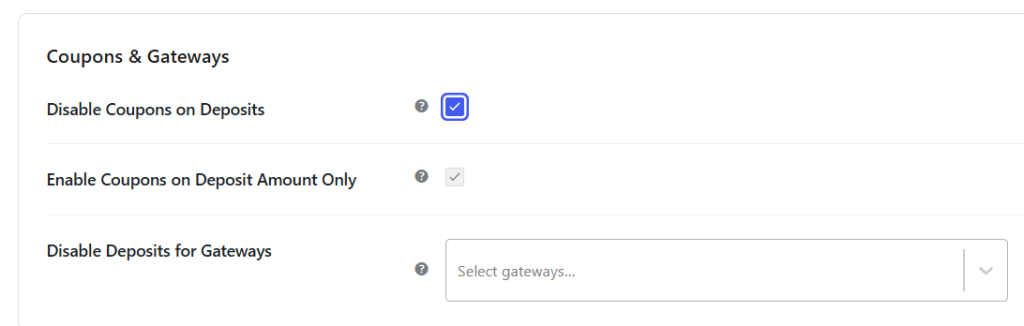
When this option is enabled and a customer places an order with a deposit, the coupon code field is not displayed on the Cart or Checkout page.
This can be useful if your store does not allow additional discounts on orders where only part of the order value is being paid upfront.
Enable Coupons on Deposit Amount Only
↑ Back to topEnable Enable Coupons on Deposit Amount Only when you want the coupon discount to be calculated against the deposit amount rather than the full product or order value.
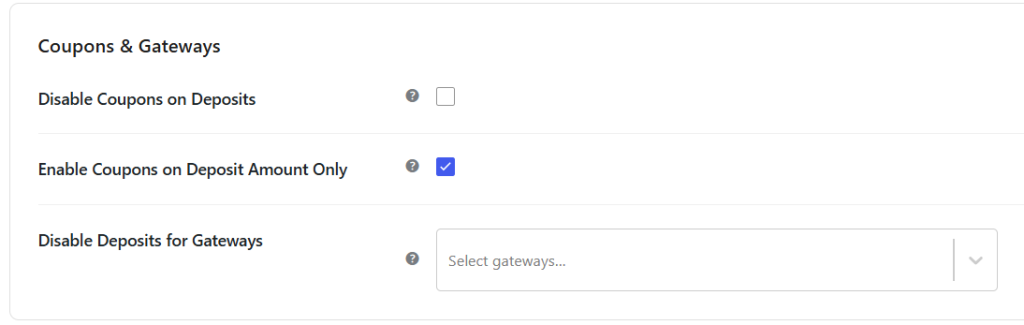
For example, suppose a product costs $500 and the customer has to pay a $100 deposit. If a 10% coupon is applied only to the deposit, the discount will be calculated on $100, giving the customer a $10 discount on the initial payment.
Disable Deposits for Gateways
↑ Back to topUse Disable Deposits for Gateways when you do not want specific payment methods to be available when customers choose the deposit option.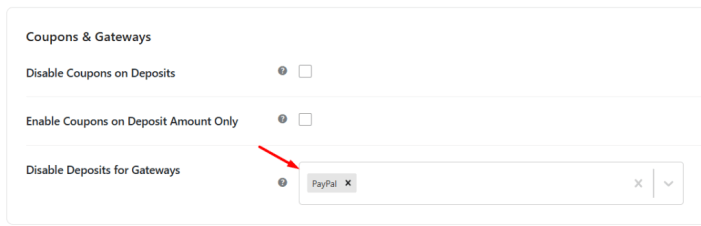
Select the payment gateways you want to exclude. For example, if you select Paypal, then it will be available on the checkout only when the customer chooses Full Payment.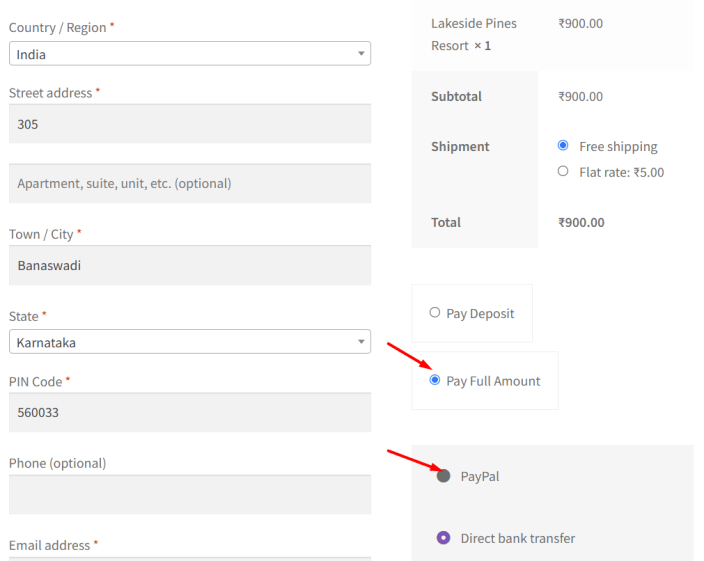
But the excluded paypal payment gateway will not be available when the customer chooses Pay Deposit at checkout.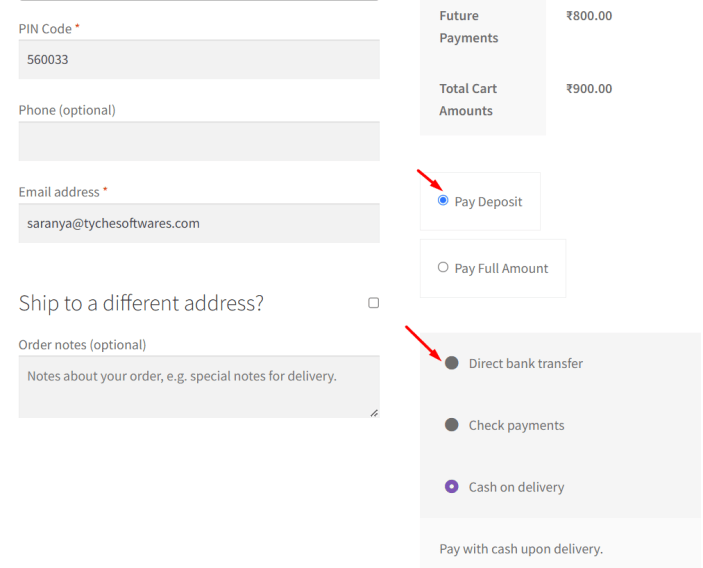
This allows you to restrict deposits to the payment gateways that support your store’s deposit payment setup.
Full Payment Discount
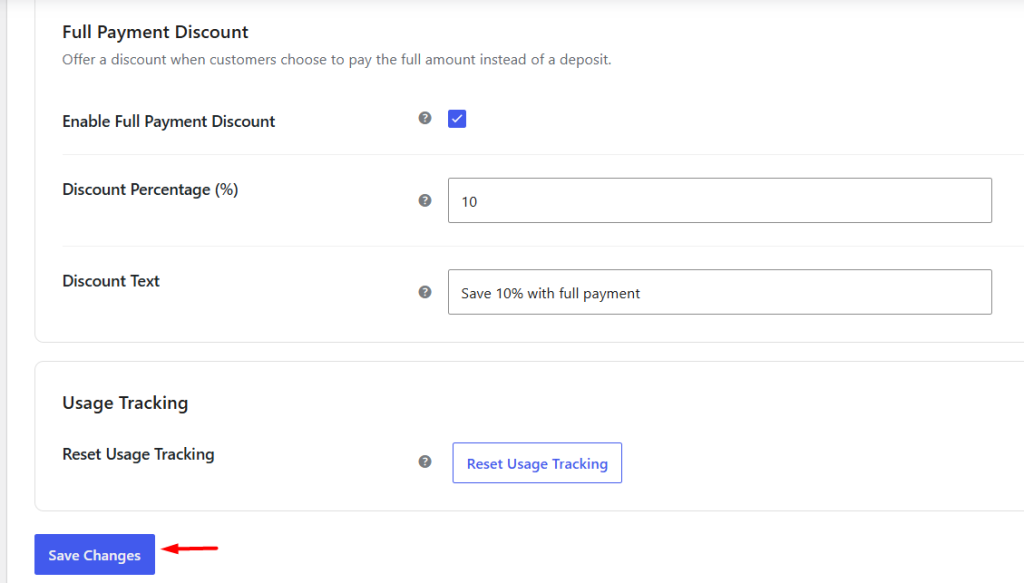
↑ Back to topIf you want to encourage customers to pay the complete order amount upfront, you can offer a discount for choosing full payment instead of a deposit.
Enable Enable Full Payment Discount, enter the discount percentage, and add the message you want to show customers with the full payment option, such as “Save 10% with Full Payment.”
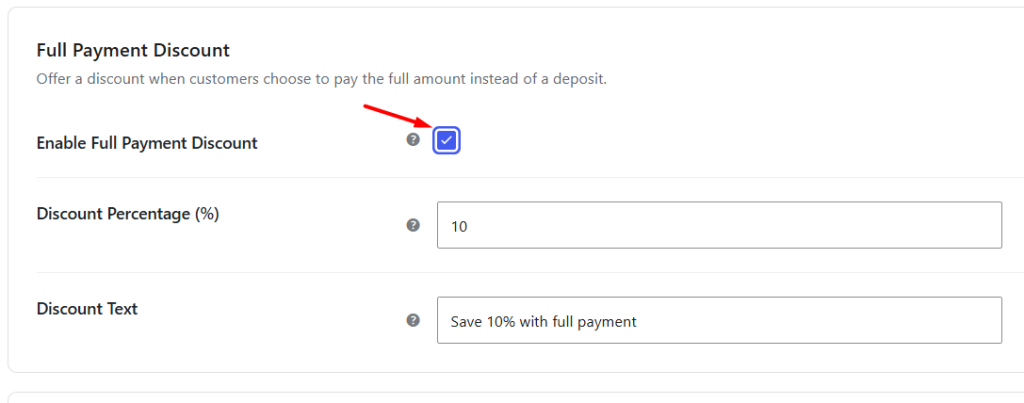
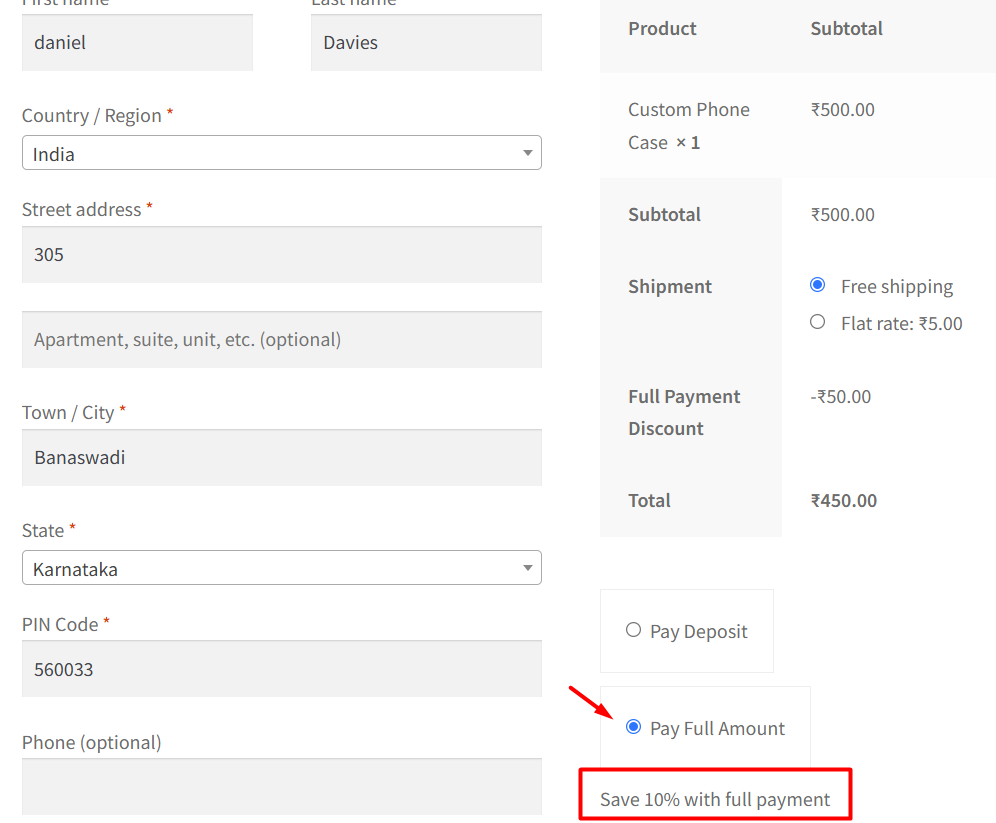
For example, if the order total is $500 and you offer a 10% full payment discount, the customer can choose Full Payment to receive a $50 discount. The amount payable today is reduced from $500 to $450.
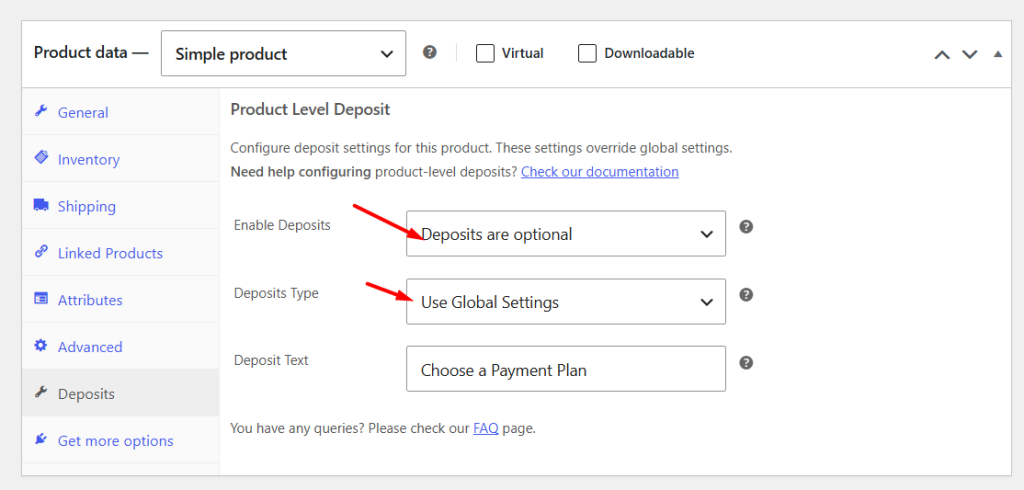
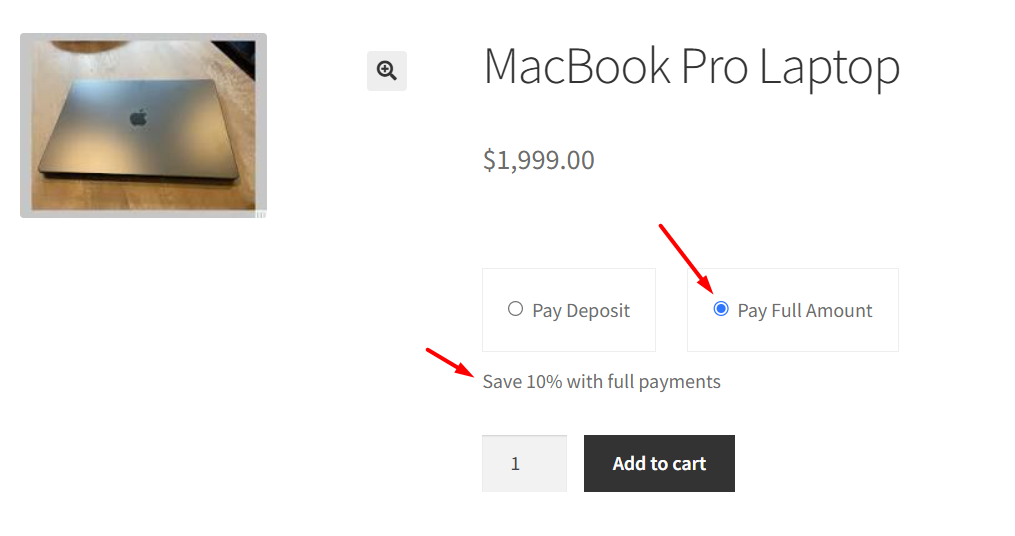
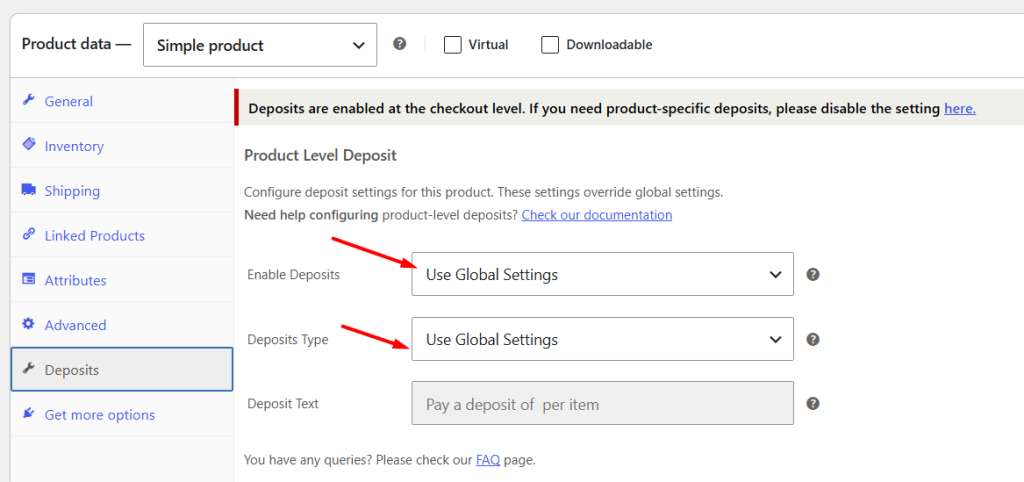
To display the Full Payment option with the discount message on a product page, configure the product-level deposit settings as follows:
- Enable Deposits: Select Deposits are optional.
- Deposits Type: Select Use Global Settings.
These settings allow customers to choose between Pay Deposit and Pay Full Amount, while the product uses the full payment discount configured in the global deposit settings.
For example, if you have configured a 10% full payment discount, the product page displays the Pay Deposit and Pay Full Amount options along with the discount message, such as “Save 10% with full payments.”
Reset Usage Tracking
↑ Back to topUse Reset Usage Tracking if you need to clear the usage-tracking data collected by the plugin.
Save Changes
↑ Back to topOnce you have configured the settings, click Save Changes.
Note: At the product level data there is an option to Use Global Settings for specific products that should follow these settings. If you need different deposit rules for an individual product, you can configure Product-Level Deposits from the product settings. To use product-specific deposit settings, disable Enable Deposits at Checkout in the global settings first.
With the global deposit settings configured, you can control how customers pay deposits across your store—from the deposit amount and shipping charges to coupons, payment gateways, and full payment discounts.
Product Level Deposit
↑ Back to topDeposits allow customers to pay part of the product price when placing an order and pay the remaining amount later.
By default, your products use the global deposit settings configured in the General section of the Deposits plugin. These settings control how deposits work across your store.
If you want a particular product to have different deposit settings, you can configure them from Products > Edit Product > Product Data > Deposits. The settings you configure here will apply to this product instead of the corresponding global settings.
For example, you may allow deposits for most products but require the full payment for one particular product. You can use the product-level settings to make that change without changing the deposit settings for the rest of your store.
Click on the Deposits tab on the Add/Edit product page.

Note: Before configuring product-level deposits, make sure Enable Deposits at Checkout is disabled in the global settings. This setting enables deposits for the whole order at checkout and must be disabled when you want to configure deposits for individual products.

Select any of the options from Enable Deposits to decide whether customers can pay a deposit for this product and whether the product should follow the deposit behaviour configured for your store.

You can choose from the following options:
- Use Global Settings – The deposit behaviour configured in the global settings will be used for this product. This is useful when you want the product to follow the same deposit behaviour as the rest of your store.
- Deposits are optional – Customers can choose whether to pay the deposit or the full product price when purchasing this product.
- Force Deposits – Customers must pay the deposit when purchasing this product. They cannot choose to pay the full amount instead.
- No – Deposits will not be available for this product. Customers must pay the full product price.
Deposit Type and AmountEnter the amount that customers need to pay upfront based on the selected Deposits Type.
- If Percentage is selected, enter the percentage of the product price that should be collected as the deposit.
- If Fixed Amount is selected, enter the specific amount that should be collected as the deposit.
- If Use Global Settings is selected for Deposits Type, the default deposit amount configured in the global settings will be used.
 Deposit TextUse Deposit Text to add a custom message that will be displayed on the product page alongside the deposit option.You can use this message to tell customers how much they need to pay upfront or explain that the remaining amount will be paid later.For example, you can enter:Pay deposit now and the remaining amount later.
The text entered here applies to this product. It does not change the deposit text configured for other products. For setting deposit text for all other products, you need to set it from the setting Deposit Text available in Global Level WooCommerce Deposit.Payment PlansUse Payment Plans to add payment plans that customers can select when purchasing this product. Before selecting a payment plan here, you need to create the payment plan from the Payment Plans tab of the Deposits plugin. Once created, the payment plan will appear in this dropdown, where you can select it for the products.You can select one or more payment plans to give customers different options for paying the remaining amount.For example, you could offer:- Plan 1: Pay 50% now and the remaining 50% later.
- Plan 2: Pay 30% now, followed by two additional payments.

If Global Settings is selected, the payment plans configured in the global settings will be used for this product.If you want to offer different payment plans for a particular product, you can configure them at the product level instead.
Product-level deposit settings give you more control over how customers pay for individual products. You can decide whether deposits are available, set the deposit amount, customize the deposit message, and select the payment plans you want to offer.
These settings apply only to the product you configure, so you can offer different deposit and payment options for specific products without changing the deposit settings for the rest of your store.
Payment Plans
Payment Plans let you split a product’s price into multiple scheduled payments instead of collecting the full amount at once.
For example, suppose you sell a MacBook Pro for $1,999. You want to give customers the option to pay part of the price upfront and the rest over the next two months.
You could create a payment plan like this:
- $999 when the customer places the order
- $500 after 1 month
- $500 after 2 months
The customer pays $999 at checkout as the deposit amount, while the remaining $1,000 is scheduled as two future payments.

Create a payment plan
↑ Back to topGo to WooCommerce > Settings > Deposits > Payment Plans. This is where you can create and manage payment plans for your store.

Click on Add Payment Plan, enter a name and description for the plan. For example, let’s create a payment plan for the Mac pro prouduct worth $1999 like this:
- $999 when the customer places the order
- $500 after 1 month
- $500 after 2 monthsLet’s add a Name as 3-Month Payment Plan and the Description as Pay $999 today, followed by $500 after 1 month and $500 after another 1 month. The name and description help you identify the plan when you have multiple payment plans configured in your store.

Under Payment Plan Schedule, add the payments that the customer needs to make. For each payment, you can choose a Payment Scheme based on how you want to calculate the payment amount:
- Fixed Amount – Enter a specific amount that the customer should pay. For example, you can enter $999 for the first payment of the MacBook Pro.
- Percentage (%) – Enter a percentage of the product price that the customer should pay. For example, if you enter 50% for a $1,999 product, the payment amount will be $999.50.

For our MacBook Pro example, select Fixed Amount and enter $999 for the first payment. Click + to add the remaining payment schedules. Once you have added all the payments, click Create Plan to save the payment plan.

Creating a payment plan does not automatically make it available at checkout. You need to select Payment Plan as the deposit type and choose the payment plan you created. You can do this either from the global deposit settings or for an individual product using the deposit type setting. For example, let’s choose the 3 month payment plan.

When the customer proceeds to checkout, the deposit and payment plan options are shown based on the settings configured for the product. As the 3-Month Payment Plan is assigned to the MacBook Pro, the payment plan is shown when the customer adds the product to the cart.
The cart displays the product price along with the payment plan selected for the product.

When the customer proceeds to checkout, the payment plan is already applied to the order on the checkout page as well.

View scheduled payments after an order is placed
↑ Back to topAfter a customer places an order using a payment plan, you can view the scheduled payments associated with the order from WooCommerce > Orders.
Open the original order to view the payment details and the amount that has already been paid. The order also shows the remaining amount scheduled for future payments.

If the order provides a View Scheduled Payments option, click it to view the scheduled payment created for the remaining balance. The scheduled payment shows the amount that is due.
You can open it to view its payment details and use View Original Order to return to the original order.

This lets you track the initial payment and the remaining scheduled payments from the WooCommerce order details.
Send email notifications for Scheduled payments
↑ Back to topOnce you have created a payment plan, you can configure email notifications to keep customers informed about their remaining instalments. These emails help customers know when a payment is due and how to complete it.
Go to WooCommerce > Settings > Deposits > Emails to configure the following notifications:
- Payment Reminder Email: Used for scheduled Stripe instalments when automatic payments are enabled. You can enable Enable Reminder Emails and set how many hours before the scheduled payment the reminder should be sent. For automatic charging to work, customers must select the option to save their payment information during the initial order.

- Remaining Payment Invoice Email: Sent when a scheduled instalment is created and is awaiting payment. It can include a payment link that customers can use to complete the instalment manually. You can customize the email subject, heading, and message for both notifications. Click Save Changes to apply your settings.

The customer receives the invoice email with the payment details and a link to complete the remaining payment:

For more details about automatic Stripe payments, refer to Auto-charging installments on Stripe.
Payable Today and Future Payment Options
↑ Back to topThere is a new feature added in version 1.4 of Deposits for WooCommerce plugin where the ‘Payable Today’ amount and ‘Future Amount’ of the product is displayed on the product page itself when the ‘Pay Deposit’ option is selected.
Let us see how this works by creating a payment plan from WooCommerce -> Products -> Payment Plan page. For instance we create a Booking Plan where Future Payment option is used.

So when this plan is selected for the product, the customer needs to make a 20% payment at the checkout while booking the order and remaining 80% needs to be paid in 30 days after the order is placed.
Now let us select this plan for the product Hotel Pride as shown below:

When you select this product on the front end, on the Products page you will find 2 options, Pay Deposit and Pay Full Amount. When you select the Pay Deposit option, you will get the details of the Booking Plan displaying the price to be payable today and that to be paid in future as shown below:
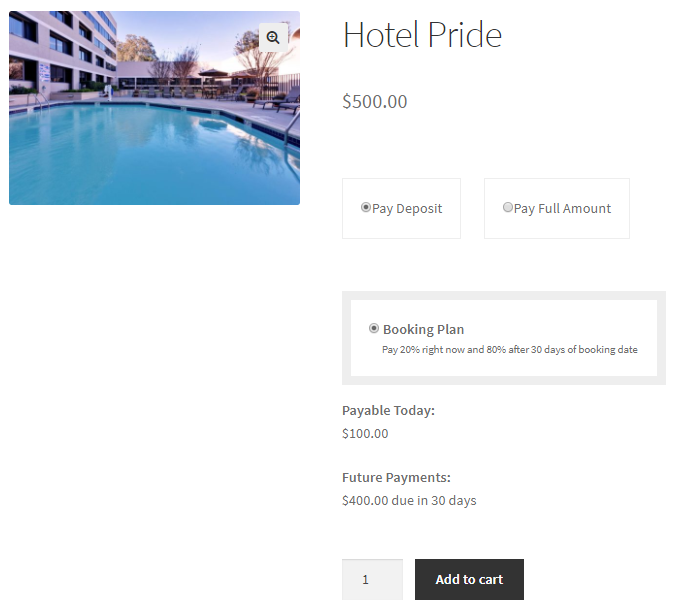
Similarly when you add this product to the cart, on the Cart page you will see the plan details like 20% total payment to be made today and remaining 80% in future as shown below:
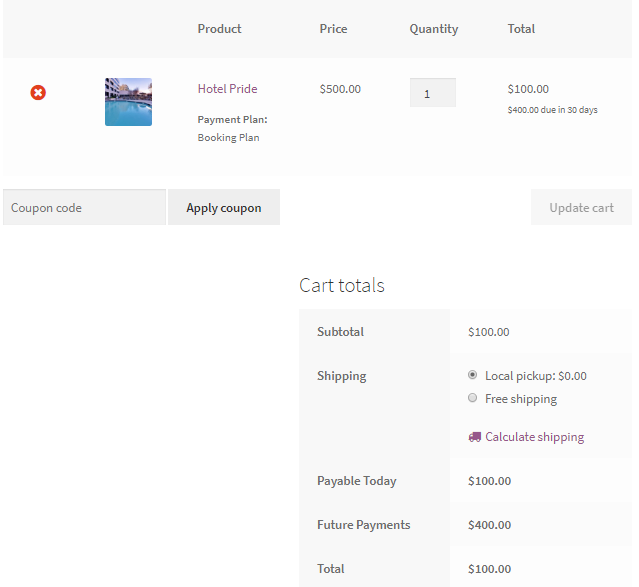
Thus the Order Total is $100 payable today and $400 as future payment. This will reflect on the Checkout page under Your Order section as shown below:
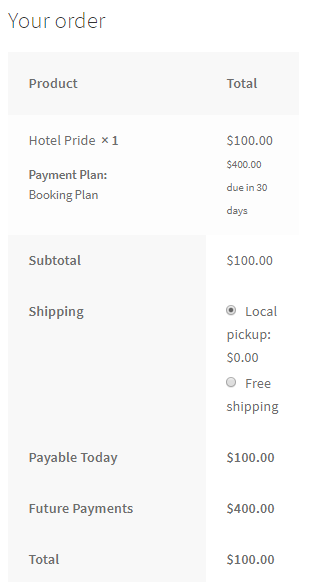
Once the order is placed, the Order details can be checked under WooCommerce -> Orders -> Edit Orders page as shown below:
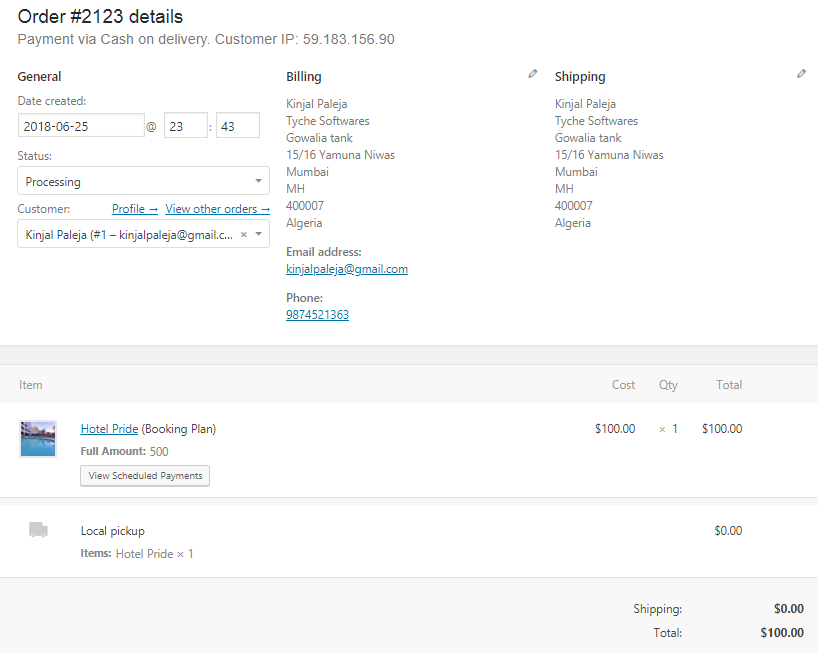
As you can see Order #2123 shows the details of payment of $100 made for product Hotel Pride with the Full Amount of $500 displayed. Below the Full Amount, you will find a View Scheduled Payments button. When you click on it, you will be taken to a new order that was created for remaining payment of $400 as shown below:

Here as you can see, Order #2124 is created showing a total of $400. When you click on the order, you will land on the Edit Orders page displaying the remaining payment details as shown below:
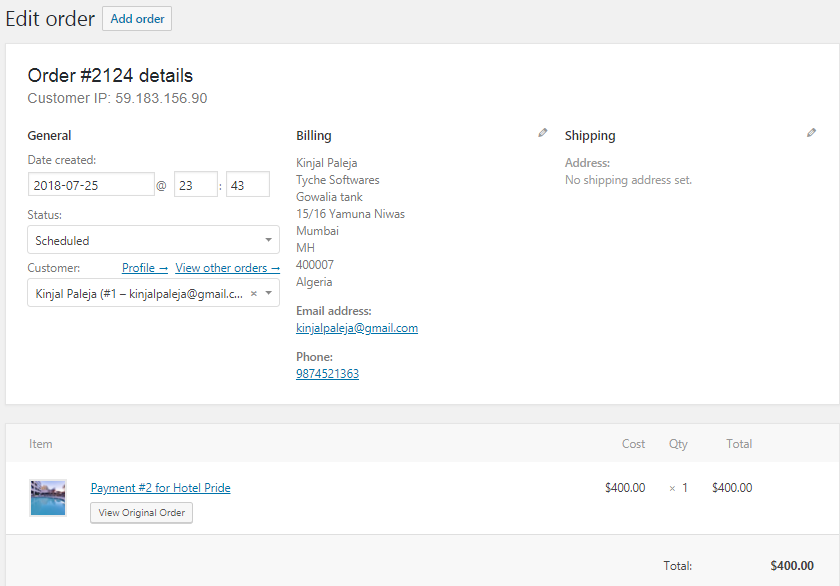
If you want to check the details of the original order, you can click on the View Original Order button as shown above. on the View Original Order button as shown above.
Full Payment before X days of booking
↑ Back to topIn our eaIn our earlier post, we saw how the Payable Today and Future Payments feature works using Deposits for WooCommerce plugin. In this post, we will look at a new functionality where Full payment has to be made before X days of booking.
When customers book a hotel room or another time-based service, you may want to let them place the booking without an upfront payment and collect the full amount a few days before the booking date. Let us see how this works.
With Deposits for WooCommerce, you can create a payment plan that schedules the remaining amount for a specified number of days before the customer’s booking date.
For example, you can configure a $199 Hotel Room Booking so that the customer pays nothing when placing the booking and the full $199 is due 10 days before the booking date.
This type of payment plan can be used with Booking & Appointment for WooCommerce and WooCommerce Bookings and the plugins should be activated.
Create the payment plan
↑ Back to topGo to WooCommerce → Settings → Deposits → Payment Plans and add a new payment plan.
Give the plan a name that clearly describes when the payment is due. For instance we create a Full Payment Plan where no payment has to be made immediately, but full amount has to be paid before the specified days.

So when this plan is selected for the product, the customer needs to make 0% payment at the checkout while booking the order and has to pay full amount which is 100% before 10 days of the selected date.
Now let us select this plan for the product Hotel Booking product as shown below:

Enable booking for the product and configure the booking options to allow customers to select their booking date.
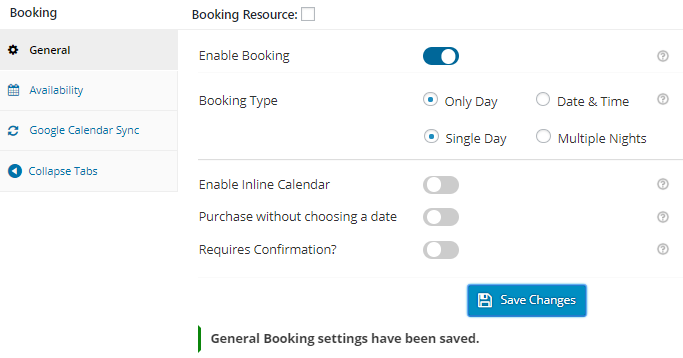
When you select the Hotel Room Booking product on the front end, on the Products page you will find 2 options, Pay Deposit and Pay Full Amount.Select the deposit option and continue selecting the booking date from the booking calendar.
For this example, let’s say the customer selects October 20 as the check-in date and October 23 as the check-out date, for a stay of 3 nights.
The payment plan is configured to collect the full payment 10 days before the booking date. The payment details displayed on the product page show the amount payable today and the amount scheduled for future payment.

Because the payment plan is configured with 0% payable initially, the customer does not have to pay anything at checkout. The full amount of $199 is scheduled for payment on December 10, which is 10 days before the December 20 booking date.
When the customer adds the product to the cart, the same payment details are displayed on the Cart page.


The Order Total is $199, with the full amount scheduled for payment 10 days before the booking date. The same payment information is displayed on the Checkout page under the order details.

The order details also show the payment schedule.

Once the order is placed, the Order details can be checked under WooCommerce -> Orders -> Edit Orders page as shown below:

As you can see, Order #500820 shows the details of payment of the Hotel Room Booking, the selected booking dates, and the payment-plan details. Below these details, you will find the View Scheduled Payments button. Select it to view the scheduled payment order created for the remaining $199.

Here as you can see, Order #500822 is created showing a total of $199. When you click on the order, you will land on the Edit Orders page displaying the payment details as shown below:

If you want to check the details of the original order, you can click on the View Original Order button as shown above.
Also, if the date selected for booking is less than 10 days, then the payment option will show Full Amount payable on Products page and no payment will be due after 10 days. Say for instance, we select Booking date as 29th June, 2018, then the amount payable will show full amount and no future payment option will be displayed as shown below:

In this case, the frontend shows the full booking amount as payable, and no future payment is scheduled.
Therefore, when the selected booking date falls within the configured 10-day period, the Before payment option does not apply and the full booking amount is payable immediately.
Auto-charging installments on Stripe
↑ Back to topDeposits for WooCommerce can automatically charge customers for their scheduled instalments through Stripe. This allows you to collect the remaining amount according to the deposit or payment plan schedule without requiring the customer to manually make each payment.
The process depends on how the deposit is configured. For Fixed Amount and Percentage deposits, the remaining payment is generated when the store admin initiates the payment. With Payment Plans, the scheduled instalments are created automatically according to the payment plan.
Before configuring the email notifications, enable automatic charging for Stripe payments.
Go to WooCommerce > Settings > Deposits > General and enable Auto-charge with Stripe.

You can choose to enable Deposits on either the whole order or individual products.

As you can see, you can choose the type of Deposit, the Default Deposit Amount and other things under the settings. The rest of the documentation will give you more details about each.
Fixed Amount and Percentage
↑ Back to topWhen you set the Default Deposit Type to Fixed Amount or Percentage, it is up to the admin on when they decide to generate the second invoice. This is what happens.
First, the customer places the order on the shop.
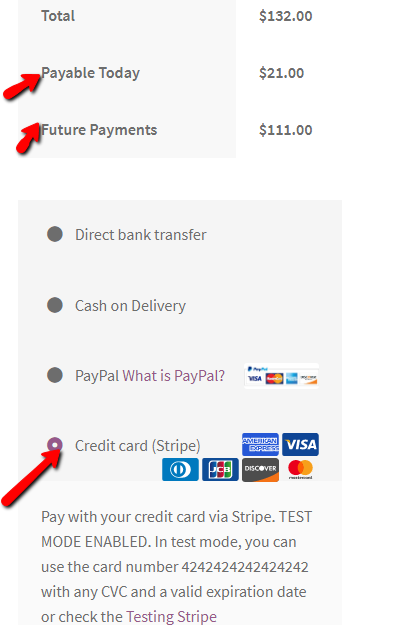
After the order is placed, the customer receives the following order details.
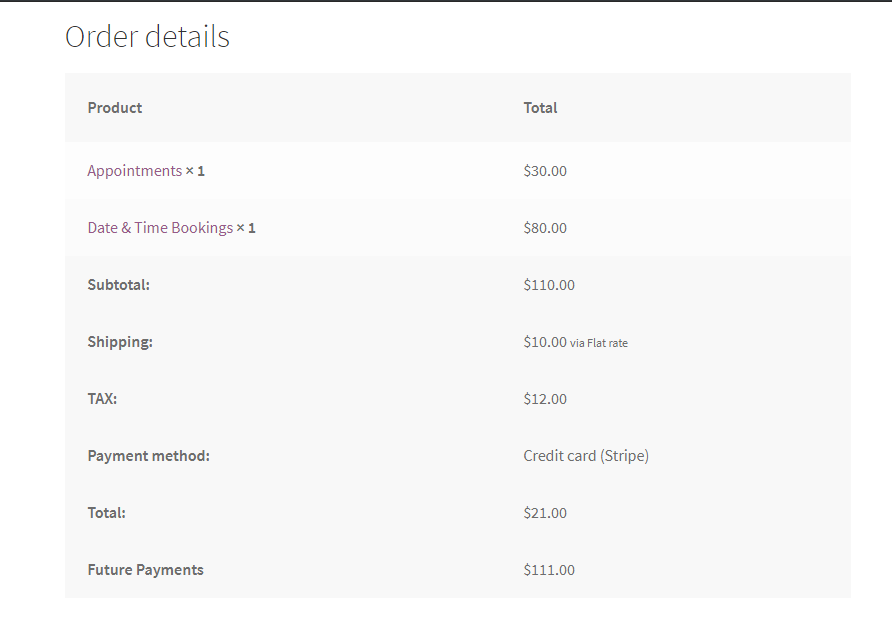
The admin will receive an email of the order confirmation. This order will be reflected on the WooCommerce dashboard under WooCommerce -> Orders. An email is also automatically sent to the customer, confirming their order.
Once you click on the order, you will see that the first invoice is generated.

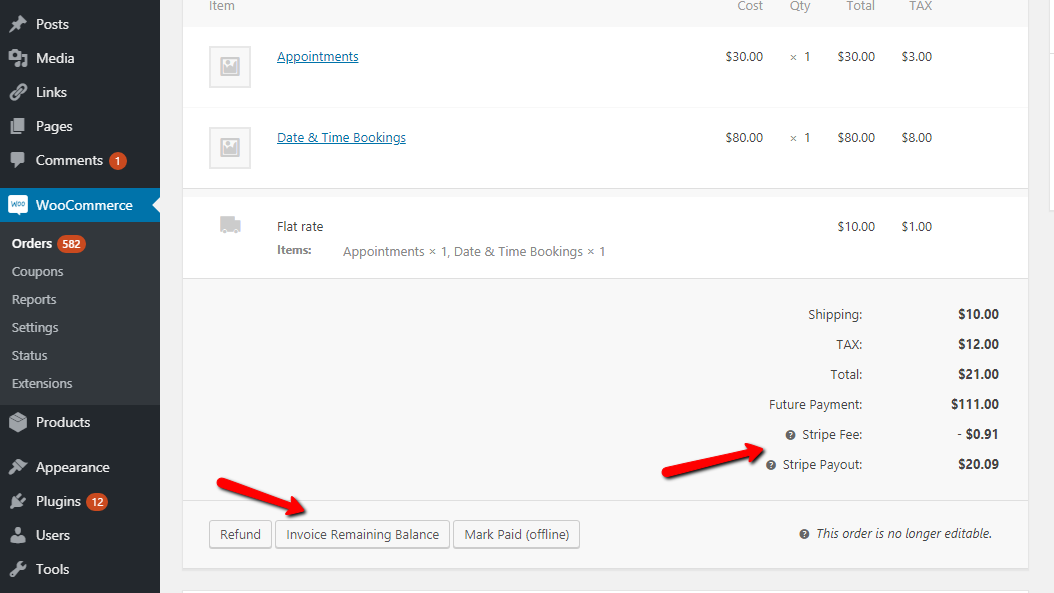
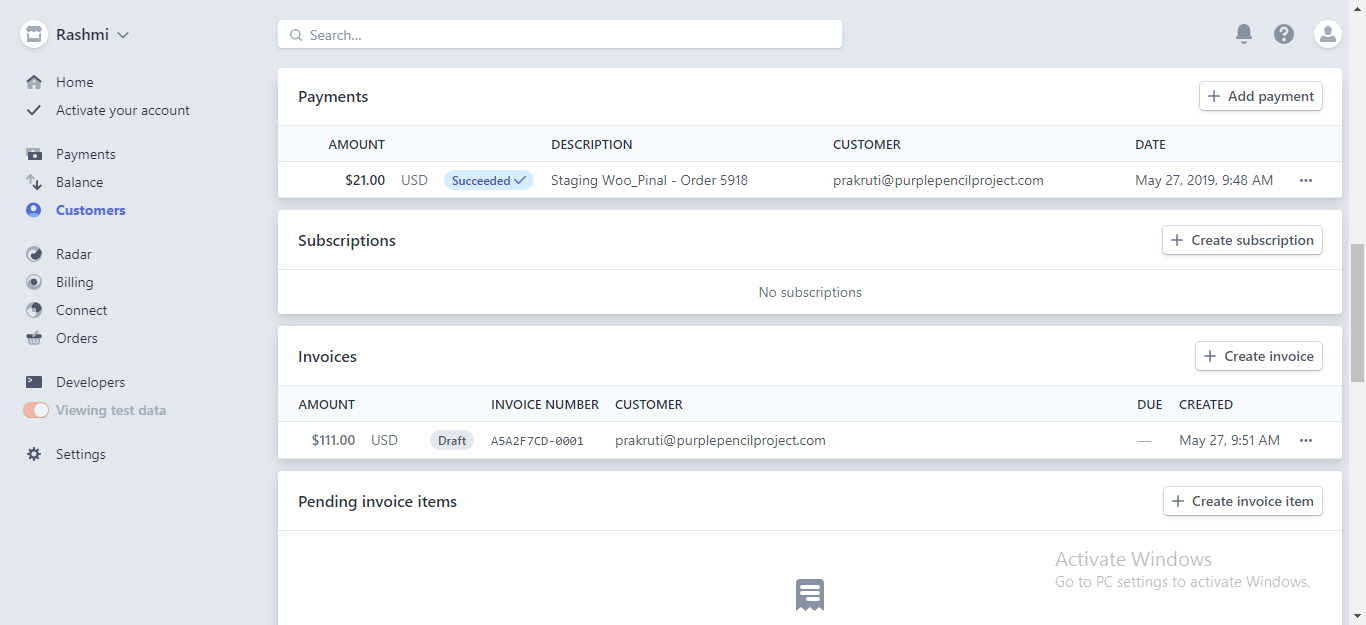
Now, when the admin wants the Future Payment to be charged, they will click on the ‘Invoice Remaining Balance’. An order is generated for the remaining amount with the status Pending Payment. At this point an invoice is also created in Stripe in Draft mode.
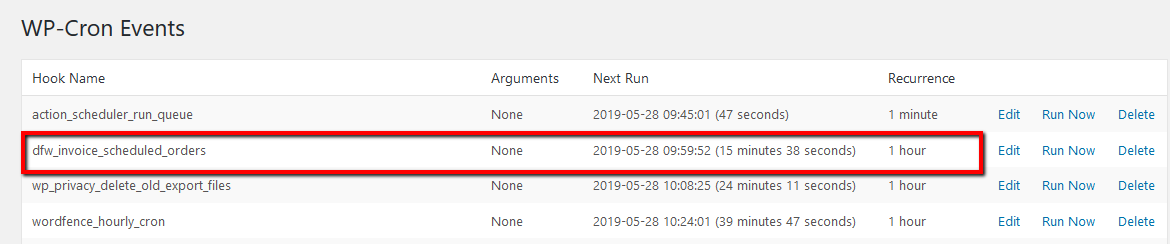
A cron event is run hourly when the automated payments for remaining amounts is enabled. So once the admin has generated an order for the remaining amount, the cron event will open the invoice for payment in Stripe.
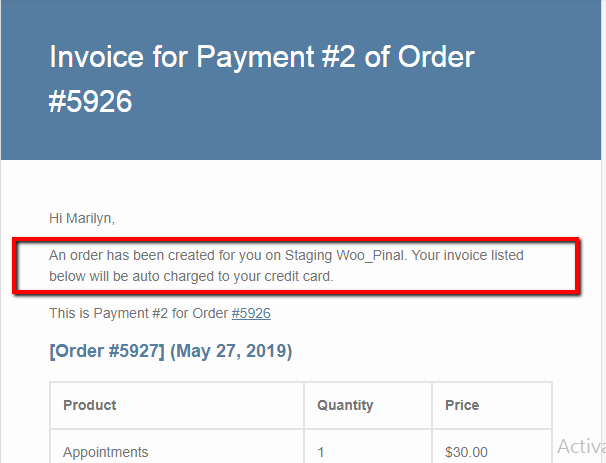
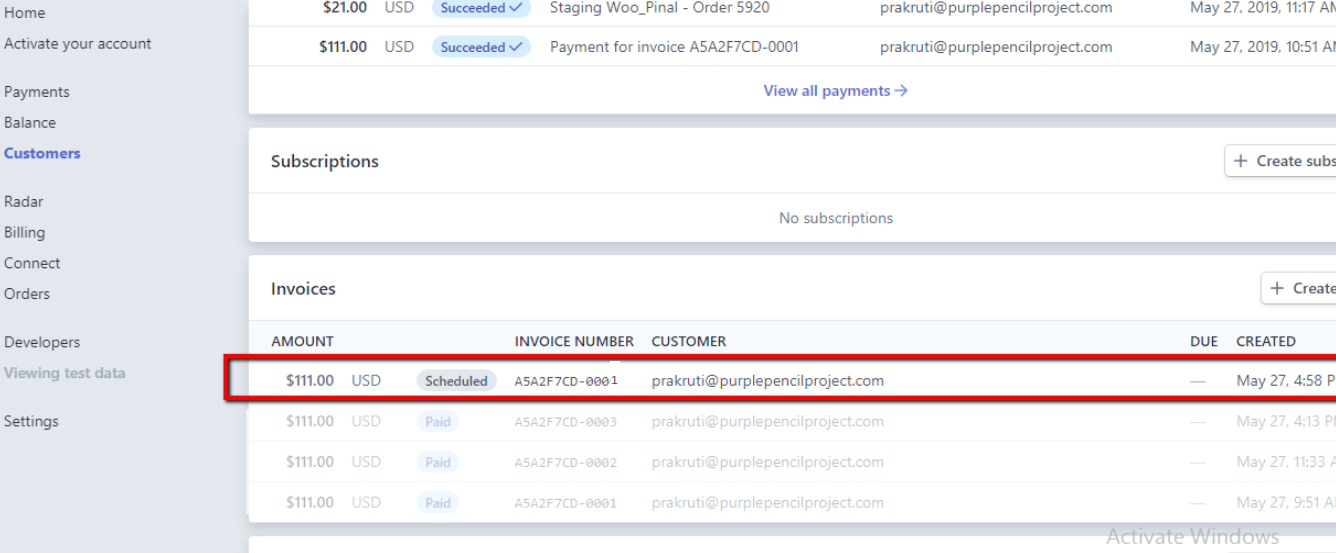
Once the cron is run, the invoice is opened for payment in Stripe. At this stage the invoice status changes from Draft to Scheduled. When the invoice is opened for payment, the customer receives an email confirming that their card will be charged for the remainder payment.
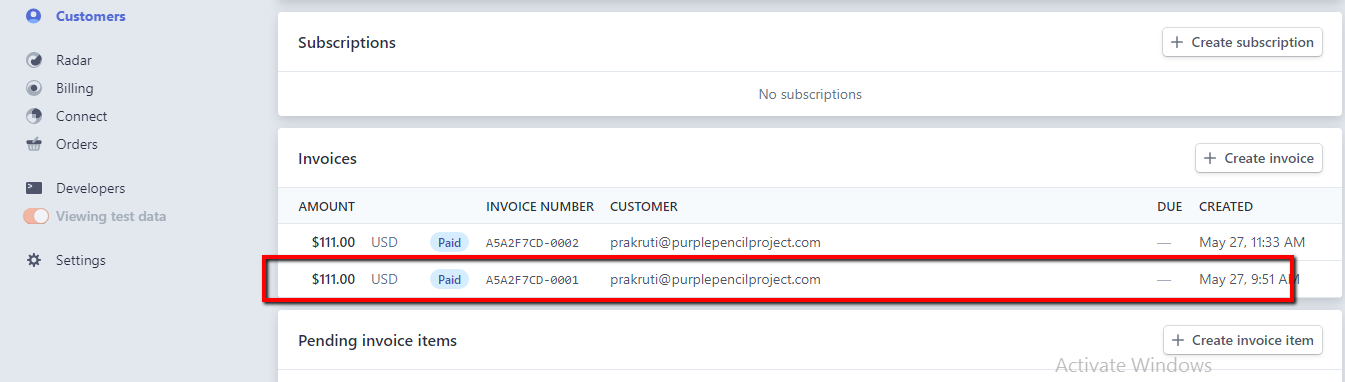
Once Stripe receives the payment (usually takes up to an hour), the invoice status changes from Scheduled to Paid.
Draft changes to Scheduled as shown below.
Scheduled changes to Paid as shown below.
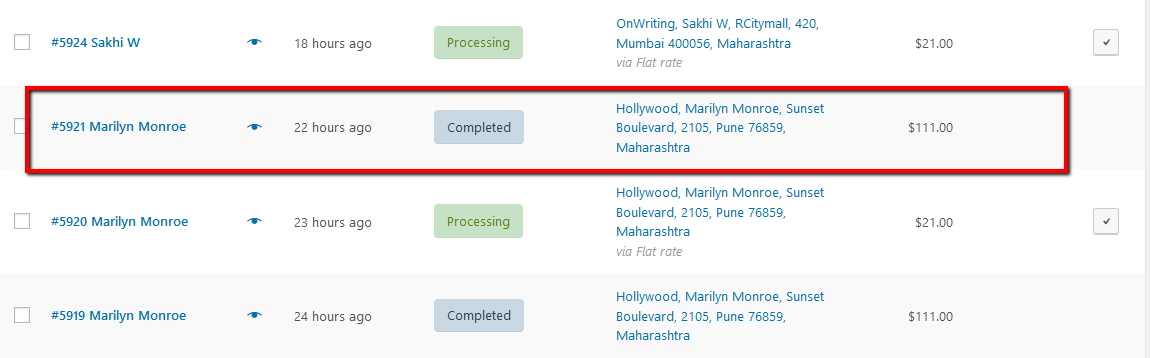
After an invoice is marked as paid in Stripe, the order is marked as Complete in WooCommerce.
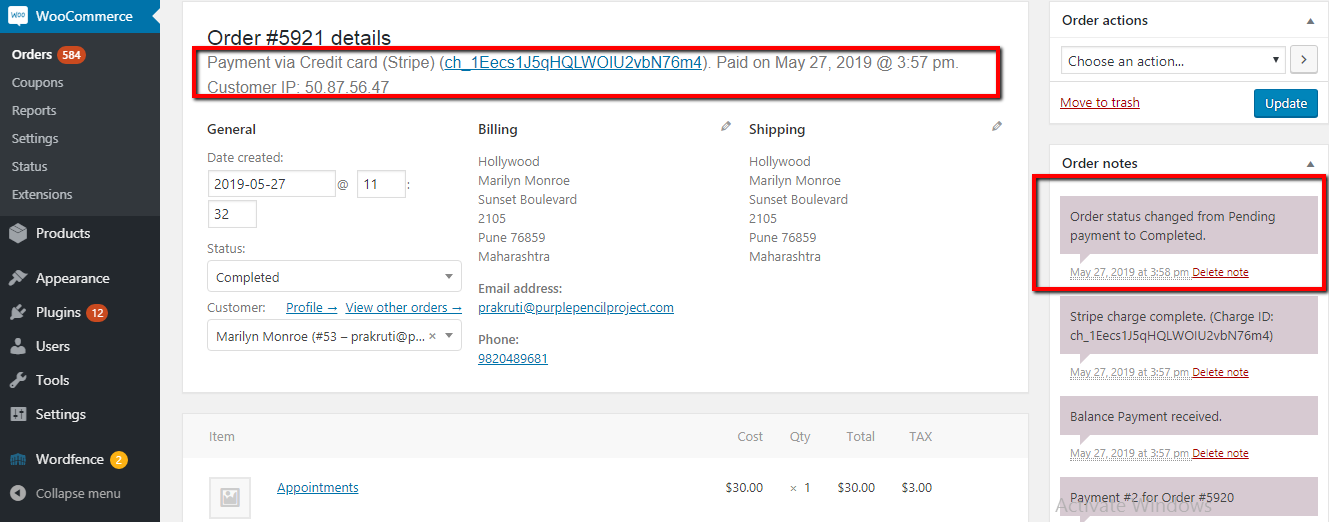
At the same time, the Stripe payment link is added to the order (making it easy for the admin to track the payments). Order notes are also added, stating the same.
When the Default Deposit Type is set to Payment Plans, the admin does not even need to generate the invoice manually. Orders are generated with the status Scheduled in WooCommerce and invoices are also generated in Draft mode automatically. On the date the payment for an invoice is due, it is opened for payment in Stripe by the plugin. No action is needed from the site admin in this process.
Please note: When placing an initial order, customers must select the ‘Save payment information to my account for future purchases’ checkbox to save their card details for future payments.
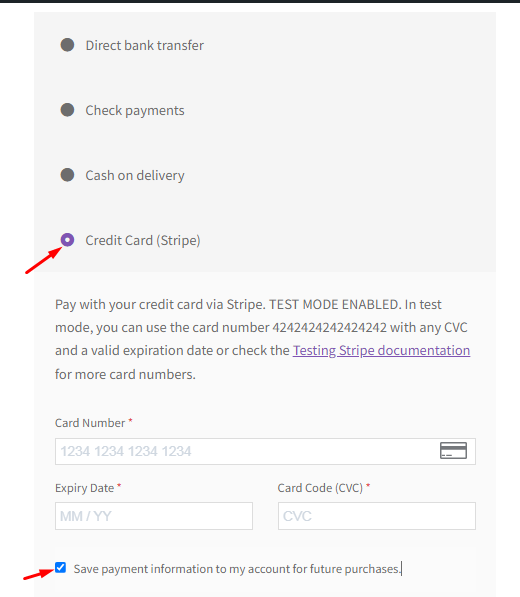
Automatic payments will only occur if this checkbox is enabled during the initial order. If it is not selected, a direct Stripe invoice link will be included in the reminder email for the customer to manually complete the payment of any failed Stripe invoices.
Card Failure
↑ Back to topIf for some reason, either because the customer has discontinued the Credit Card or it has stopped functioning or it has expired, the Stripe payment will be declined when it tried to auto charge. After that, Stripe tries auto collecting the payment for up to three times. Our plugin updates the order with notes on when the next payment is due. After that, the admin may have to reach out to the customer individually for next steps.
Compatibility with Composite & Bundle Products
↑ Back to topDeposits for WooCommerce works with WooCommerce Composite Products and WooCommerce Product Bundles. This lets you collect an upfront payment and schedule the remaining balance for products made up of multiple items.
Let us see how these plugins work together.
Deposits with Composite Products:
↑ Back to topWhen using deposits with a composite product, configure the deposit settings consistently for the main composite product and its component products.
Let us consider a composite product ‘DSLR Kit’ with 2 simple product in it – ‘Lens‘ & ‘Memory Card‘. The DSLR Kit individual price is $1000 with Lens priced at $200 and the memory card is $100 in price.
With composite products, The main product as well as the child products should have the same deposit settings i.e same deposit type as well as amount.
In this example, we have set the deposit to 10% of the total price in all the 3 products.
This is how the product page looks when we select ‘Lens‘:
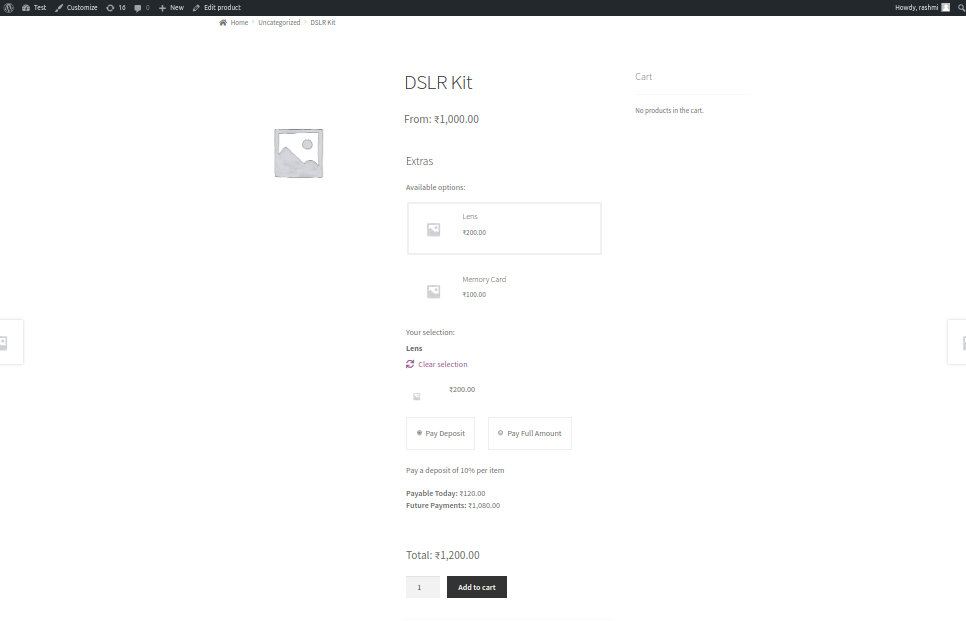
The ‘Payable Today’ & ‘Future Payments’ on the product page displays the amount based on the total composite price.
Cart & Checkout Page:
The cart page displays the subtotal as $120, in which $20 is the deposit for the ‘Lens’ product. As you can see the ‘Future Payments’ is set to $1080.
On the ‘Edit Order’ page, the ‘Invoice Remaining Balance’ will be applied to the main composite product only and not the child products i.e there won’t be separate invoices for all the child products. The invoice will be created for the remaining amount of $1080.
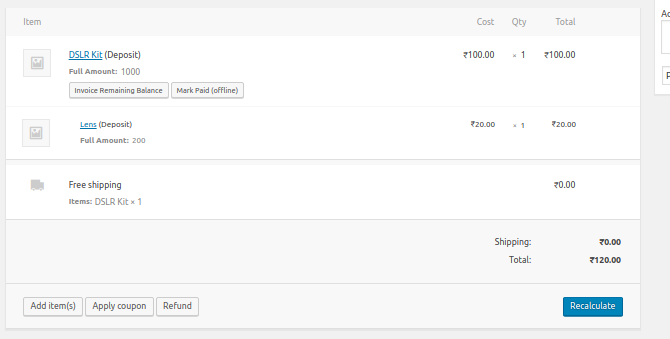
The main thing is that all the products should have the same deposit settings.
Deposits with WooCommerce Product Bundles:
↑ Back to topDeposits can also be used with WooCommerce Product Bundles. The deposit is calculated based on the bundle’s applicable total price.
Configure the deposit settings for the bundle and its bundled products according to your store’s pricing and deposit requirements.
If we take the same setup with the product Bundles plugin, the product page will look like this:
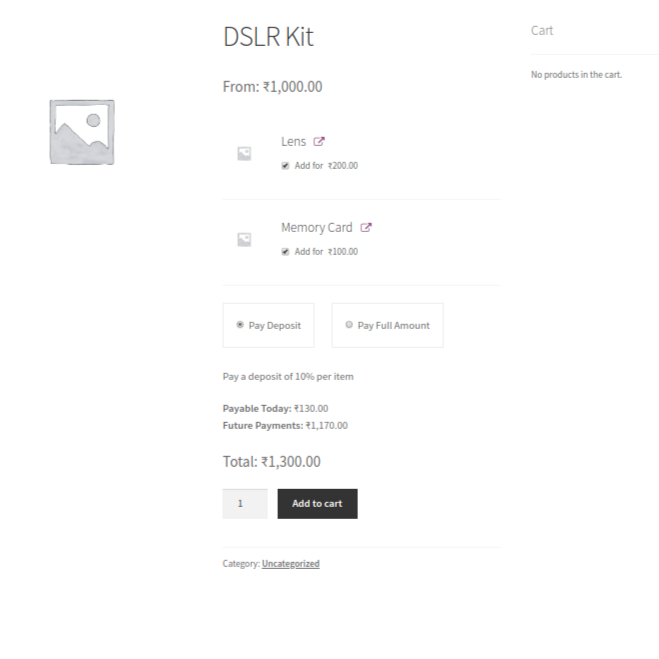
The ‘Payable Today’ is calculated based on the total amount of the bundles. The cart, checkout & order admin behaviour is same as that of the composite products.
Can I allow customers to pay only a deposit instead of the full amount?
Yes. You can configure the product so that only the “Pay Deposit” option is displayed on the product and checkout pages. Customers will not see the option to pay the full amount upfront.
What type of deposits are available?
The plugin allows you to set deposits as a fixed amount, a percentage of the product price, or the order total, or create different payment plans with predefined installment schedules. the Filter section on which the rule should be applied.
Is Deposits for WooCommerce plugin compatible with WooCommerce Bookings and the Booking & Appointment plugin for WooCommerce?
Yes. Deposits for WooCommerce is fully compatible with both the WooCommerce Bookings plugin and Tyche’s Booking & Appointment plugin. This allows you to collect deposits and configure payment plans for bookable products.
Does the WooCommerce Deposits plugin support third-party payment gateway plugins?
Yes, our Deposits for WooCommerce works with all payment gateway plugins to collect the deposit amount. However, if you want the remaining payments to be charged automatically, this feature is officially supported only with the WooCommerce Stripe Payment Gateway plugin.
Does the plugin handle future installment payments automatically?<br>
Yes. If customers choose a payment plan and pay using Stripe, the remaining installments are charged automatically on the scheduled dates.
Will customers automatically receive an email reminder with the invoice for the next installment of a payment plan?
Yes. The plugin automatically sends an email with the invoice for the next installment on the scheduled payment date. This ensures your customers are reminded and can complete the payment on time without any manual follow-up.
Can I disable partial payments for specific products?
Yes. You can enable deposits globally while disabling them for specific products. This allows you to offer deposits on selected items while requiring full payment for others.
Can customers pay a deposit for some products and full payment for others in the same cart?
Yes. The plugin supports mixed carts. Customers can pay a deposit for eligible products while paying the full amount for products where deposits are disabled — all within the same order.
Can I collect a deposit at checkout and charge the remaining amount manually later?
Yes. You can collect a deposit at checkout and allow customers to pay the remaining balance later. The plugin can automatically send reminder emails with a “Pay Now” link, allowing customers to complete the remaining payment at their convenience. You can also manually collect the remaining amount by sharing the payment link with the customer.
Can I configure deposits site-wide?
Yes. You can configure deposits globally so that they apply to all products on your store. You can also choose to override these settings at the product level if needed.
Is Deposits for WooCommerce plugin compliant with GDPR guidelines?
We have made every effort to make our plugin compliant to the GDPR guidelines. As a part of compliance we do not capture any data of end users and customers without consent.
Questions & Support
↑ Back to topHave a question before you buy? Please fill out this pre-sales form.

