
Take complete control of your WooCommerce product display with 20+ sorting options, drag-and-drop ordering, scheduling, role-based sorting, and integrated analytics.
Installation
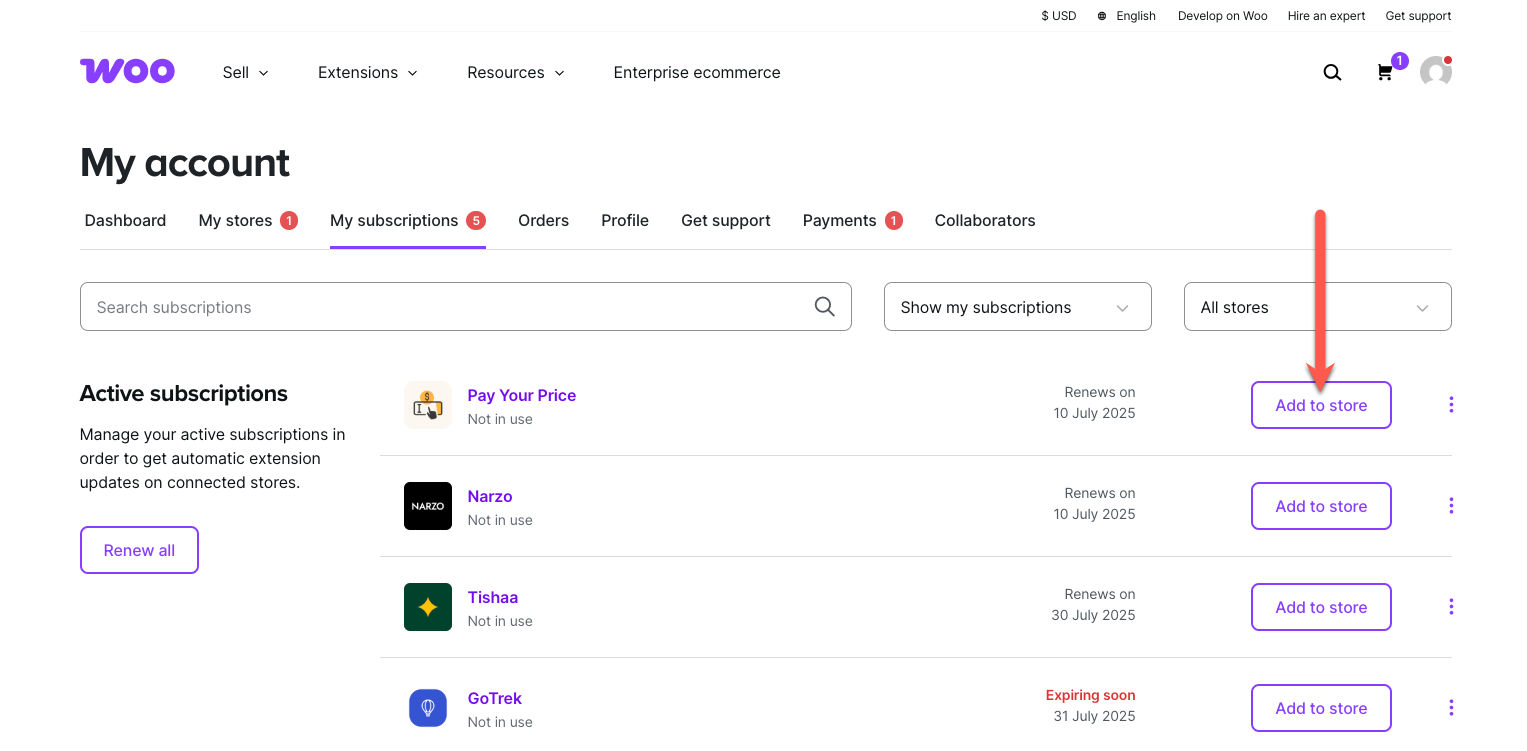
↑ Back to topTo start using a product from WooCommerce.com, you can use the “Add to store” functionality on the order confirmation page or the My subscriptions section in your account.
- Navigate to My subscriptions.
- Find the Add to store button next to the product you’re planning to install.
- Follow the instructions on the screen, and the product will be automatically added to your store.
Alternative options and more information at:
Managing WooCommerce.com subscriptions.
Configuration
↑ Back to topAccessing Settings
↑ Back to topGo to WooCommerce > Settings > Products > Sort Product Catalog to access all configuration options.
Settings Tabs
↑ Back to top| Tab | Purpose |
|---|---|
| General | Enable plugin, set defaults, products per page |
| Sorting Options | Enable/disable and label each sorting option |
| Category Rules | Per-category and per-tag sorting overrides |
| Manual Sorting | Drag-and-drop product ordering |
| Scheduling | Time-based sorting rules |
| User Roles | Role-based sorting defaults |
| Analytics | Sorting usage tracking settings |
| Appearance | Dropdown styling and display |
| Advanced | Debug mode, import/export, data management |
General Settings
↑ Back to top| Setting | Description | Default |
|---|---|---|
| Enable Plugin | Master switch to enable/disable all features | Enabled |
| Default Sort (Desktop) | Default sorting for desktop visitors | Menu Order |
| Default Sort (Mobile) | Different default for mobile (optional) | Same as desktop |
| Products Per Page | Number of products shown per page | 12 |
| Hide Native Dropdown | Remove WooCommerce’s sorting dropdown | No |
| Remember Customer Preference | Save visitor’s sorting choice | Yes |
Sorting Options
↑ Back to topAvailable Options
↑ Back to topSort Product Catalog includes 20+ sorting options:
| Option | Key | Description |
|---|---|---|
| Default | menu_order | WordPress menu order |
| Popularity | popularity | By total sales count |
| Average Rating | rating | By customer review rating |
| Newest | date | Most recent first |
| Oldest | date-asc | Oldest first |
| Price: Low to High | price | Ascending price |
| Price: High to Low | price-desc | Descending price |
| Alphabetical: A-Z | title | Product name A to Z |
| Alphabetical: Z-A | title-desc | Product name Z to A |
| SKU: A-Z | sku | SKU ascending |
| SKU: Z-A | sku-desc | SKU descending |
| In Stock First | stock_status | Available products first |
| By Stock Quantity | stock_quantity | Most stock first |
| On Sale First | on_sale | Sale items prioritized |
| Featured First | featured | Featured products first |
| Biggest Discount First | discount | Highest discount percentage |
| Most Reviewed | review_count | Most reviews first |
| Random | rand | Randomized order |
| Recently Modified | modified | Recently updated first |
| Manual Order | manual | Custom drag-and-drop order |
Managing Sorting Options
↑ Back to top- Go to Sorting Options tab
- Toggle each option on/off using the switch
- Customize the label shown in the dropdown
- Use Enable All or Disable All for bulk actions
- Click Save Changes
Custom Labels
↑ Back to topPersonalize sorting labels to match your brand:
- “Best Sellers” instead of “Popularity”
- “New Arrivals” instead of “Newest”
- “Biggest Savings” instead of “Biggest Discount First”
Category & Tag Rules
↑ Back to topCreate specific sorting rules for individual categories or product tags.
Creating a Category Rule
↑ Back to top- Go to Category Rules tab
- Click Add Category Rule
- Select a Category or Tag
- Choose the Default Sort for that category
- Optionally override Products Per Page
- Click Save Changes
Rule Priority
↑ Back to topWhen a product belongs to multiple categories with rules:
- More specific rules take priority
- Child categories override parent categories
- Tag rules can be configured with custom priority
Examples
↑ Back to top| Category | Default Sort | Products/Page |
|---|---|---|
| Sale | Biggest Discount First | 24 |
| New Arrivals | Newest | 12 |
| Best Sellers | Popularity | 16 |
Manual Product Ordering
↑ Back to topArrange products exactly how you want with drag-and-drop ordering.
Accessing Manual Sorting
↑ Back to top- Go to Manual Sorting tab
- Select the Scope:
- Shop-wide – Applies to all shop pages
- Category – Specific category only
- Tag – Specific tag only
- Products load in a sortable list
Ordering Products
↑ Back to top- Drag and drop products to reorder
- Use Search to find specific products
- Filter by category if needed
- Paginate through large catalogs
- Changes save automatically
How It Works
↑ Back to top- Manual order is stored as product menu_order
- When “Manual Order” sorting is active, products display in your custom sequence
- Works independently per category/tag when scoped
Tips
↑ Back to top- Pin featured products to the top
- Group related products together
- Move slow-moving inventory up for visibility
- Rearrange after restocking
Scheduling
↑ Back to topAutomate sorting changes for promotions, seasons, or special events.
Creating a Schedule
↑ Back to top- Go to Scheduling tab
- Click Add Schedule
- Configure:
- Name – Descriptive title (e.g., “Black Friday Sale”)
- Sorting – Which sorting to apply
- Scope – Shop-wide, category, or tag
- Start Date/Time – When schedule begins
- End Date/Time – When schedule ends
- Recurrence – One-time or recurring
- Priority – Higher number = higher priority
- Click Save
Recurrence Options
↑ Back to top| Type | Description |
|---|---|
| One-time | Runs once between start and end dates |
| Daily | Repeats every day at the same time |
| Weekly | Repeats every week on the same day |
| Monthly | Repeats every month on the same date |
| Yearly | Repeats annually (great for holidays) |
Priority System
↑ Back to topWhen multiple schedules overlap:
- Higher priority number takes precedence
- Equal priority: most recently created wins
- Default sorting applies when no schedule is active
Example Schedules
↑ Back to top| Name | Sorting | Dates | Recurrence |
|---|---|---|---|
| Black Friday | Biggest Discount | Nov 24-27 | Yearly |
| Weekend Features | Featured First | Sat-Sun | Weekly |
| New Month Refresh | Newest | 1st-3rd | Monthly |
| Flash Sale | On Sale First | One-time | One-time |
Role-Based Sorting
↑ Back to topShow different default sorting to different user types.
Configuring Role-Based Sorting
↑ Back to top- Go to User Roles tab
- For each role, select the Default Sorting:
- Administrator
- Shop Manager
- Customer
- Subscriber
- Wholesale Customer (if using wholesale plugin)
- Custom roles
- Set Priority for users with multiple roles
- Click Save Changes
Use Cases
↑ Back to top| Role | Default Sorting | Reason |
|---|---|---|
| Wholesale | Price: Low to High | Cost-focused buyers |
| Customer | Popularity | Social proof browsing |
| Shop Manager | Stock Quantity | Inventory management |
| Guest | Featured First | Highlight key products |
Priority When Multi-Role
↑ Back to topIf a user has multiple roles (e.g., Customer + Wholesale):
- Assign priority numbers to each role
- Highest priority role’s sorting applies
Analytics
↑ Back to topTrack which sorting options your customers use most.
Enabling Analytics
↑ Back to top- Go to Analytics tab or Advanced tab
- Enable Track Sorting Usage
- Analytics begin collecting immediately
Viewing Analytics
↑ Back to top- Go to WooCommerce > Analytics > Sorting Analytics
- Select date range using the date picker
- View data for:
- Shop page sorting usage
- Category pages sorting usage
- Tag pages sorting usage
Analytics Data
↑ Back to top| Metric | Description |
|---|---|
| Page Views | Total views of that page type |
| Sorting Option | Which sort was active |
| Usage Count | How many times that option was used |
| Percentage | Share of total usage |
Using Analytics Data
↑ Back to top- Identify popular sorting preferences
- Set better defaults based on actual usage
- A/B test different default sorting
- Optimize for conversion
Privacy
↑ Back to top- Server-side tracking only (no client scripts)
- No personally identifiable information stored
- Session-based tracking
- Can be disabled anytime
- Compliant with privacy regulations
Appearance Settings
↑ Back to topCustomize how the sorting dropdown looks on your store.
Dropdown Styling
↑ Back to top| Setting | Description |
|---|---|
| Text Before Dropdown | Label shown before dropdown (e.g., “Sort by:”) |
| Text After Dropdown | Text shown after dropdown |
| Show Result Count | Display “Showing X of Y products” |
| Dropdown Width | CSS width value (e.g., 200px, auto) |
Custom CSS
↑ Back to topAdd custom styling in your theme or Customizer:
/* Sorting dropdown container */
.woocommerce-ordering {
    margin-bottom: 20px;
}

/* Dropdown select element */
.woocommerce-ordering select.orderby {
    padding: 10px 15px;
    border-radius: 4px;
    border: 1px solid #ddd;
}

/* Result count text */
.woocommerce-result-count {
    font-size: 14px;
    color: #666;
}
Mobile-Specific Defaults
↑ Back to topOptimize sorting for mobile shoppers with separate defaults.
Why Mobile Defaults?
↑ Back to topMobile users may prefer different sorting:
- Smaller screens favor visual browsing
- Different purchasing behavior
- Touch interface considerations
Configuring Mobile Defaults
↑ Back to top- Go to General tab
- Enable Different Default for Mobile
- Select Mobile Default Sort
- Click Save Changes
Detection Method
↑ Back to topMobile detection uses WordPress’s wp_is_mobile() function:
- Tablets may be detected as mobile
- Based on user agent
- Server-side detection (no JavaScript)
Customer Preference Memory
↑ Back to topRemember each visitor’s preferred sorting option.
How It Works
↑ Back to top- Customer changes sorting on your shop
- Preference is saved to their browser (localStorage)
- On next visit, their preferred sorting is automatically applied
- Works for both guests and logged-in customers
Enabling/Disabling
↑ Back to top- Go to General tab
- Toggle Remember Customer Preference
- Click Save Changes
Technical Details
↑ Back to top- Uses browser localStorage
- No server-side storage for guests
- Logged-in users can optionally save to user meta
- Clears when browser data is cleared
Import/Export Settings
↑ Back to topBackup and migrate your configuration easily.
Exporting Settings
↑ Back to top- Go to Advanced tab
- Click Export Settings
- A JSON file downloads with all settings:
- General settings
- Sorting options
- Category rules
- Schedules
- Role-based sorting
- Appearance settings
Importing Settings
↑ Back to top- Go to Advanced tab
- Click Import Settings
- Select a previously exported JSON file
- All settings are restored
- Reload the page to see changes
What’s Included
↑ Back to top| Included | Not Included |
|---|---|
| All plugin settings | Analytics data |
| Category rules | Manual product orders |
| Schedules | Transients/cache |
| Role sorting config |
Elementor Integration
↑ Back to topSort Product Catalog works with Elementor product widgets.
Supported Widgets
↑ Back to top- Products widget
- Archive Products widget
- WooCommerce Products widget (Pro)
- Loop Grid with products
How It Works
↑ Back to topThe plugin hooks into Elementor’s query system:
elementor/query/{query_id}filterelementor_pro/products/queryfilter
Your sorting rules automatically apply to Elementor product displays.
Configuration
↑ Back to topNo special configuration needed. Just:
- Set up your sorting rules normally
- Elementor widgets will respect those rules
- Category-specific rules apply when viewing categories
Troubleshooting
↑ Back to topSorting Not Working
↑ Back to top- Check plugin is enabled – General tab > Enable Plugin
- Check sorting option is enabled – Sorting Options tab
- Clear caches – Plugin cache, page cache, browser cache
- Check for conflicts – Disable other sorting plugins
- Enable debug mode – Advanced tab for error logging
Manual Order Not Applying
↑ Back to top- Ensure “Manual Order” sorting is enabled in Sorting Options
- Verify products were reordered in Manual Sorting tab
- Check if category rule is overriding shop-wide order
- Clear all caches
Schedule Not Activating
↑ Back to top- Verify start/end dates are correct
- Check timezone settings in WordPress
- Ensure schedule is enabled (not paused)
- Check priority if other schedules overlap
- Verify WordPress cron is working
Analytics Not Showing Data
↑ Back to top- Ensure analytics tracking is enabled
- Visit shop pages to generate data
- Check date range includes recent visits
- Verify WooCommerce Analytics is accessible
Theme Compatibility
↑ Back to topIf sorting dropdown doesn’t appear:
- Theme must use
woocommerce_catalog_orderbyhook - Check theme isn’t removing the hook
- Contact theme developer if needed
FAQ
↑ Back to topHow many sorting options are available?
↑ Back to topSort Product Catalog includes 20+ sorting options, more than any other solution. This includes unique options like “Biggest Discount First” (discount percentage).
Can I use different sorting for different categories?
↑ Back to topYes! Use the Category Rules tab to set specific default sorting for any category or product tag.
Does it work with WooCommerce Blocks?
↑ Back to topYes, the plugin is fully compatible with WooCommerce’s block-based shop templates and archive pages.
Will it slow down my site?
↑ Back to topNo. All sorting is applied at the database query level, not in PHP. This ensures optimal performance with no additional load time.
Can wholesale customers see different sorting?
↑ Back to topYes! Use the User Roles tab to configure different default sorting for any user role, including wholesale roles from plugins like B2B plugins.
How does scheduling work with overlapping times?
↑ Back to topWhen multiple schedules overlap, the one with the highest priority number takes precedence. You can set priority when creating each schedule.
Is analytics GDPR compliant?
↑ Back to topYes. Analytics tracking is server-side only, stores no personally identifiable information, and can be disabled anytime. The plugin integrates with WordPress’s Privacy Policy Guide.
Can I hide the sorting dropdown?
↑ Back to topYes. Enable “Hide Native Dropdown” in General settings to remove WooCommerce’s sorting dropdown while still applying your default sorting rules.
Does it work with Elementor?
↑ Back to topYes, Sort Product Catalog is fully compatible with Elementor’s product widgets, including the Pro Products widget and Loop Grid.
Can customers save their preference?
↑ Back to topYes. Enable “Remember Customer Preference” to save each visitor’s sorting choice in their browser. It will be applied automatically on their next visit.
How do I backup my settings?
↑ Back to topUse the Export function in the Advanced tab to download all settings as a JSON file. Import the file on another site or after reinstalling.
What happens when I uninstall?
↑ Back to topBy default, settings are preserved. Enable “Remove Data on Uninstall” in Advanced settings if you want all data deleted when uninstalling.

