
Hide Prices & Private Store for WooCommerce allows your WooCommerce store to hide prices, hide all products, enable quote requests, and show different content to different users.
Installation
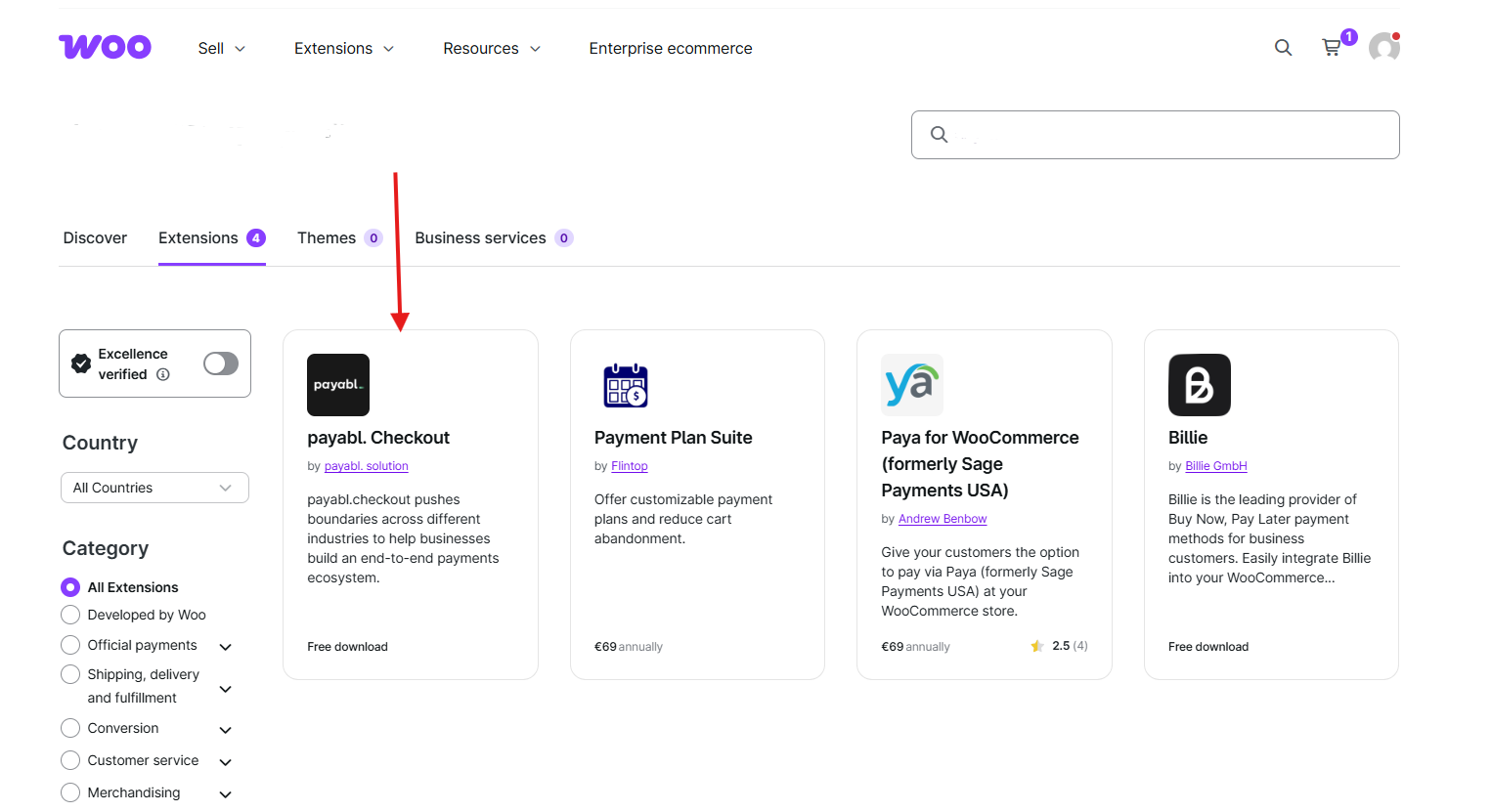
↑ Back to topTo start using a product from WooCommerce.com, you can use the “Add to store” functionality on the order confirmation page or the My subscriptions section in your account.
- Navigate to My subscriptions.
- Find the Add to store button next to the product you’re planning to install.
- Follow the instructions on the screen, and the product will be automatically added to your store.
Alternative options and more information at:
Managing WooCommerce.com subscriptions.
Setup and Configuration
↑ Back to topAfter installing and activating “Hide Prices & Private Store for WooCommerce” (see how to install and activate extensions), you will see a new “Private Store” menu item where plugin settings are controlled.
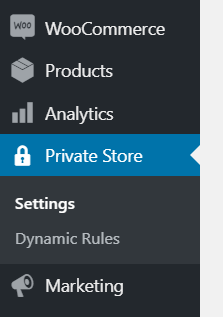
- Go to: Private Store > Settings
- Under Main Settings > Guest Access Restriction, choose one of the four options available:
- Hide prices
- Hide shop & products
- Hide website & force login
- Request quotes instead of price
Read below for an explanation of what each of these options does.
1. Main Options Explained
↑ Back to topThere are four main options available in Private Store > Settings > Guest Access Restriction. All these options control what logged out users will see. To hide prices for logged in users or another category of users, please read section 2 of the documentation.
If you’re not sure which approach fits your store, this overview of the different ways of hiding prices in WooCommerce compares them, including when quote requests are a better fit.
The four options are:
Hide prices
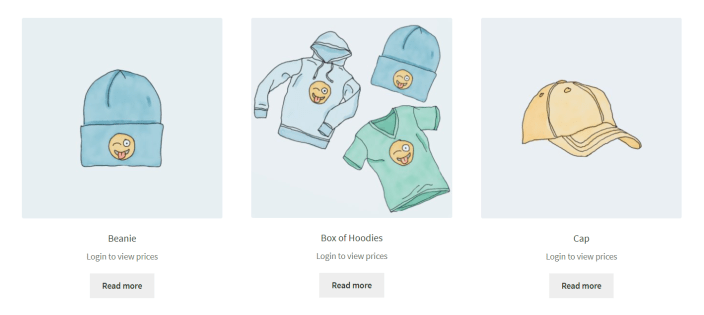
This option replaces prices with a configurable text (defaults to “Login to View Prices”). It also hides the “Add to Cart” button, preventing users from purchasing items.
Hide shop & products
This option prevents users from accessing the store without first logging in or registering an account. Logged out users will not be able to see any products. Instead, they see a login and registration form with a configurable message (defaults to “Please login to access the B2B Portal”). For the registration form to appear, customer registration must be enabled in the account creation settings in WooCommerce.

Hide website & force login
This option completely hides the website, only showing a login form. Since this option does not allow registration, it is suitable only for private membership sites or intranets, where login credentials are given to each user by store managers.
Request quotes instead of price
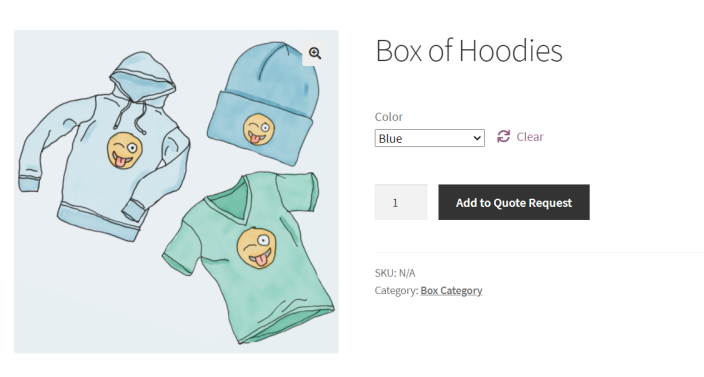
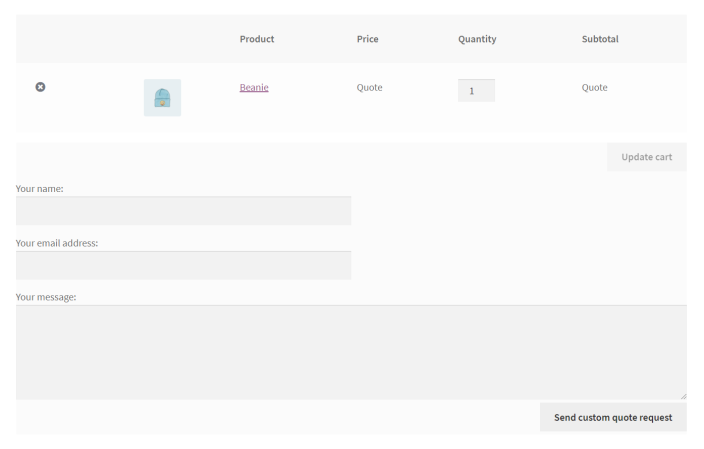
This option replaces the standard WooCommerce cart page with a Quote Basket and replaces the “Add to Cart” button with an “Add to Quote Request” button. Customers can then request quotes by filling in a form, which notifies the store via email.
2. Dynamic Rules
↑ Back to topThe dynamic rules functionality allows you to:
- Hide prices for specific categories
- Hide prices for specific items
- Hide prices by country and by user role
- Enable quote requests for specific roles or categories of users
Hiding prices through dynamic rules also removes the “Add to Cart” button, and replaces the price with a configurable text (defaults to “Login is Unavailable”).
To create a dynamic rule, go to Private Store > Dynamic Rules and publish the rule after choosing your desired options. You can create multiple rules, for example one that hides prices for a category and another that enables quote requests for a group of users.
Here are a few examples to illustrate how this functionality can be used:
Example 1
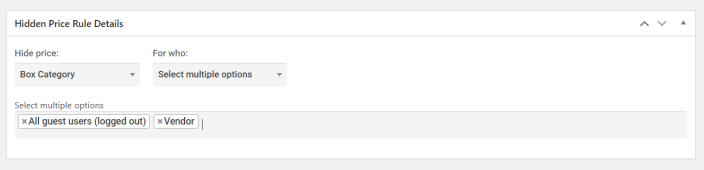
In the example above, all items in the “Box Category” have prices hidden for guest users, and for users with the role “Vendor”.
Example 2
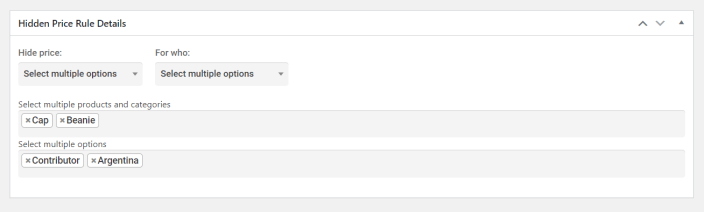
In the example above, prices for the items “Cap” and “Beanie” are hidden for all users with the role “Contributor” and all users that have an Argentina-based IP address.
To learn how to use Dynamic Rules to enable quote requests, read the next section of the documentation.
3. Quote Request System
↑ Back to top3.1 How to enable Quote Requests for a user or category of users
↑ Back to topTo enable quote requests for logged out users:
- Go to Private Store > Settings > Main Settings, and choose “Request quotes instead of price”
To enable quote requests for any other category, user, role, or country:
- Go to Private Store > Dynamic Rules, and create a “Quote Request System” rule.
Example 1: Enabling quote requests for logged in users
You would create a dynamic rule with the configuration below:

Example 2: Enabling quote requests for a combination of options
You could create a dynamic rule with the configuration below:
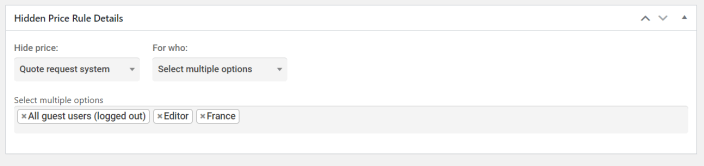
The configuration above would enable quote requests for all logged out users, for all users with the role “editor”, and for all users with a French IP address.
3.2 How the Quote Request System works and its effects
↑ Back to topThe quote request system has the following effects:
- It replaces the “Add to Cart” button with an “Add to Quote Request” button
- It replaces the Cart with a Quote Basket
- It hides prices
- It enables a customizable Quote Request Form
- It sends email notifications to a quotes inbox address to notify the shop of the request
3.3 Quote Request Text Settings
↑ Back to topThrough quote request settings, the website manager can control the quote inbox email address, as well as what fields make up the quote request form.
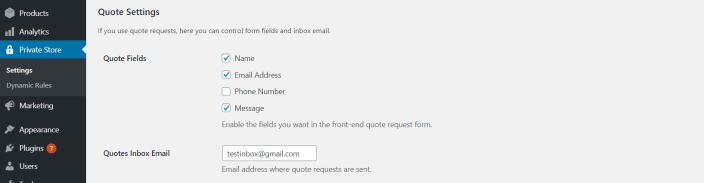
By enabling and disabling checkboxes for “Quote Fields”, you can control which fields are available in the quote request form, with 4 options:
- Name
- Email Address
- Phone Number
- Message
The Quotes Inbox Email setting controls which email address quote requests are sent to. If quote requests don’t arrive, the cause is usually your site’s email delivery rather than the plugin; see troubleshooting WooCommerce emails.
4. Content Restriction Shortcode
↑ Back to topThis feature allows you to show different content to different users by wrapping it inside a shortcode. This should work everywhere in the frontend area of the site, including pages, posts, and product descriptions.
To use the shortcode, simply wrap your content (text, images or anything else) in the following way:
[hppsw_content show_to=]Your content here[/hppsw_content]
The parameter show_to is required, and it supports the following options:
- loggedin
- loggedout
- user roles (e.g: editor, administrator, reseller)
- usernames (e.g: john.mike23, companyllc10)
Here are a few usage examples to illustrate the functionality:
Example 1
[hppsw_content show_to=reseller]Minimum order quantity is 100[/hppsw_content]
[hppsw_content show_to=vendor]Minimum order quantity is 200[/hppsw_content]
In this example, customers with the user role “reseller” would see 100, while customers with the user role “vendor” would see 200 instead.
Example 2
[hppsw_content show_to=loggedout,companyllc10]Content here…[/hppsw_content]
In this example, the content would only be visible to logged out users, and to the user “companyllc10”. All other users would not see it.
Example 3
[hppsw_content show_to=loggedin]Private membership content here…[/hppsw_content]
In this example, this content would be hidden from guest users and only visible to users that are logged in.
FAQs
↑ Back to topWhat themes will this plugin work with?
↑ Back to topThe plugin should work with all themes, and has been tested with the most popular themes on the market today.
Registration is not visible when using “Hide shop & products”
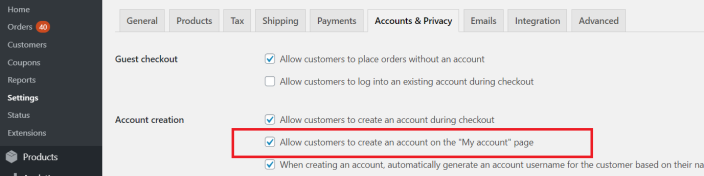
↑ Back to topIn order to see the Registration section, you must enable the following setting:
WooCommerce > Settings > Accounts & Privacy > Allow customers to create an account on the “My account” page
Logged out visitors can still see prices
↑ Back to topIf prices remain visible after enabling one of the options above, a cached version of the page is usually being served. Clear your caching plugin and any server or CDN cache, and make sure pages are not cached in a way that ignores whether the visitor is logged in.

