Conditional Checkout Fields & Edit Checkout Fields for WooCommerce, by FMEAddons, adds and controls checkout fields without code. It provides 26 field types, per-field fees, conditional rules based on cart subtotal, cart total, shipping method, payment method, or the value of another checkout field, visibility rules based on product, category, tag, or user role, repeat rules that duplicate a field for every item ordered, and custom checkout sections. It works on the classic checkout and on the Cart and Checkout Blocks, and is compatible with HPOS and Multisite.
Published by FMEAddons on the WooCommerce Marketplace.
Block Checkout and HPOS Compatibility
↑ Back to topThe Checkout Field Editor plugin is fully compatible with WooCommerce Cart and Checkout Blocks. WooCommerce core supports four additional checkout field types on the Cart and Checkout Blocks: text, select, checkbox, and date. Conditional visibility is available from WooCommerce 9.9.0 and has to be written as JSON Schema rules in PHP.
Conditional Checkout Fields adds the remaining 21 field types to the block checkout, including textarea, radio, multi-select, file upload, time, and colour, and lets you set every rule from the admin screen instead of in code. Custom fields are fully supported in the Billing, Shipping, and Additional sections.
The plugin is compatible with High Performance Order Storage (HPOS) and with Multisite.
Installing the Conditional Checkout Fields & Edit Checkout Fields Plugin
↑ Back to topInstall the Conditional Checkout Fields plugin from your WooCommerce account. Follow these steps:
- Download Conditional Checkout Fields & Edit Checkout Fields for WooCommerce from your account and save the .zip file.
- Go to WordPress Admin > Plugins > Add New, upload the .zip file, and install.
- After installation completes, activate the plugin and proceed to configuration.
What Conditional Checkout Fields Plugin does
↑ Back to top- Add custom fields.
- Add custom sections.
- Add and customize default billing fields.
- Add and customize default shipping fields.
- Display conditions.
- Add Pricing.
Configuration
↑ Back to topFrom your store’s WP Admin dashboard, navigate to WooCommerce > Settings > Conditional Checkout Fields for WooCommerce to configure the settings of the plugin.
Checkout Sections
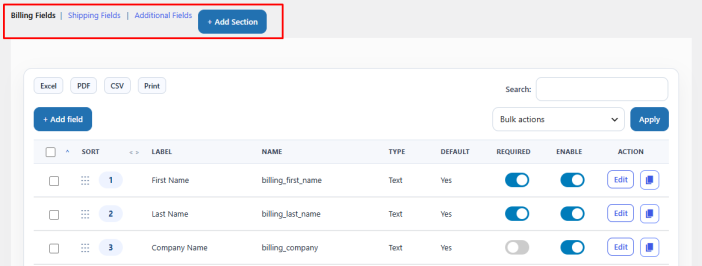
↑ Back to topThe Checkout Field Editor plugin lets you add and manage custom fields across four checkout sections:
- Billing: Add new custom fields or edit the default WooCommerce billing fields.
- Shipping: Add custom fields to the shipping section on the checkout page.
- Additional: Customise fields in the additional information section.
- New Section: Create entirely new custom sections with configurable positioning.
26 Custom Checkout Field Types
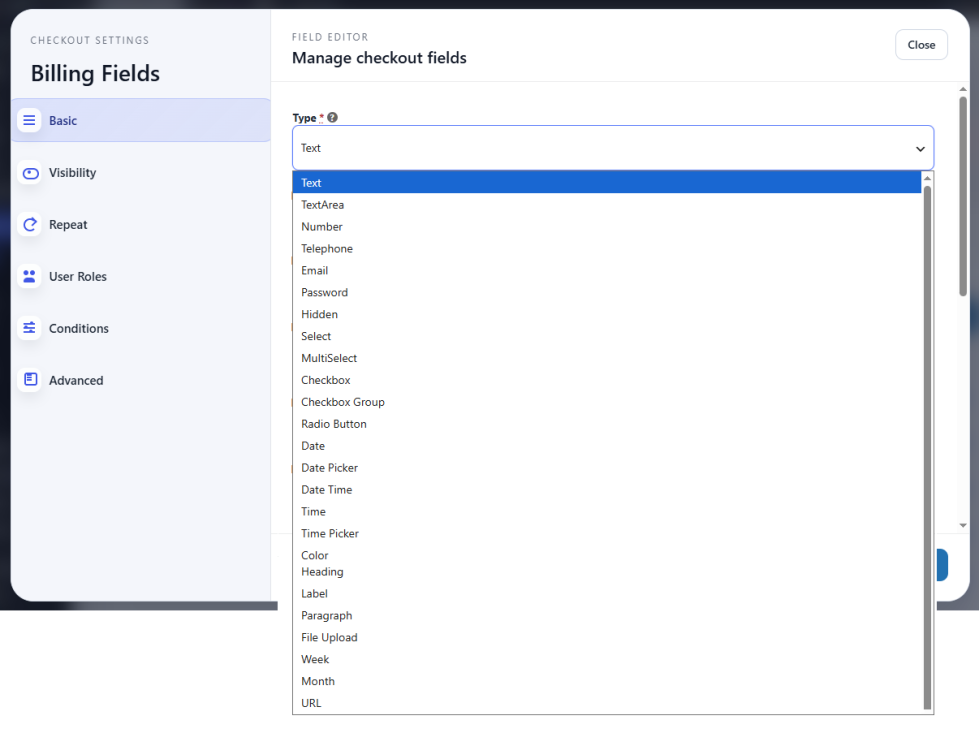
↑ Back to topThe plugin supports 26 field types for collecting information from customers at checkout:
- Text
- TextArea
- Number
- Telephone
- Password
- Hidden
- Select
- MultiSelect
- Checkbox
- Checkbox Group
- Radio Button
- Date
- Date Picker
- Date Time
- Time
- Time Picker
- Color
- Heading
- Label
- Paragraph
- File Upload
- Week
- Month
- URL
- VAT Number
How to Charge a Fee for a Checkout Field?
↑ Back to topThe Conditional Checkout Fields plugin allows you to attach a fee to any custom checkout field. When a customer fills in or selects a field that has a price assigned, that amount is automatically added to the order total. This is useful for add-on services at checkout, such as:
- Gift wrapping: a checkbox that adds a flat fee to the order
- Priority handling: a select field where different options carry different fees
- Custom engraving: a text field that charges per personalised item
- Extended warranty: an optional field that adds a fixed amount
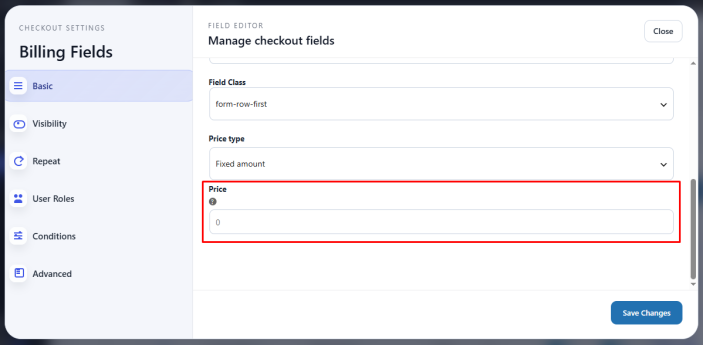
To set a price for a field, enter the amount in the Price field under Basic Settings when adding or editing a custom field. Enable Repeat Price to charge the fee once per cart item when the repeat field feature is active.
To make the fee taxable, enable the Taxable option under Visibility Settings.
Adding Custom Fields to the Checkout Page
↑ Back to topClick on the specific checkout section tab to customize fields in that section. Here, you can add new custom fields to the checkout or edit the default fields in the section. You can enable or disable each field from the list, make any field required, and duplicate any field with a single click along with all settings.
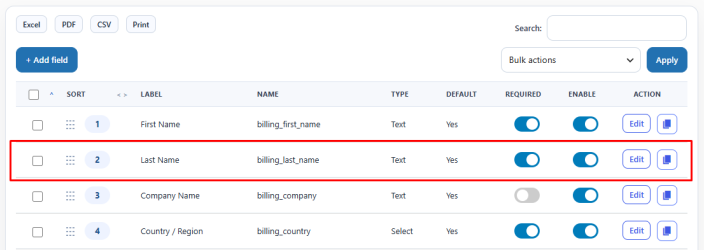
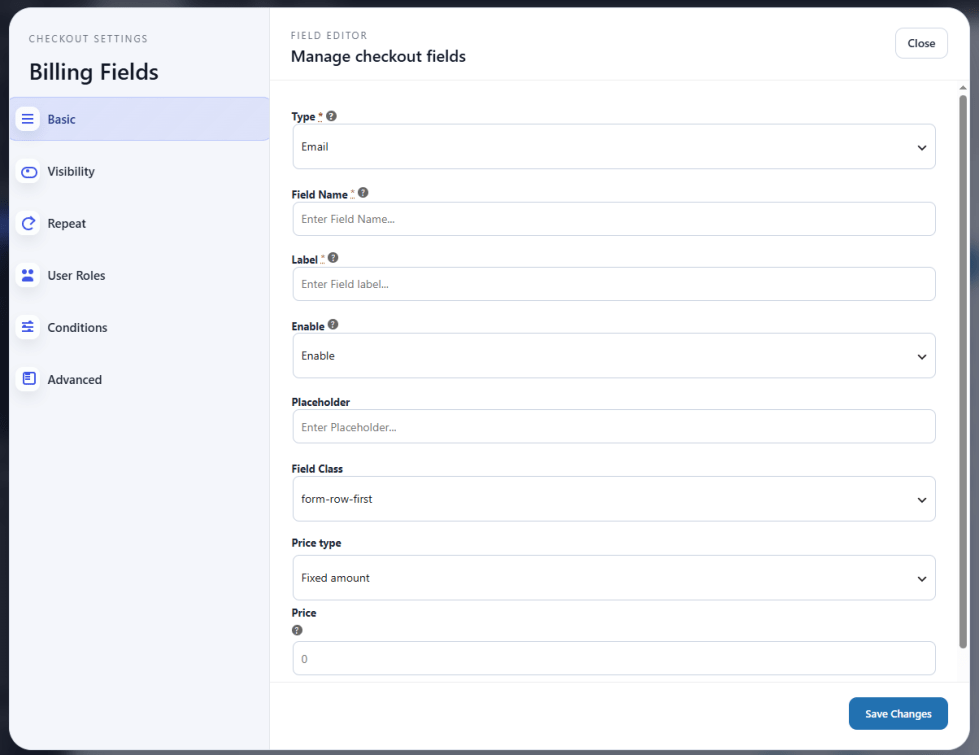
Click “Edit” to customize the default field, or click “Add Field” to add a new custom field. You can configure the following settings for each new field:
Basic Settings
↑ Back to top- Type: Choose the type of field you want to add to the checkout page. You can select between 25 different field types.
- Field Name: Set the name for the field.
- Label: Enter a label for the custom field.
- Enable: Enable or disable the field.
- Placeholder: Set a placeholder for the field.
- Field Class: Set the field class for the row. You can choose between the following:
- Form-row-first
- Form-row-last
- Form-row-wide
- Price Type: Choose the price type for the specific field. You can choose between the following types:
- Fixed Amount
- Percentage of Cart Total
- Percentage of Subtotal
- Percentage of Subtotal (ext. tax)
- Dynamic
- Price: Set a price for the custom checkout field.
- Validation: The Validation Rule dropdown assigns a built-in format rule, a global regex rule, or a confirm-field rule to the field. Selecting None leaves email, phone, URL, and password field types on their automatic built-in format rules; assigning a rule replaces those defaults. Only one rule can be assigned per field, and validation rules are mutually exclusive with an input mask; if a mask is set, format is enforced by the mask only. Once a rule is assigned, a summary confirms what it does, for example: “This field must match Email Address (billing_email — billing). Error Message: Email Address not Valid.”
Confirm rules compare this field’s value to the source field defined in the rule. Assign confirm rules on the re-enter field, for example, Confirm Email, not on the original field.
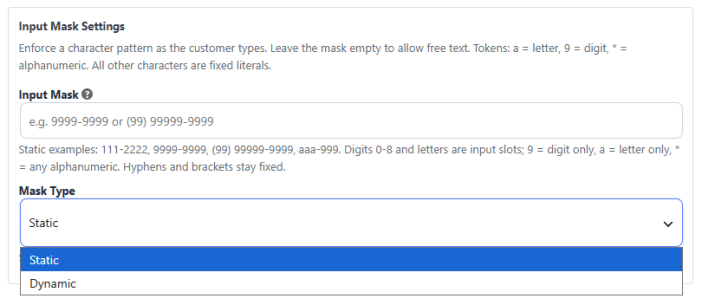
Mask Input for Text and Telephone Fields
Enforce a character pattern as the customer types. Leave the mask empty to allow free text. Tokens: a = letter, 9 = digit, * = alphanumeric. All other characters are fixed literals. Set the masking type as static or dynamic.
International Phone for Telephone Fields
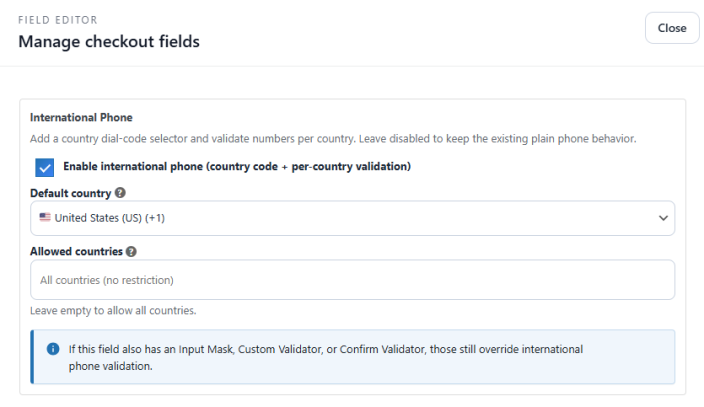
↑ Back to topAdd a country dial-code selector to a Telephone field and validate the number against the rules of the selected country. These settings appear only when the field Type is set to Telephone. Leave the option disabled to keep the plain phone behaviour. Configure the following:
- Enable international phone (country code + per-country validation): Turns the dial-code selector on for this field.
- Default Country: The country selected when the field first loads, for example, United States (US) (+1).
- Allowed Countries: Restrict the selector to chosen countries. Leave empty to allow all countries.
Note: If the same field also has an Input Mask, a Custom Validator, or a Confirm Validator assigned, those take precedence and international phone validation does not run.
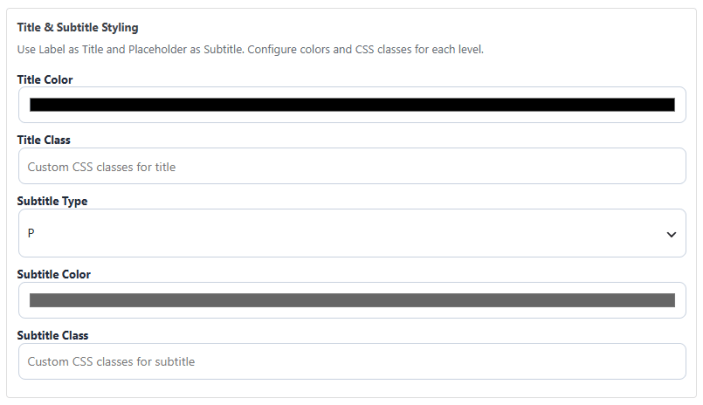
Customization for Heading, Label, and Paragraph Fields
Extensive personalization for the headings, labels, and paragraph fields. You will have the following additional options:
- Title Color
- Title Class
- Subtitle Type
- Subtitle Color
- Subtitle Class
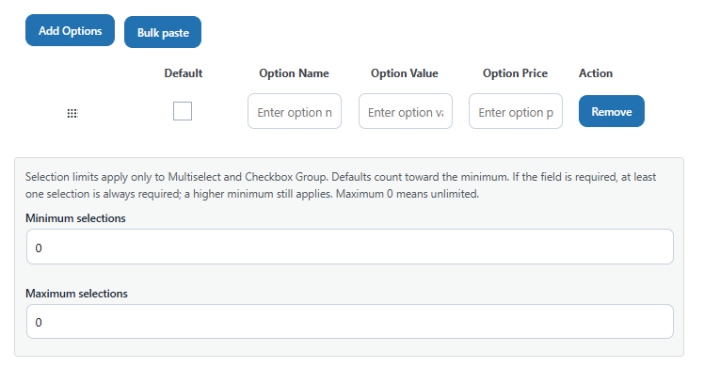
Selection Limits for Multiselect and Checkbox Group
↑ Back to topControl how many options a customer can choose for Multiselect or Checkbox Group fields.
- Minimum Selections: The fewest options a customer must choose. Set to 0 for no minimum.
- Maximum Selections: The most options a customer can choose. Set to 0 for unlimited.
Options set as Default count toward the minimum. If the field is Required, at least one selection is always needed, and a higher minimum still applies on top of that.
VAT Number Field Type with Country-Aware EU Format Validation
↑ Back to topAdd VAT number field to your checkout page. The field validates EU VAT numbers against each country’s format, and can optionally verify them with VIES and apply reverse-charge tax exemption on cross-border B2B orders.
- Require Country Prefix: The customer must include the two-letter country code, for example DE123456789. Leave it disabled to accept the number without a prefix.
- Restrict to Specific EU Countries: Show the field only when the billing country matches one of the countries you select. Leave empty to show it for all EU countries.
- Enable VIES Verification: Check the number against the EU’s official VIES service.
- Require Valid VIES Result to Complete Checkout: The order cannot be placed unless VIES confirms the number. Leave this disabled, and VIES downtime will never block checkout.
- Automatic Reverse-Charge Tax Exemption: Remove VAT from the order when the conditions below are met.
Reverse charge applies only when VIES returns a verified result, the billing country differs from the store country, and both are in the EU. Domestic orders are never exempted.
Option Manager for Select/Radio/Multiselect/Checkbox Group
↑ Back to topEasily add and manage the choices a customer selects from, set their order, and give any of them a price.
Click Add Options to add an option row. Each row has:
- Default: Pre-select this option on the checkout page. Select and Radio Button accept one default. Multiselect and Checkbox Group accept several.
- Option Name: The label the customer sees.
- Option Value: The value saved to the order.
- Option Price: A fee added to the order when the option is selected. Leave empty for no charge.
- Action: Click Remove to delete the row.
Drag the handle on the left of any row to reorder options. The order you set here is the order customers see.
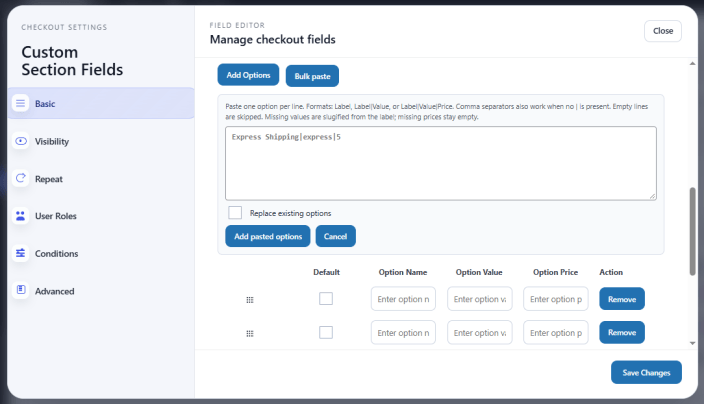
Bulk paste
Click Bulk paste to add many options at once. Enter one option per line in any of these formats:
- Label
- Label|Value
- Label|Value|Price
For example, Express Shipping|express|5 creates an option labelled Express Shipping with the value express and a price of 5.
How to Show a Field Only for Certain Products, Categories, or Roles
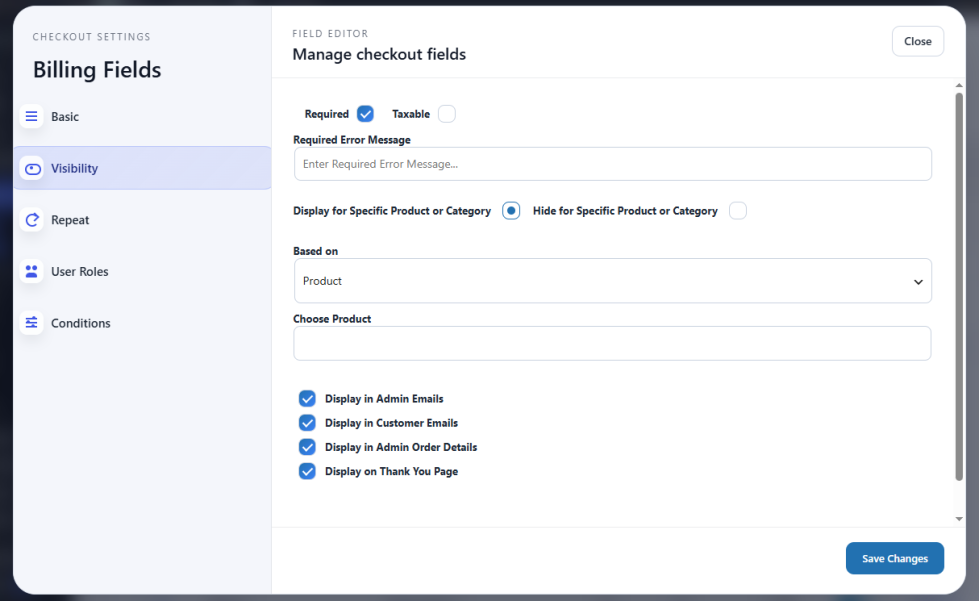
↑ Back to top- Required: Make the field mandatory.
- Required Error Message: Enter the error message for the required field.
- Taxable: Click the checkbox to make the field taxable.
- Display/Hide for Specific Product or Category or Tag: Hide or display the field for a specific product, category, or tag.
- Based On: Choose if you want to hide based on product, category, or tag.
- Choose Product/Category/Product Tag: Choose the product, category, or tag based on which you want to hide or display the field.
- Display in Admin Emails: Check to display the field in admin emails.
- Display in Customer Emails: Check to display the field in customer emails.
- Display in Admin Order Details: Check to display the field in Admin order details.
- Display on Thank You Page: Check to display the custom field on the Thank You page.
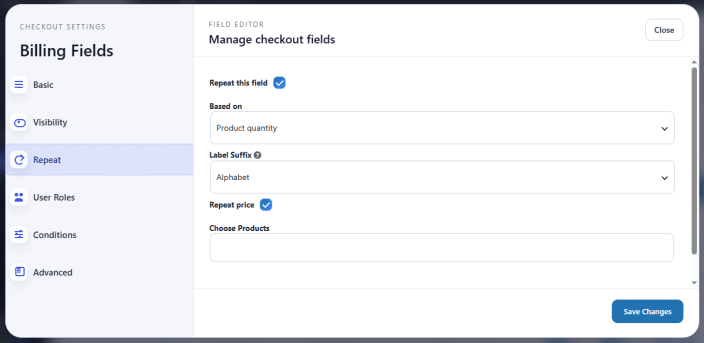
Repeat Field Settings
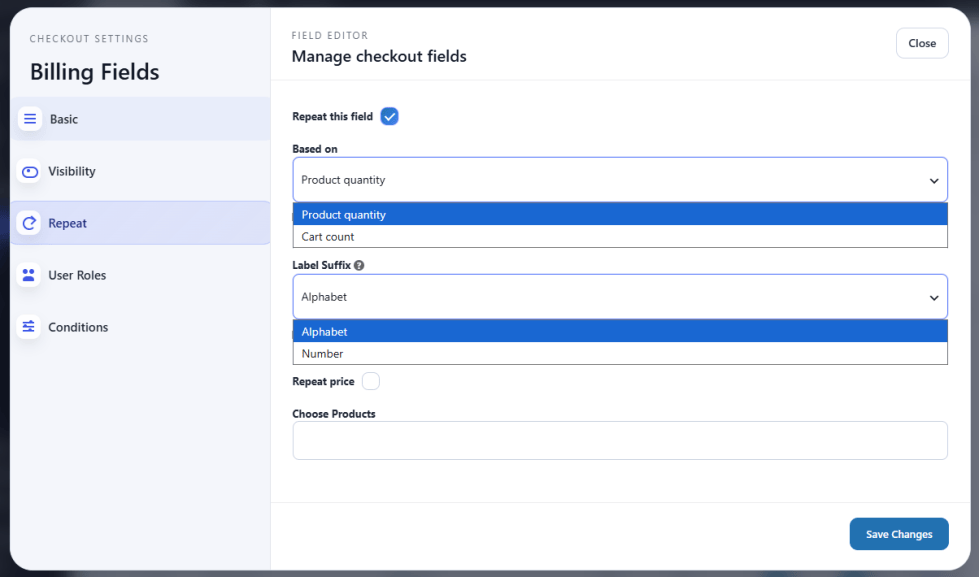
↑ Back to top- Repeat this Field: Click the checkbox to repeat the field.
- Based on: Select based on what condition you want to repeat the field. You can choose between the following:
- Product Quantity
- Cart Count
- Label Suffix: Choose the label suffix for the repeating field. You can select as:
- Alphabet
- Number
- Repeat Price: Click the checkbox if you want to repeat the price as well.
- Choose Products: Choose the product (s) based on which you want to repeat the field.
User Roles Settings
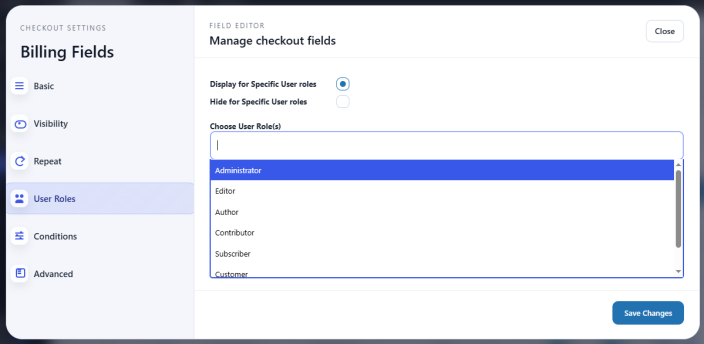
↑ Back to top- Display for Specific User Roles: Check if you want to display the field for specific user roles.
- Hide for Specific User Roles: Click the checkbox if you want to hide the field for specific user roels.
- Choose User Role(s): Choose the user role(s) for which you want to hide or display the custom checkout field.
How to Show or Hide a Field Based on a Condition
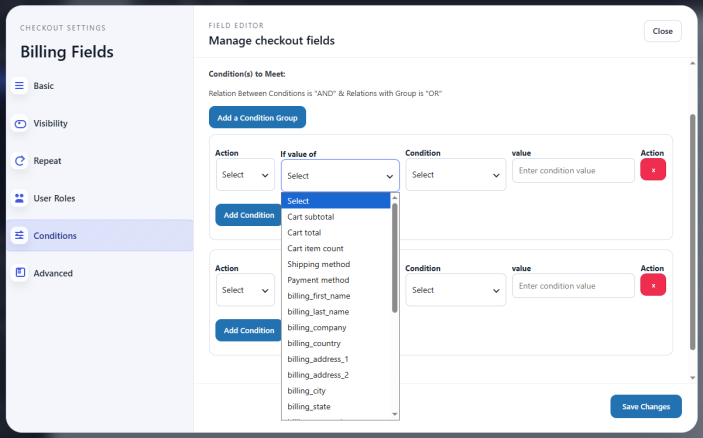
↑ Back to topApply conditional logic to checkout fields and control the display of fields based on different conditions. Click on “Add a Condition Group” and configure conditional logic. The plugin uses “AND” and “OR” conditions.
Note: The relation Between Conditions is “AND,” & Relations between Groups is “OR”. In the case of “AND”, all conditions must be true. In the OR condition, if any operation is true, the expression will be true.
Create conditional fields based on the following configuration:
- Action: Choose if you want to “Show” or “Hide” the field based on the condition.
- If Value of: Choose the value for which you want to apply the condition rule. You can choose any of the fields (custom or default) to apply the condition, or you can choose the following values:
- Cart Subtotal
- Cart Total
- Shipping Method
- Payment Method
- Choose any of the checkout fields
- Condition: Choose the condition that you want to apply to the value. You can choose between the following:
- Is empty
- Is not empty
- Is equal to
- Is greater than
- Is less than
- Is not equal to
- Is checked
- Value: Enter the value to match the condition.
You can follow the same configuration for adding custom fields to the billing, shipping, and additional sections on the checkout page.
Advanced Settings
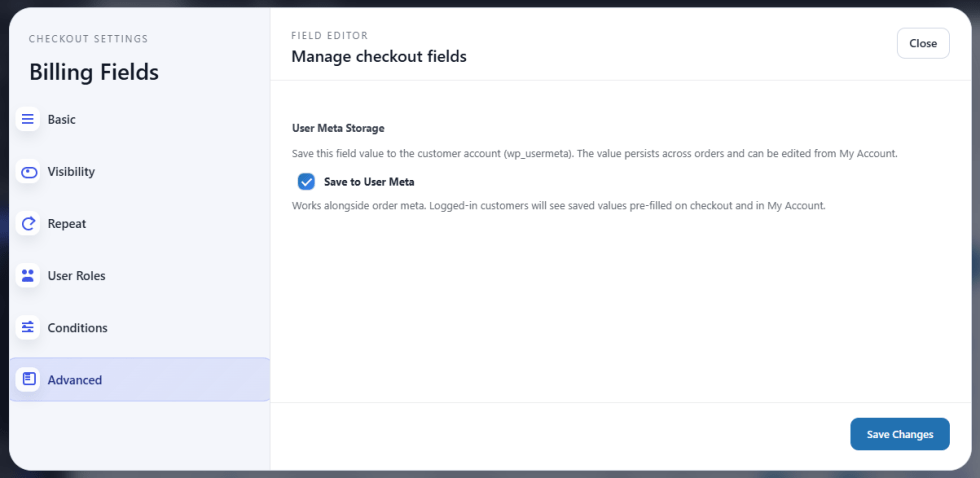
↑ Back to topSave values to customer accounts and pre-fill on future orders. The value persists across orders and can be edited from My Account.
Common Use Cases
↑ Back to topThe following examples show how store owners use the Checkout Field Editor to handle real checkout scenarios.
Gift Wrapping Fee
↑ Back to topAdd a Checkbox field labelled “Gift Wrapping” with a price of $5. Under Visibility Settings, set Display/Hide for Specific Product or Category to show the field only when a gift-eligible product is in the cart. Customers who check the box are charged $5 automatically.
B2B VAT Number Collection
↑ Back to topAdd a Text field labelled “VAT Number” and use Visibility Settings to show it only when a business or wholesale product is in the cart. Use User Roles Settings to display it only for the Wholesale user role. Leave it optional or mark it Required depending on your tax requirements.
Per-Item Personalisation
↑ Back to topAdd a Text field labelled “Engraving Text” and enable Repeat this Field with Based On set to Product Quantity. Select the relevant product under Choose Products. The field will appear once for each unit ordered, allowing customers to provide individual text for each item.
Wholesale-Only Checkout Fields
↑ Back to topAdd fields for purchase order numbers, payment terms, or delivery instructions. Under User Roles Settings, set Display for Specific User Roles and choose the Wholesale role. These fields remain hidden from retail customers entirely.
Conditional Delivery Time Slot
↑ Back to topAdd a Time field labelled “Preferred Delivery Time.” Under Conditional Logic Settings, set the condition to show the field only when the Shipping Method is equal to your delivery shipping option. The field is hidden for customers who select standard shipping or local pickup.
Adding New Section to the Checkout Page
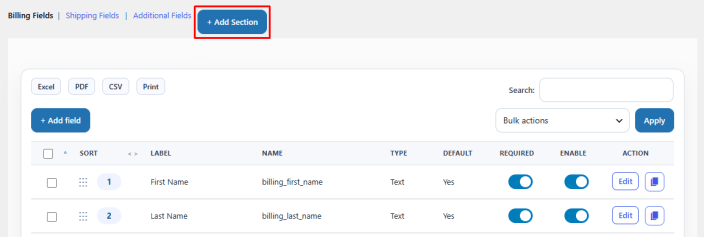
↑ Back to topThe Checkout Field Editor allows you to create entirely new sections on the checkout page with a custom title, position, and fields. Navigate to the New Section tab and click Add Section to configure:
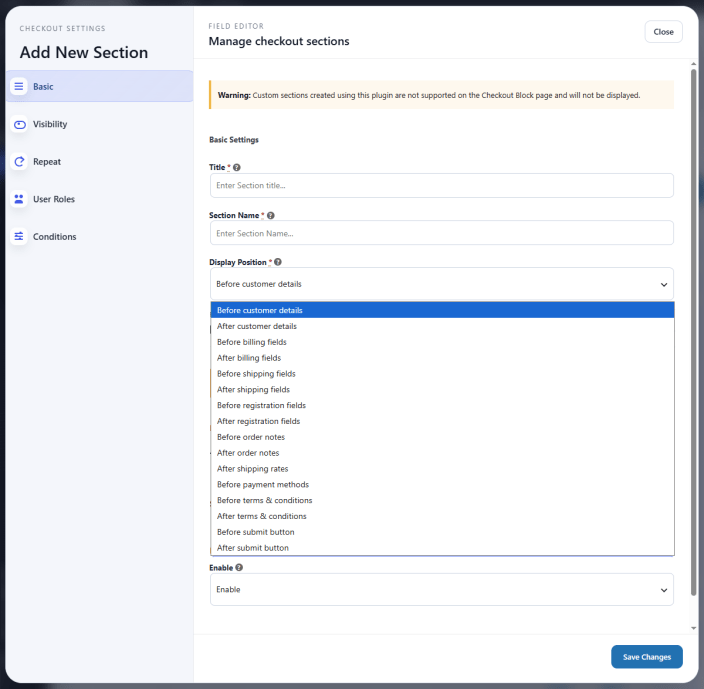
Warning: Custom sections created using this plugin are not supported on the Checkout Block page and will not be displayed.
Basic Settings
↑ Back to top- Title: Add the title for the custom section.
- Section Name: Enter a name for the checkout section.
- Display Position: Choose the display position for the custom section. You can choose between the following options:
- Before Customer Details
- After Customer Details
- Before Billing Fields
- After Billing Fields
- Before Shipping Fields
- After Shipping Fields
- Before Registration Fields
- After Registration Fields
- Before Order Notes
- After Order Notes
- After Shipping Rates
- Before Payment Methods
- Before Terms & Conditions
- After Terms & Conditions
- Before Submit Button
- After Submit Button
- Enable: Enable or disable the custom checkout section.
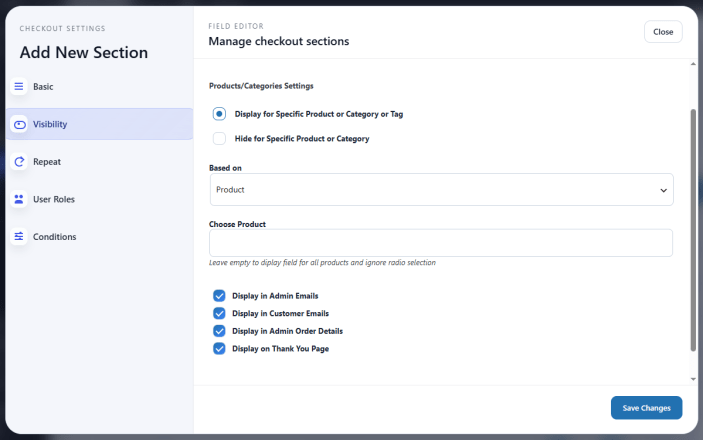
Visibility Settings
↑ Back to top- Display/Hide for Specific Product or Category: Hide or display the section for specific products or categories.
- Based on: Choose whether to apply visibility settings based on products or categories.
- Choose Product/Category: Select the product or category for which you want to show or hide the section.
- Display in Admin Emails: Check to display the section details in admin emails.
- Display in Customer Emails: Check to display the section details in customer emails.
- Display in Admin Order Details: Check to display the section details in Admin order details.
- Display on Thank You Page: Check to display the custom section on the Thank You page.
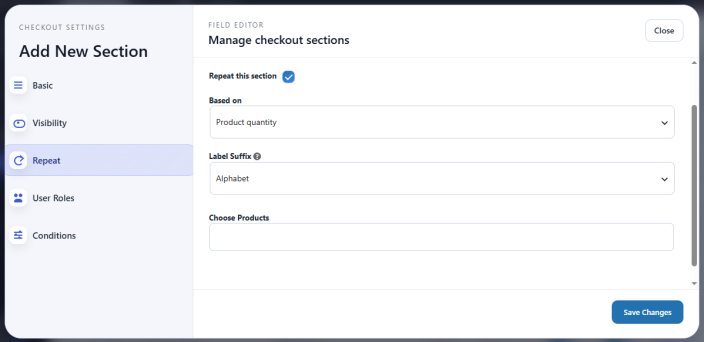
Repeat Section Settings
↑ Back to top- Repeat this Section: Click the checkbox to repeat the section.
- Based on: Select the condition based on which you want to repeat the section. You can choose between the following:
- Product Quantity
- Cart Count
- Label Suffix: Choose the label suffix for the repeating section. You can select:
- Alphabet
- Number
- Choose Products: Choose the product(s) based on which you want to repeat the section.
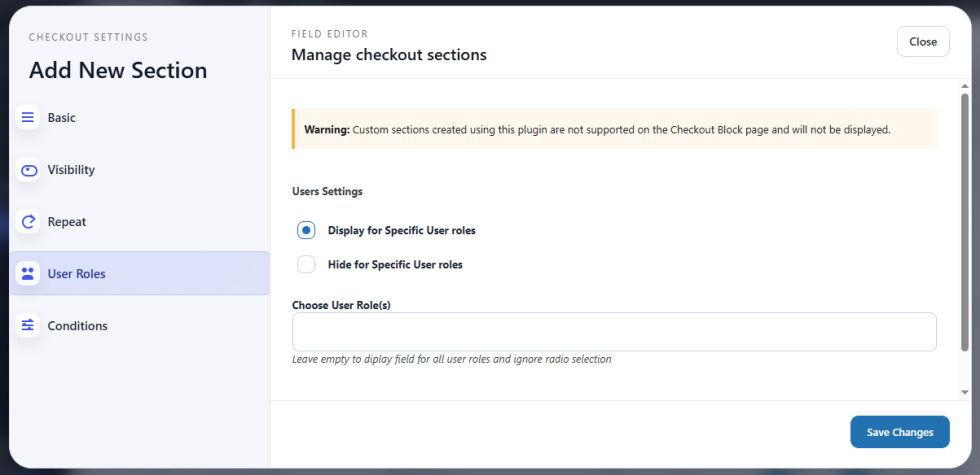
User Roles Settings
↑ Back to top- Display for Specific User Roles: Check if you want to display the section for specific user roles.
- Hide for Specific User Roles: Click the checkbox if you want to hide the section for specific user roles.
- Choose User Role(s): Choose the user role(s) for which you want to hide or display the custom section.
Conditions Logic Settings
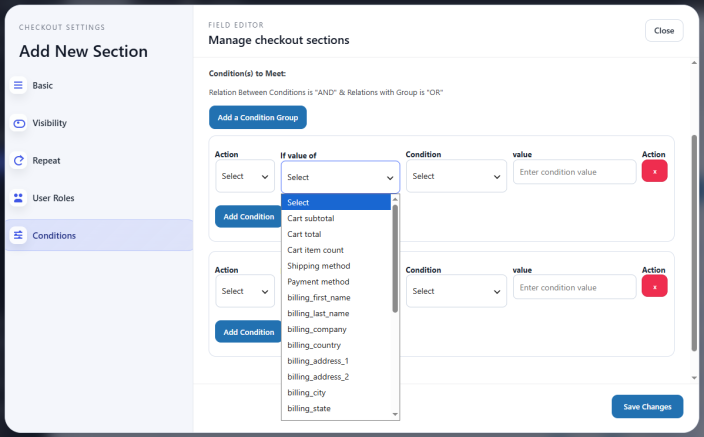
↑ Back to topApply conditional logic to sections and control the display of sections based on different conditions. Click on “Add a Condition Group” and configure the conditional logic. The plugin uses “AND” and “OR” conditions.
Note: The relation between conditions is “AND,” and the relation between groups is “OR.” In the case of “AND”, all conditions must be true. In the case of “OR”, if any condition is true, the expression will evaluate as true.
Create conditional sections based on the following configuration:
- Action: Choose whether you want to “Show” or “Hide” the section based on the condition.
- If Value of: Choose the value for which you want to apply the condition rule. You can select any section (custom or default) to apply the condition, or choose from the following values:
- Cart Subtotal
- Cart Total
- Cart Item Count
- Shipping Method
- Payment Method
- Choose any of the checkout fields (Default or Custom)
- Condition: Choose the condition you want to apply to the value. You can select from the following:
- Is empty
- Is not empty
- Is equal to
- Is greater than
- Is less than
- Is not equal to
- Is checked
- Value: Enter the value to match the condition.
Search, Export, or Print Checkout Fields
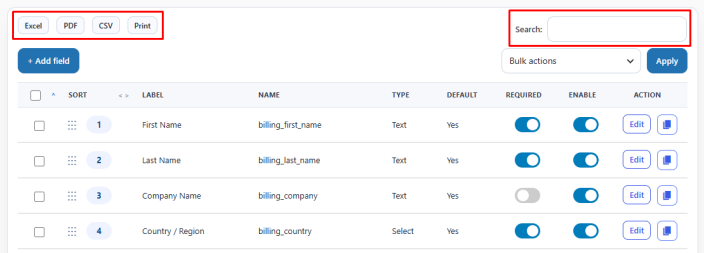
↑ Back to topQuickly find, manage, export, or print checkout fields using the checkout field editor plugin. Navigate to WooCommerce > Settings > Conditional Checkout Fields and use the search bar to instantly find any specific checkout field across all sections.
Easily export your checkout fields in multiple formats for reporting, backup, or documentation purposes:
- Excel
- CSV
You can also print the complete list of checkout fields for quick review, internal sharing, or maintaining offline records. This feature helps store admins efficiently manage and organize all custom checkout fields without manually reviewing each section.
Bulk Actions for Each Checkout Section
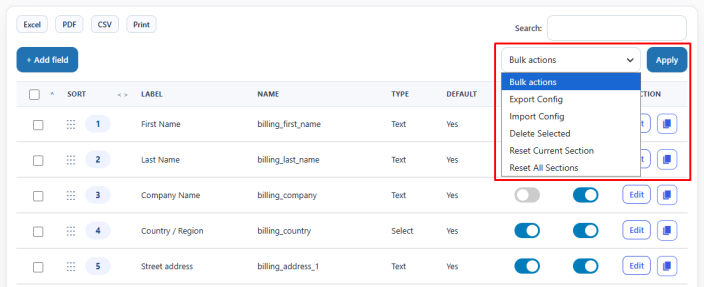
↑ Back to topUse bulk actions to easily make changes to each section of the checkout. You can use different options from the dropdown menu to apply changes. You will have the following options:
- Export Config: Export the configurations for the section.
- Import Config: Import the configurations for the section.
- Delete Selected: Delete the selected fields.
- Reset Current Section: Reset all the fields and configuration in the current section.
- Reset All Sections: Reset all checkout sections to default.
General Settings
↑ Back to topConfigure the general settings for the plugin in this section. To do so, go to WooCommerce > Settings > Conditional Checkout Fields > General Settings:
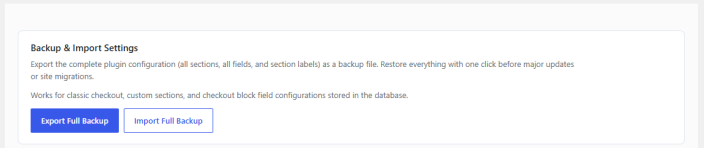
Backup & Import Settings
↑ Back to topExport the full plugin configuration, all sections, all fields, and section labels ( general), as a backup file. This covers classic checkout and custom sections configurations stored in the database, so you can restore everything with one click before major updates or site migrations.
- Export Full Backup: Downloads a backup file containing your complete field editor configuration.
- Import Full Backup: Restores a previously exported backup file, replacing your current configuration.
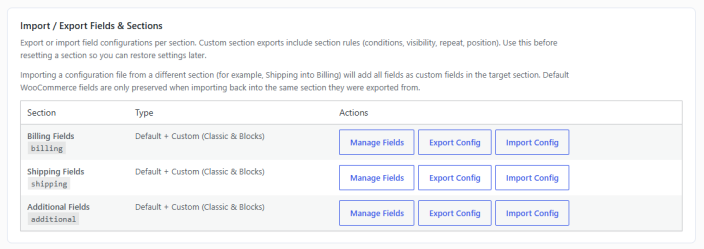
Import/Export Fields & Sections
↑ Back to topExport or import field configurations on a per-section basis. Custom section exports include the section’s rules, conditions, visibility, repeat, and position, so this is worth using before resetting a section, giving you a way to restore its settings afterward.
Important: Importing a configuration file into a different section than it was exported from, for example, importing a Shipping export into Billing, adds all of its fields as custom fields in the target section. Default WooCommerce fields are only preserved when a configuration is imported back into the same section it was exported from.
The table lists each section along with its field type and available actions:
- Billing Fields (billing): Default + Custom (Classic & Blocks)
- Shipping Fields (shipping): Default + Custom (Classic & Blocks)
- Additional Fields (additional): Default + Custom (Classic & Blocks)
Each section provides three actions:
- Manage Fields: Opens the field editor for that section.
- Export Config: Downloads that section’s field configuration as a file.
- Import Config: Restores a previously exported configuration into that section.
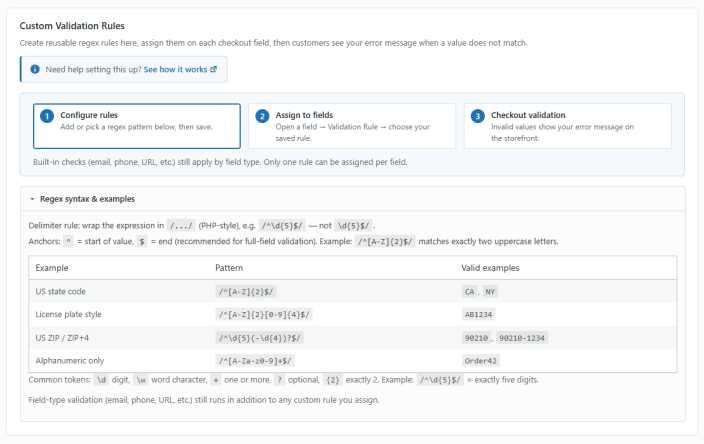
Custom Validation Rules
↑ Back to topCreate reusable regex rules, assign them to checkout fields, and show customers a custom error message when their entry doesn’t match.
Setting up a validation rule follows three steps:
- Configure Rules: Add or pick a regex pattern below, then save.
- Assign to Fields: Open a field, go to Validation Rule, and choose your saved rule.
- Checkout Validation: Invalid values show your error message on the storefront.
Built-in checks (email, phone, URL, etc.) still apply by field type, and only one custom rule can be assigned per field.
Regex Syntax & Examples
- Delimiter Rule: Wrap every expression in /…/ (PHP-style), for example /^\d{5}$/, not \d{5}$/.
- Use Anchors to Control Matching: ^ marks the start of the value, and $ marks the end, recommended for full-field validation. For example, /^[A-Z]{2}$/ matches exactly two uppercase letters.
| Example | Pattern | Valid Examples |
| US state code | /^[A-Z]{2}$/ | CA, NY |
| License plate style | /^[A-Z]{2}[0-9]{4}$/ | AB1234 |
| US ZIP / ZIP+4 | /^\d{5}(-\d{4})?$/ | 90210, 90210-1234 |
| Alphanumeric only | /^[A-Za-z0-9]+$/ | Order42 |
Common tokens: \d (digit), \w (word character), + (one or more), ? (optional), {2} (exactly 2). For example, /^\d{5}$/ means exactly five digits.
Field-type validation (email, phone, URL, etc.) still runs in addition to any custom rule you assign.
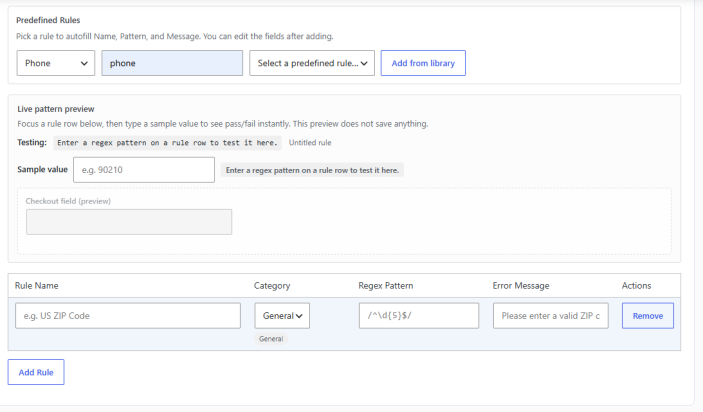
Predefined Rules
↑ Back to topPick a rule from the built-in library to autofill its Name, Pattern, and Message, then edit any of the fields after adding it.
Filter by category using All categories, or search for a specific rule: Postal, ID, Phone, Tax, Finance, or General. Then choose a rule from the Select a predefined rule dropdown, covering common formats like postal codes, national ID numbers, phone numbers, tax and finance identifiers, and general-purpose patterns, and click Add from library to add it to your saved rules.
Live Pattern Preview
Test a rule’s regex pattern before saving it. Focus a rule row below, then type a sample value into the Sample Value field to see it pass or fail instantly against that rule’s pattern, shown live in the checkout field preview. This preview doesn’t save anything.
Each rule row includes:
- Rule Name: A label for the rule, for example “US ZIP Code.”
- Category: Assign the rule to a category, such as General, Postal, ID, Phone, Tax, or Finance.
- Regex Pattern: The pattern the field value must match, for example /^\d{5}$/.
- Error Message: The message shown to customers when their entry doesn’t match the pattern.
- Actions: Remove the rule.
Click Add Rule to create a new custom rule from scratch.
Confirm Field Validators
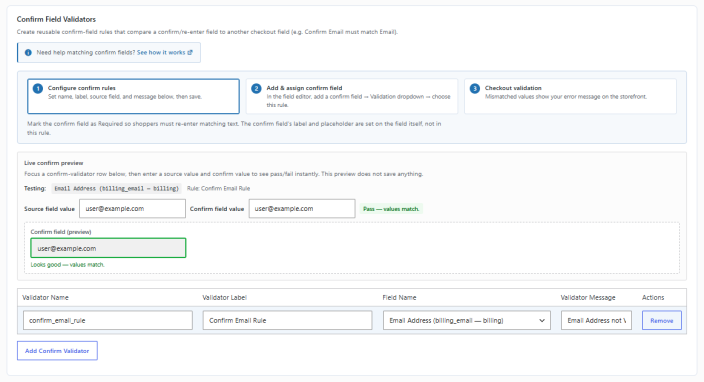
↑ Back to topCreate reusable confirm-field rules that compare a confirm or re-enter field to another checkout field, for example, ensuring a Confirm Email field matches Email.
Setting up a confirm validator follows three steps:
- Configure Confirm Rules: Set the name, label, source field, and message below, then save.
- Add & Assign Confirm Field: In the field editor, add a confirm field, then choose this rule from the Validation dropdown.
- Checkout Validation: Mismatched values show your error message on the storefront.
Mark the confirm field as Required so shoppers must re-enter matching text. The confirm field’s label and placeholder are set on the field itself, not in this rule.
Live Confirm Preview
Test a confirm validator before saving it. Focus a confirm-validator row below, then enter a source value and a confirm value into the Source Field Value and Confirm Field Value fields to see them pass or fail instantly, shown live in the confirm field preview. This preview doesn’t save anything.
Each validator row includes:
- Validator Name: An internal identifier for the rule, for example “confirm_email_rule.”
- Validator Label: A display label for the rule, for example “Confirm Email Rule.”
- Field Name: Select the source checkout field from the dropdown that this validator compares against.
- Validator Message: The message shown to customers when the confirm value doesn’t match the source field.
- Actions: Remove the rule.
Click Add Confirm Validator to create a new confirm validator from scratch.
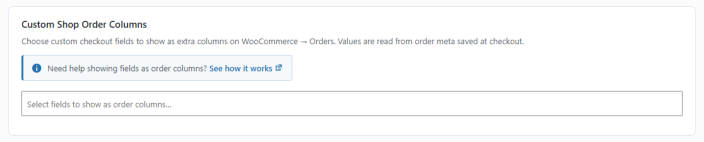
Custom Shop Order Columns
↑ Back to topChoose custom checkout fields to display as extra columns on the WooCommerce Orders screen. Values are read from the order meta saved at checkout, so the columns reflect exactly what the customer entered.
Use the Select fields to show as order columns field to pick which custom checkout fields appear as columns, giving your team visibility into custom field data directly from the orders list without opening each order individually.
Enable Inline Validation
↑ Back to topWhen enabled, custom checkout fields on block checkout validate as users leave each field, known as validation on blur. Classic checkout always validates on submit only, regardless of this setting.
Enable field validation on blur during block checkout to give customers immediate feedback on invalid entries as they move through the form, rather than waiting until they submit the order.

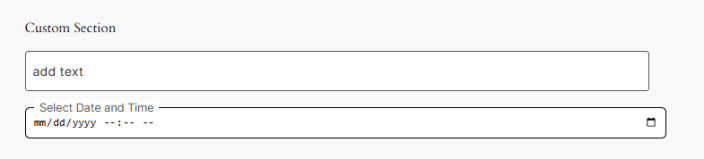
Adding Custom Sections to Block Checkout
↑ Back to topDisplay custom checkout section in the Gutenberg Editor (Block Checkout). To do so, go to WooCommerce > Settings > Conditional Checkout Fields > Add Section.
- Add a new custom section.
- Go to the checkout editor page.
- Add a “Custom Section” before or after any current checkout section.
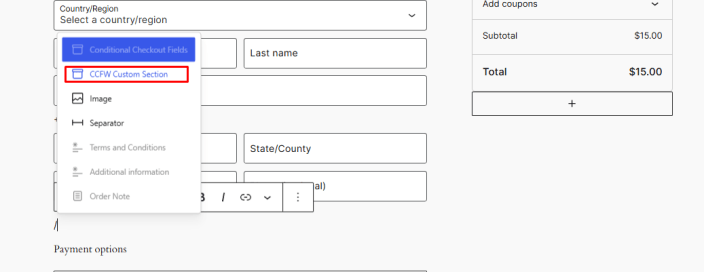
- From the right-side settings menu, select the specific custom section you want to add.
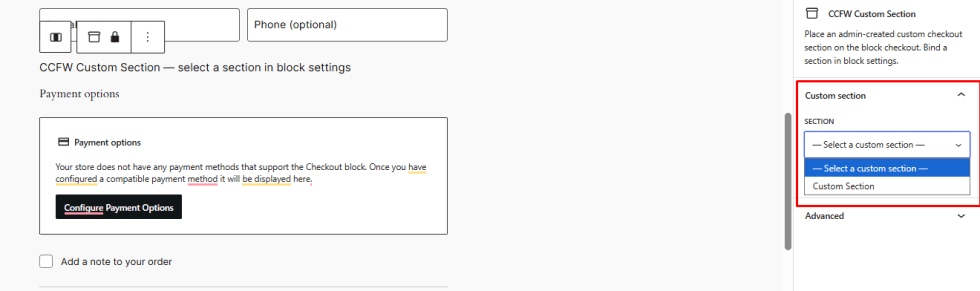
Payment and Shipping Restrictions
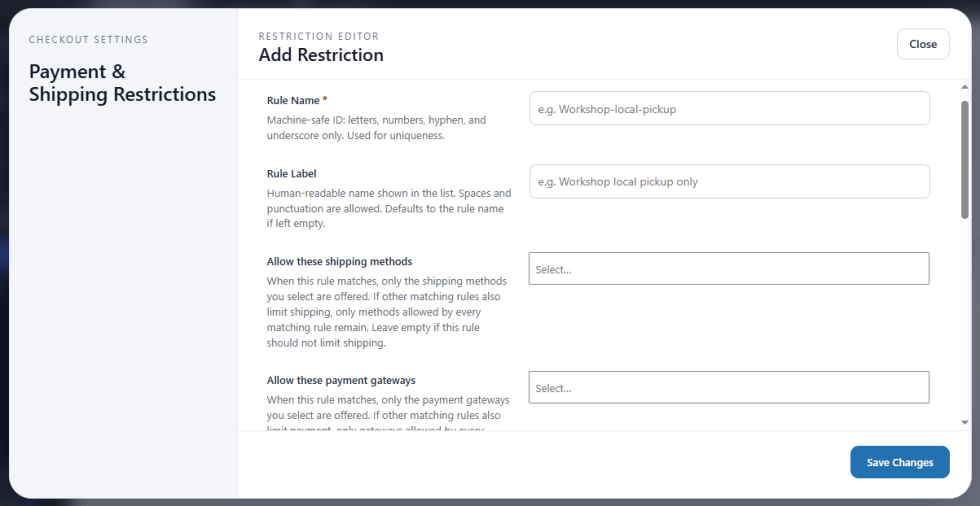
↑ Back to topControl which shipping methods and payment gateways a customer can choose, based on what they enter in your checkout fields. Restrictions work as an allow list. When a rule matches, only the methods and gateways you selected remain available, and everything else is hidden.
Go to WooCommerce > Settings > Conditional Checkout Fields > Payment and Shipping Restrictions and configure the following:
- Rule Name: A machine-safe identifier for the rule. Letters, numbers, hyphens, and underscores only, and it must be unique. For example, Workshop-local-pickup. This field is required.
- Rule Label: The human-readable name shown in the restrictions list. Spaces and punctuation are allowed. If you leave it empty, the rule name is used instead. For example, “Workshop local pickup only”.
- Allow These Shipping Methods: Select the shipping methods that stay available when this rule matches. Every other method is hidden. Leave it empty if this rule should not affect shipping at all.
- Allow These Payment Gateways: Select the payment gateways that stay available when this rule matches. Every other gateway is hidden. Leave it empty if this rule should not affect payment at all.
You must choose at least one shipping method or one payment gateway. A rule that limits neither has nothing to do.
Condition(s) to Meet
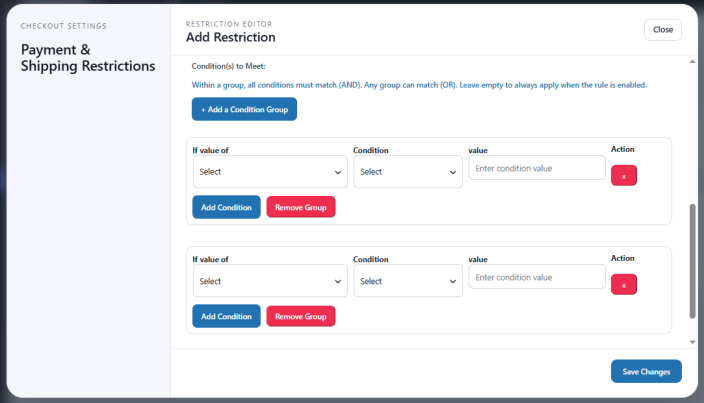
↑ Back to topClick + Add a Condition Group, then Add Condition to set the field, the comparison, and the value. Within a group, all conditions must match (AND), and any group matching is enough (OR). Leave conditions empty for the rule to always apply while enabled.
- If value of: The checkout field the condition reads.
- Condition: How the value is compared.
- Value: What the value is compared against.
- Action: Remove the condition row.
How Multiple Rules Interact
↑ Back to topWhen several rules match the same order, only the options allowed by every matching rule remain. If one rule allows Flat rate and Local pickup and another allows Local pickup and Free shipping, the customer is offered Local pickup only. Shipping and payment are evaluated separately.
Warning: If matching rules have no options in common, none are shown. Test an order that triggers every overlapping rule and confirm at least one shipping method and one gateway is still offered.
FAQs
↑ Back to topCan I edit or delete the default checkout fields?
This extension allows you to edit the default checkout fields and hide them. Moreover, you can change the sequence of default fields, and apply validation.
Is it possible to display custom checkout fields to only specific users?
Yes, you can assign checkout fields to specific user roles. This way you can create custom checkout fields for specific user roles.
Can I add condition fields to the checkout page?
The extension lets you create conditional checkout fields. You can apply And or Or based conditions on different fields to get the required information from your customers.