WooCommerce Wishlists lets shoppers save products to an unlimited number of lists and keep each one private, shared by link, or public.
- Guests can create lists without an account. An abandoned guest list is cleaned up automatically after 30 days.
- Signed-in customers keep their lists indefinitely, and a guest’s lists are claimed by their account when they log in or register.
Requirements
↑ Back to top- WordPress 6.8 or later
- WooCommerce 10.4 or later
- PHP 7.4 or later
- Works on classic themes and block themes, and is compatible with High-Performance Order Storage (HPOS)
Installation
↑ Back to top- Download the .zip file from your WooCommerce account.
- Go to: WordPress Admin > Plugins > Add New to upload the file you downloaded with Choose File.
- Activate the extension.
More information at: Installing and Managing Plugins.
On activation the extension creates the five pages it needs — Wishlists, Create a List, Manage List, Find a List and View a List — each already containing the correct shortcode, and selects them under Wishlist Page Options. In most stores there is nothing further to configure.
Settings
↑ Back to topAll settings are at WooCommerce > Settings > Wishlists.
Wishlist Options
↑ Back to top| Setting | What it does |
|---|---|
| Allow Guests to Create Lists | Whether visitors without an account can create lists. Yes — anyone can. No — the button is hidden and only signed-in customers can create lists. Registration Required — guests see the button, but are asked to log in or register before the save completes. |
| Automatically Create Lists | Set to Yes and a shopper’s first list is created for them with a generic title. Set to No and they are asked to name it first. |
| Message for Guests | Shown to visitors who are not signed in when they reach the Create a List page. Only applies when Allow Guests to Create Lists is set to No. |
| Redirect to Wishlist | Whether to send the shopper to the list after they save an item. Set to No to leave them on the product. |
| Button / Link Type | Render the control as a button styled like the Add to Cart button, or as a text link. |
| Icon | Heart, Bookmark, Star, Gift, or None. Drawn in your theme’s button colour. This is also how the control reports state: outlined while the product is on none of the shopper’s lists, solid once it is on one. |
| Button / Link Text | The wording on the control — “Add to wishlist” by default. It stays the same in every state; only the icon changes. |
| One-click first save | When a shopper has no lists at all, save straight to a new list called “My List” instead of opening the picker. Faster, but it names their first list and chooses its privacy for them. Off by default. |
| Require a variation | On a variable product’s page, keep the control inactive until the shopper chooses options, the way Add to Cart waits. Shop listings and related products are not affected, since they offer no way to choose a variation. Off by default, so shoppers can save a product first and settle on options later. |
| Saved State Text | Announced to screen readers when the product is already on one of the shopper’s lists — “Saved” by default. The visible button text is unchanged. |
| Cart Label | The label shown against a cart line that came from a wishlist. “From Wishlist” by default. |
Product Listing Button
↑ Back to topThese settings govern the Add to Wishlist button on shop and category pages. Product pages are not affected by them.
| Setting | What it does |
|---|---|
| Show in Product Listings | Turn the button in product listings on or off. |
| Show for Variable Products | A listing cannot choose a variation, so a variable product saved from one is saved without it and the shopper is asked to choose options before it can go to the cart. Set to No to offer variable products only on their own product pages. |
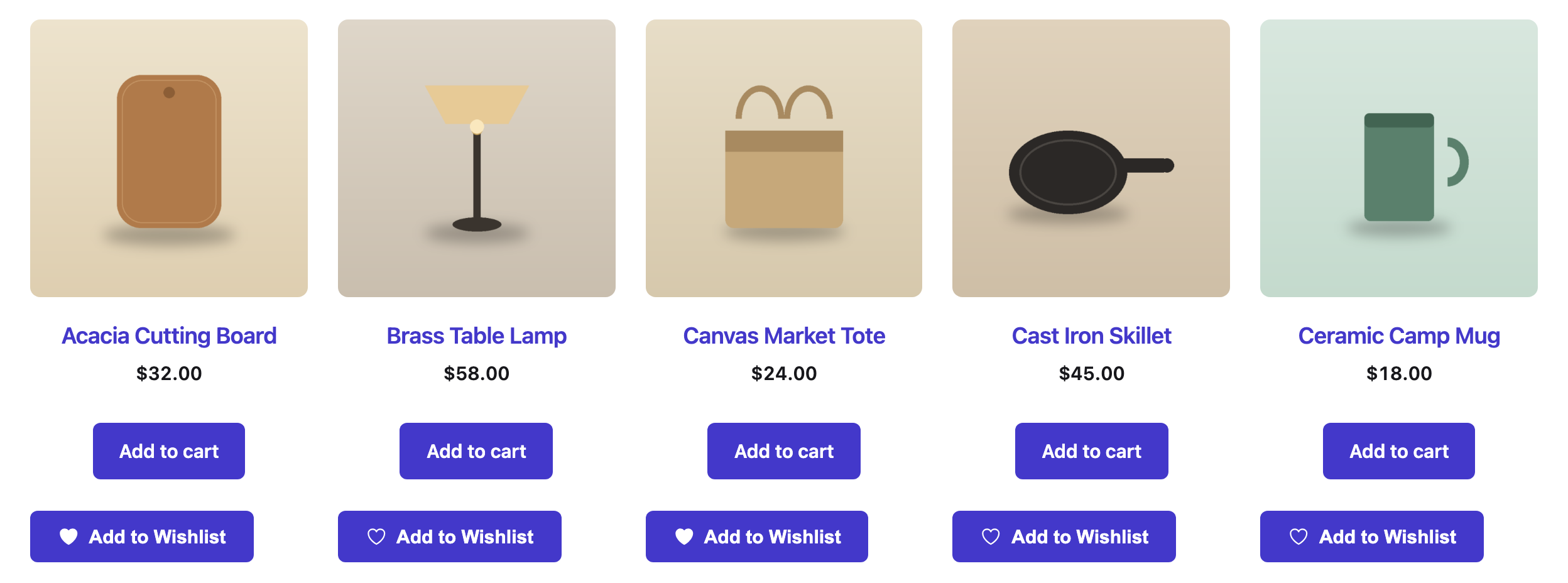
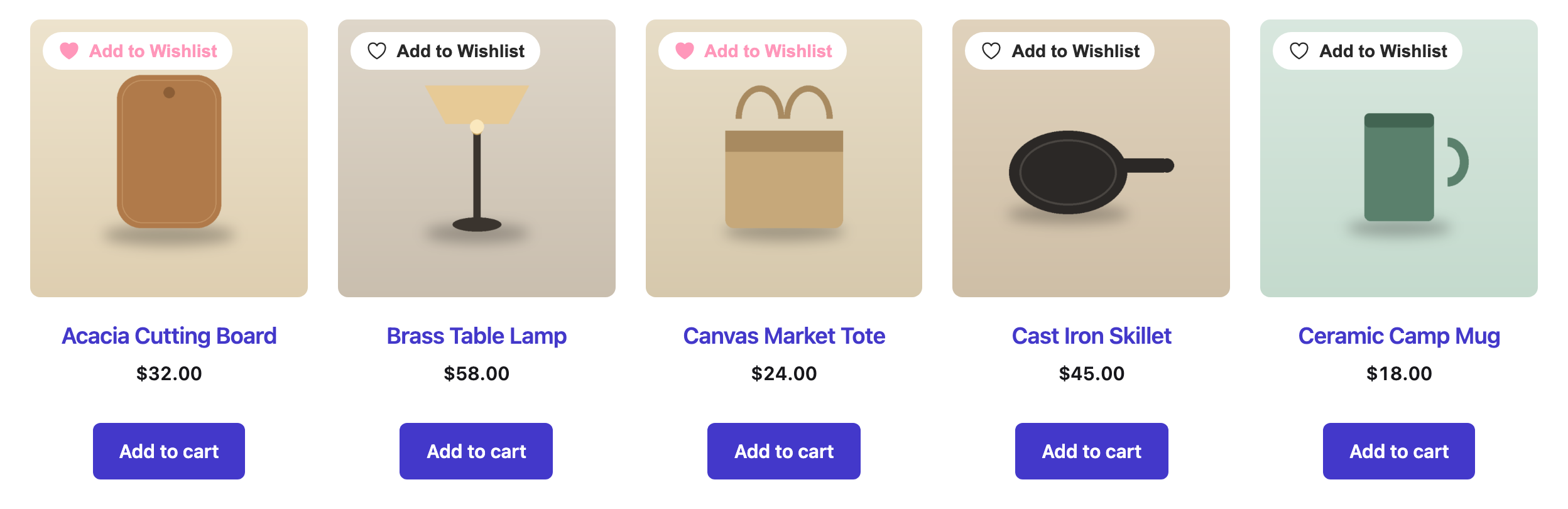
| Button Position | Where the button sits on each product tile: On the product image (laid over the top-left corner), Above the Add to Cart button, or Below the Add to Cart button. On a block theme you can also move the block in the Site Editor. |
| Show Button Text | Set to No for an icon-only button — a round badge when combined with the “On the product image” position. Screen readers still hear the text. |
| Button Text | Separate wording for the listing button. Leave blank to use the Button / Link Text above. |
Wishlist Processing Options
↑ Back to topWhat happens to a list item once it has been ordered. These are the settings that make a list behave like a gift registry.
| Setting | What it does |
|---|---|
| Automatic Removal | Remove an item from the list once it has been purchased. |
| Automatic Removal on Status | The order status the purchase must reach before the item is removed. |
| Automatic Removal Type | Remove the item only from the buyer’s own list, or from any list it appears on. Choose Remove From Any List for a gift registry, so an item bought by a friend clears from the registry owner’s list. |
| Show Previous Ordered Total | Adds a column to View a List and Manage List showing how many of each item have already been ordered — the “already bought” column of a registry. |
| Previous Ordered Column Heading | The heading for that column. “Ordered” by default. |
Sharing and Style Options
↑ Back to top| Setting | What it does |
|---|---|
| Social Options | Which of Facebook, Twitter, Email and Pinterest appear in the sharing row on a public or shared list. |
| Custom Buttons | By default the control inherits your theme’s and WooCommerce’s own button styling. Tick Enable Custom Wishlist Button Colors to override the button and text colours instead. |
| Custom CSS | Somewhere to put a few style rules without editing your theme. A convenience, not a requirement. |
Notification and Add to Cart Options
↑ Back to top| Setting | What it does |
|---|---|
| Send Notifications | Email a list’s owner when the price of a product on their list drops. |
| Prompt for Quantities | Ask the shopper how many they want when adding to the cart from a list, rather than using the quantity stored on the list. |
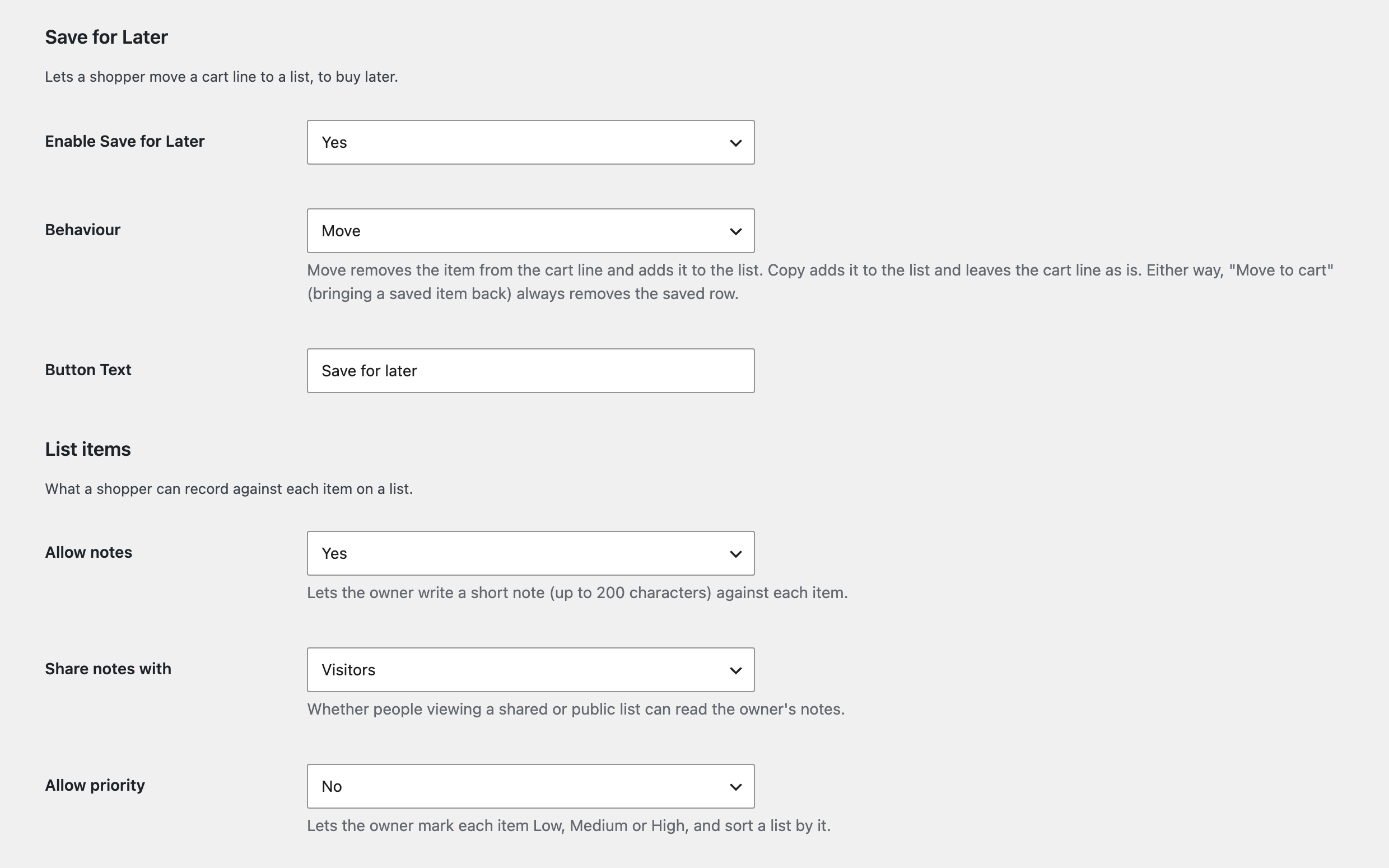
Save for Later Options
↑ Back to topThese settings control the Save for later link on cart lines. See Save for later under What Your Shoppers See.
| Setting | What it does |
|---|---|
| Enable Save for Later | On by default. Set to No to remove the link from every cart line and hide the saved section below the cart. |
| Behaviour | Move, the default, takes the line out of the cart when it is saved. Copy saves it to the list and leaves the cart line as it is. With either, Move to cart on a saved row removes that row from the saved list. |
| Button Text | The wording of the link on each cart line. “Save for later” by default. |
List Items
↑ Back to topWhat a shopper can record against each item on a list.
| Setting | What it does |
|---|---|
| Allow notes | On by default. The owner of a list can write a note of up to 200 characters against each item. |
| Share notes with | Visitors, the default, lets people viewing a shared or public list read the owner’s notes. No one keeps notes private to the owner. |
| Allow priority | Off by default. Set to Yes to let the owner mark each item Low, Medium or High, and sort the list by priority. |
Wishlist Page Options
↑ Back to topWishlists needs five pages, one per screen. They are created and selected for you on activation. To use your own pages instead, select them here and add the matching shortcode to each.
| Page | Purpose | Shortcode |
|---|---|---|
| My Lists Page | Where a shopper manages and creates their own lists | [wc_wishlists_my_archive] |
| Create a List | Where new lists are created | [wc_wishlists_create] |
| Edit a List | Where a shopper edits their own list | [wc_wishlists_edit] |
| Find a List | Where public lists can be searched for | [wc_wishlists_search] |
| View a List | Where public and shared lists are viewed | [wc_wishlists_single] |
Signed-in customers also get a Wishlists tab on their WooCommerce My Account page, at /my-account/account-wishlists/.
Wishlists does not add its pages to any menu. Add links to My Lists, Find a List and Create a List yourself via Appearance > Menus, or anywhere else on your site.
Placing the Add to Wishlist Button
↑ Back to topOn a classic theme the button is added to the product page and to product listings automatically, in the positions set above. There is nothing to place by hand.
On product pages
↑ Back to top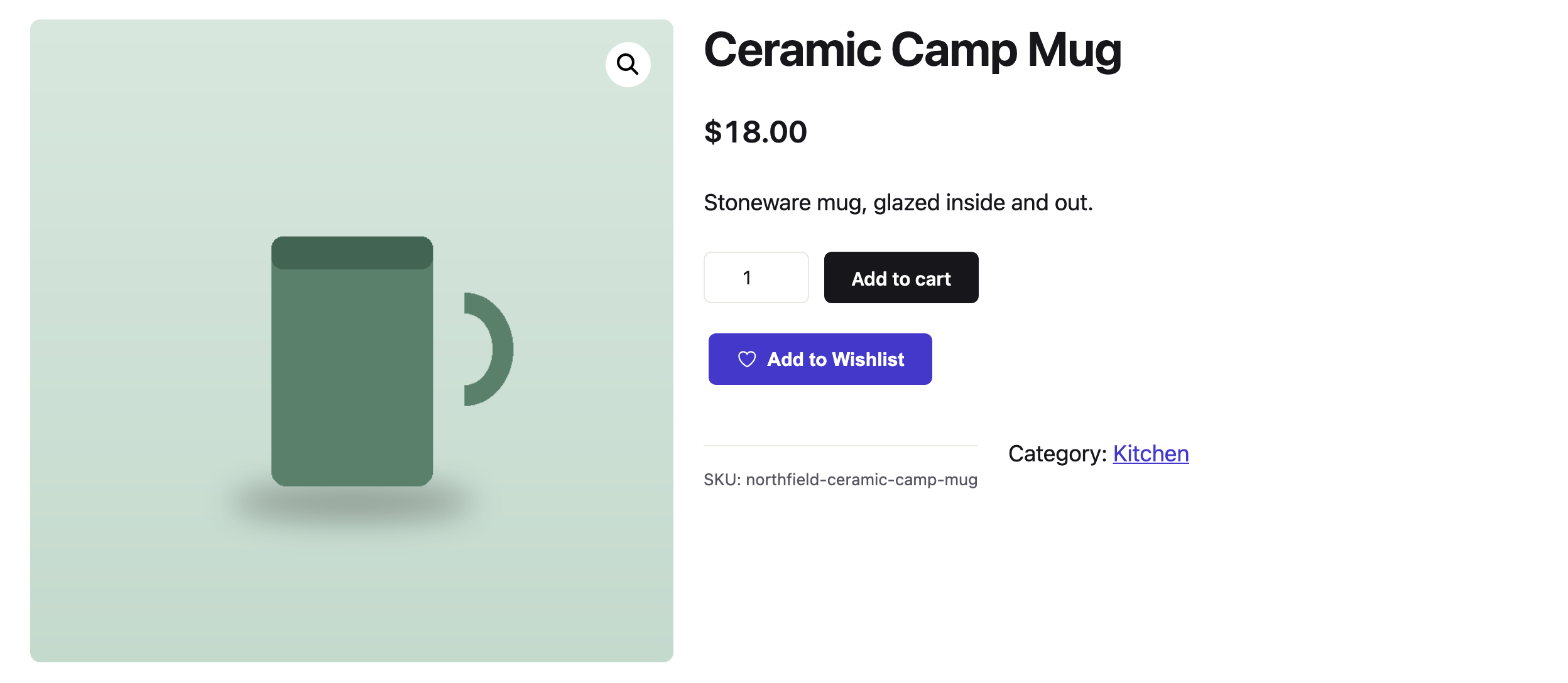
In shop and category listings
↑ Back to topIn its default position, below each tile’s Add to Cart button:
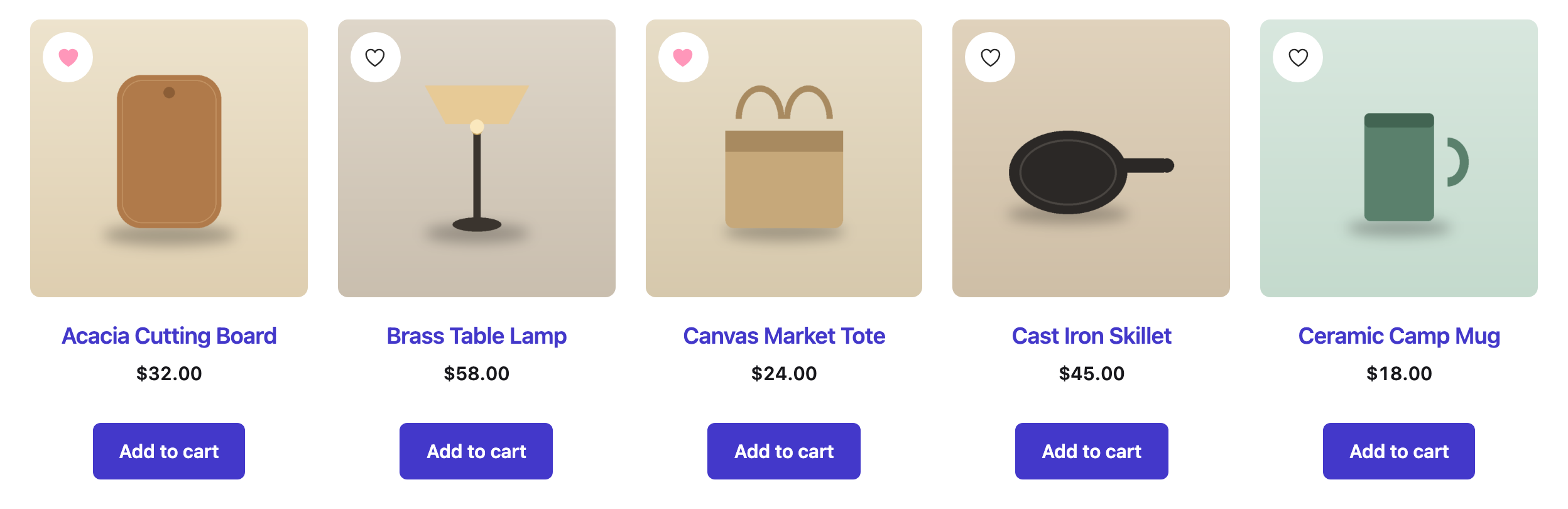
Set Button Position to “On the product image” and the same button sits in the corner of each photo. Products already on a list show the solid heart; the rest show the outline:
Also set Show Button Text to No and it becomes a round icon-only badge:
On block themes
↑ Back to topWishlists registers two blocks, both under the WooCommerce category in the inserter:
- Add to Wishlist — the save control for a single product. It is added to the product template automatically, and works inside a Product Collection or Product Template so every tile in a grid gets one.
- Wishlist — displays a shopper’s list.
Both are real blocks in the Site Editor: open Appearance > Editor, edit the Single Product or Product Catalog template, and you can move, restyle or delete the button like any other block. Colour, typography, spacing and border controls are in the block sidebar, and both blocks read your theme.json.
Shortcodes
↑ Back to topFor page builders and custom templates:
- [wc_wishlists_button] — renders the Add to Wishlist control for the product being displayed.
- [wc_wishlists_add_link product_id=”123″ title=”Save this”] — the same control for a named product, anywhere on the site.
titlesets the button text; usetitle="product_title"for “Add [product name] to Wishlist”.
What Your Shoppers See
↑ Back to topSaving a product
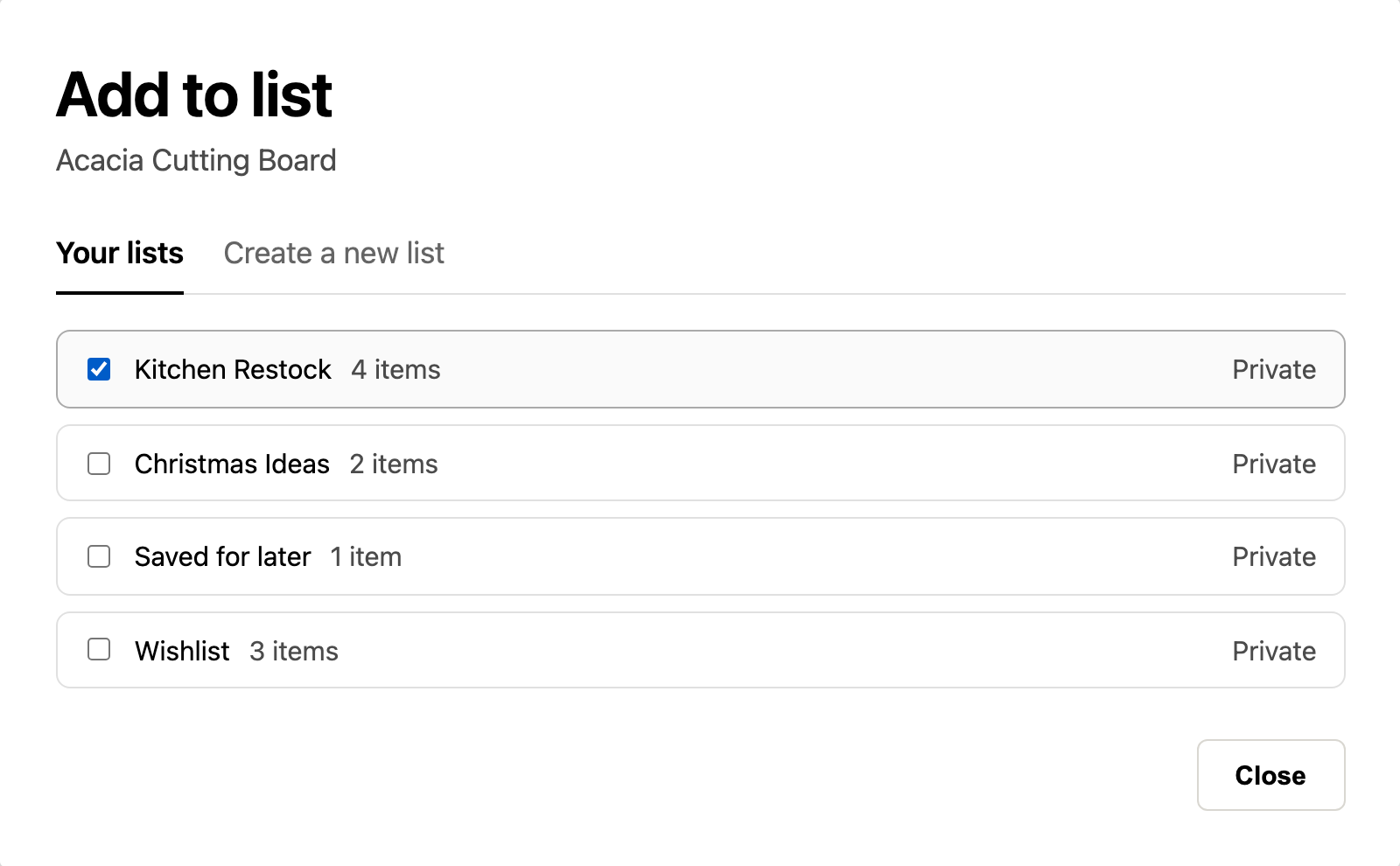
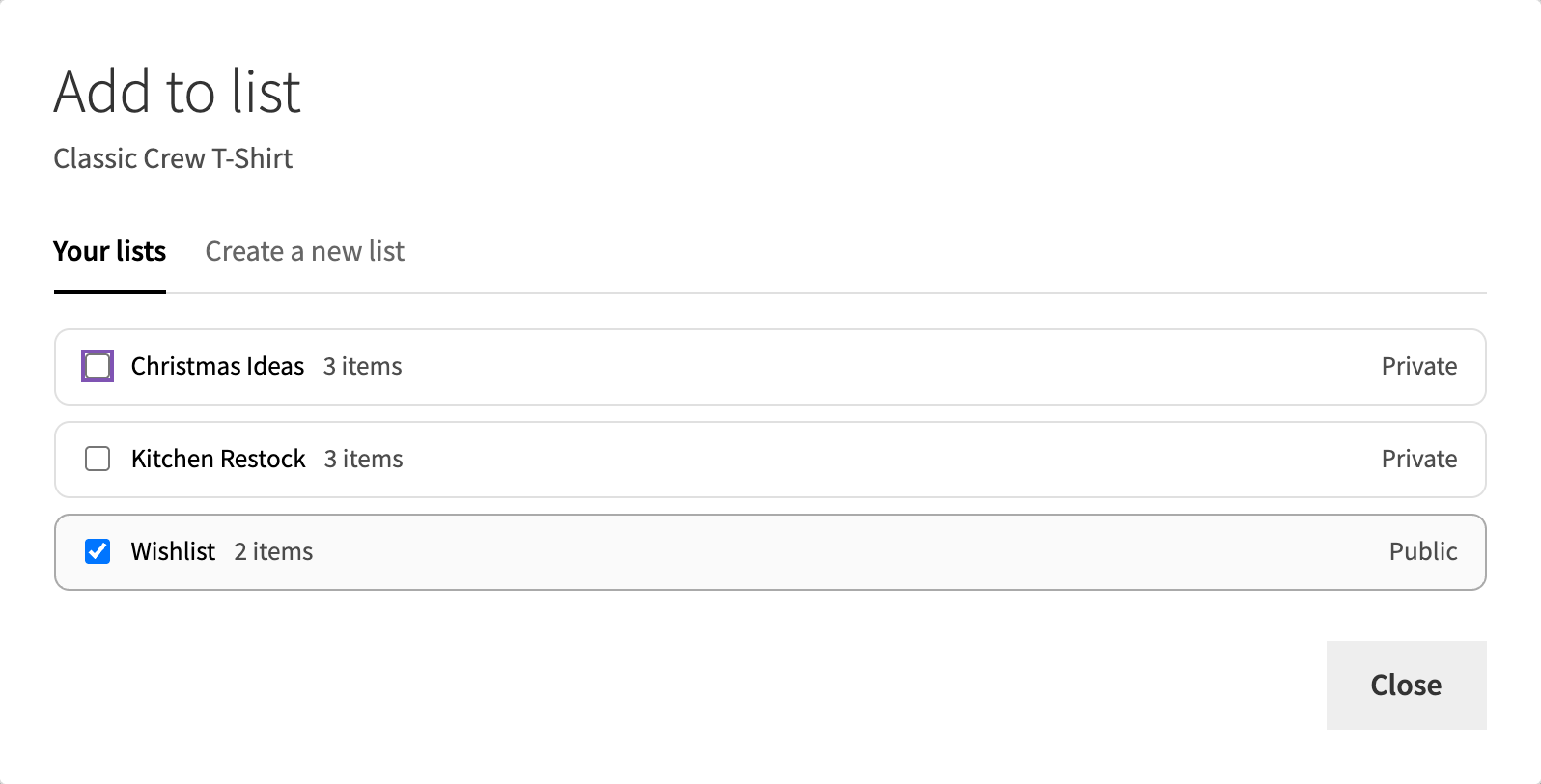
↑ Back to topClicking Add to Wishlist opens the list picker without leaving the page. The Your lists tab shows each of the shopper’s lists with its item count and privacy, and a tick against any list that already holds this product; the shopper’s default list comes first. Ticking saves, unticking removes — there is no confirm step, and Close dismisses the dialog. The Create a new list tab names a new list and saves the product to it.
A short confirmation appears after each save, with a link to the list.
On a product with Gravity Forms or other add-on fields, the picker also offers Save this configuration, so two differently configured copies of one product can sit on the same list. Each is shown, and removed, on its own.
Variable products
↑ Back to topOn a variable product the control follows the variation the shopper has chosen, so two colours of the same product can sit on one list and be removed one at a time. Before a variation is chosen, the control saves the product itself, so a shopper can keep something they like and settle on the colour or size later. To make the control wait for a chosen variation instead, turn on Require a variation.
A variable product saved without a variation — from its own page before choosing one, or from a shop listing, which has no way to choose one — is listed with Choose options, linking to the product page, instead of an Add to Cart that could not succeed. The same applies to a product whose add-on fields have not been filled in.
Save for later
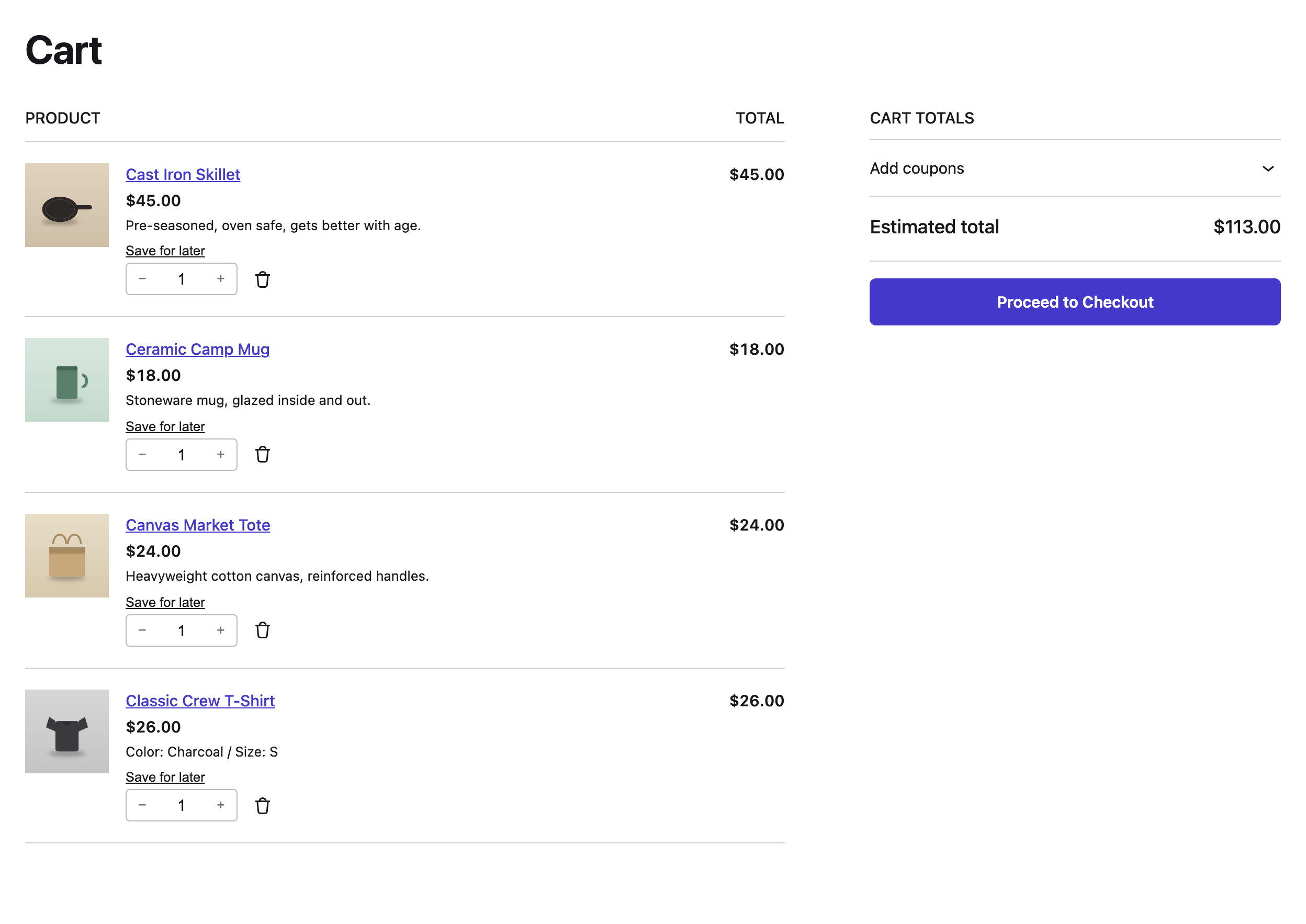
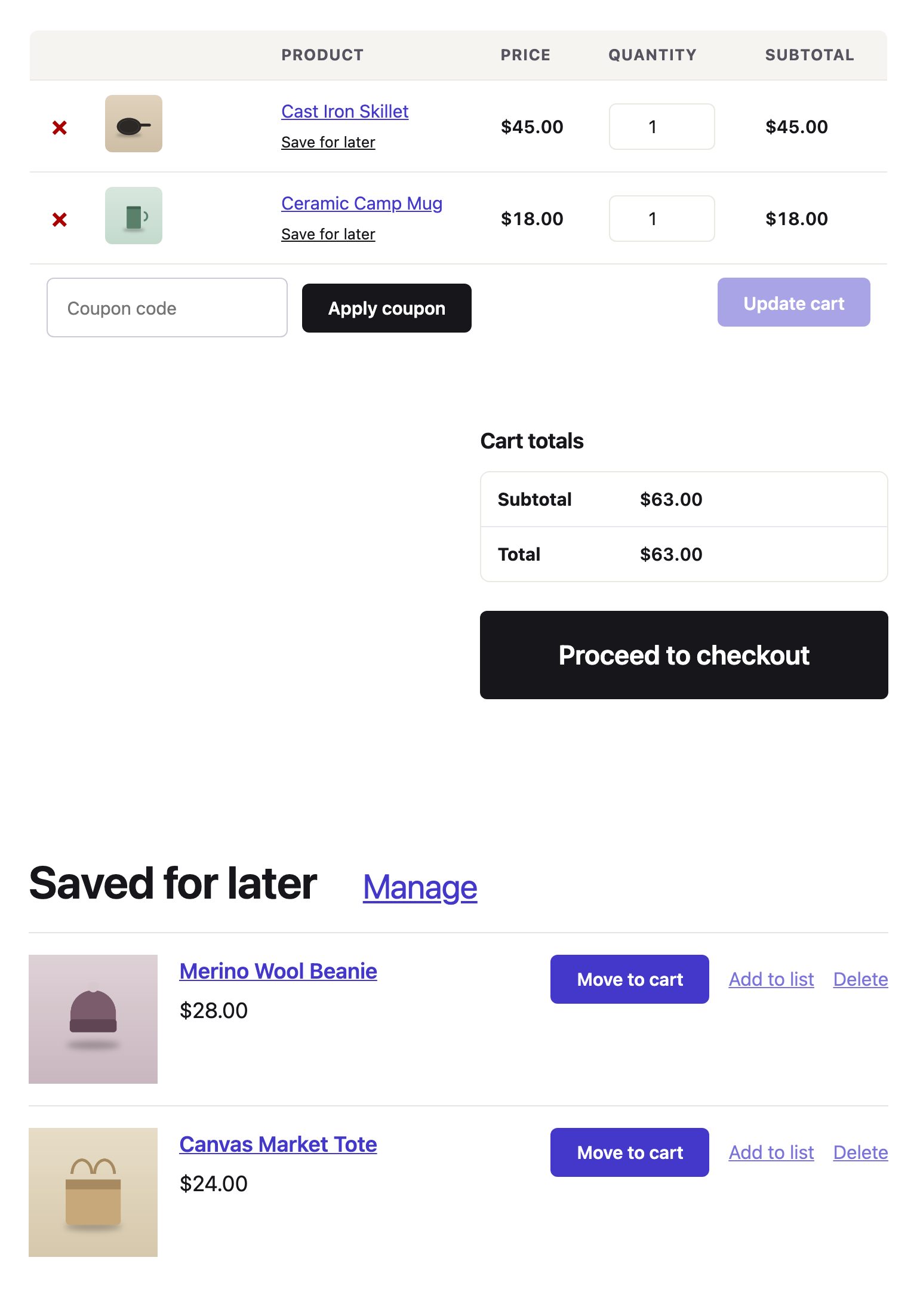
↑ Back to topEvery cart line has a Save for later link, on the classic cart page and on the Cart block, for guests and signed-in customers alike. Selecting it takes the line out of the cart and puts it on a list called Saved for later.
The saved products appear below the cart with their image, name, chosen options and price. Each row has Move to cart, Add to list and Delete. On the Cart block, saving and moving back happen in place, without a page reload. With JavaScript off, every control is an ordinary link and still works.
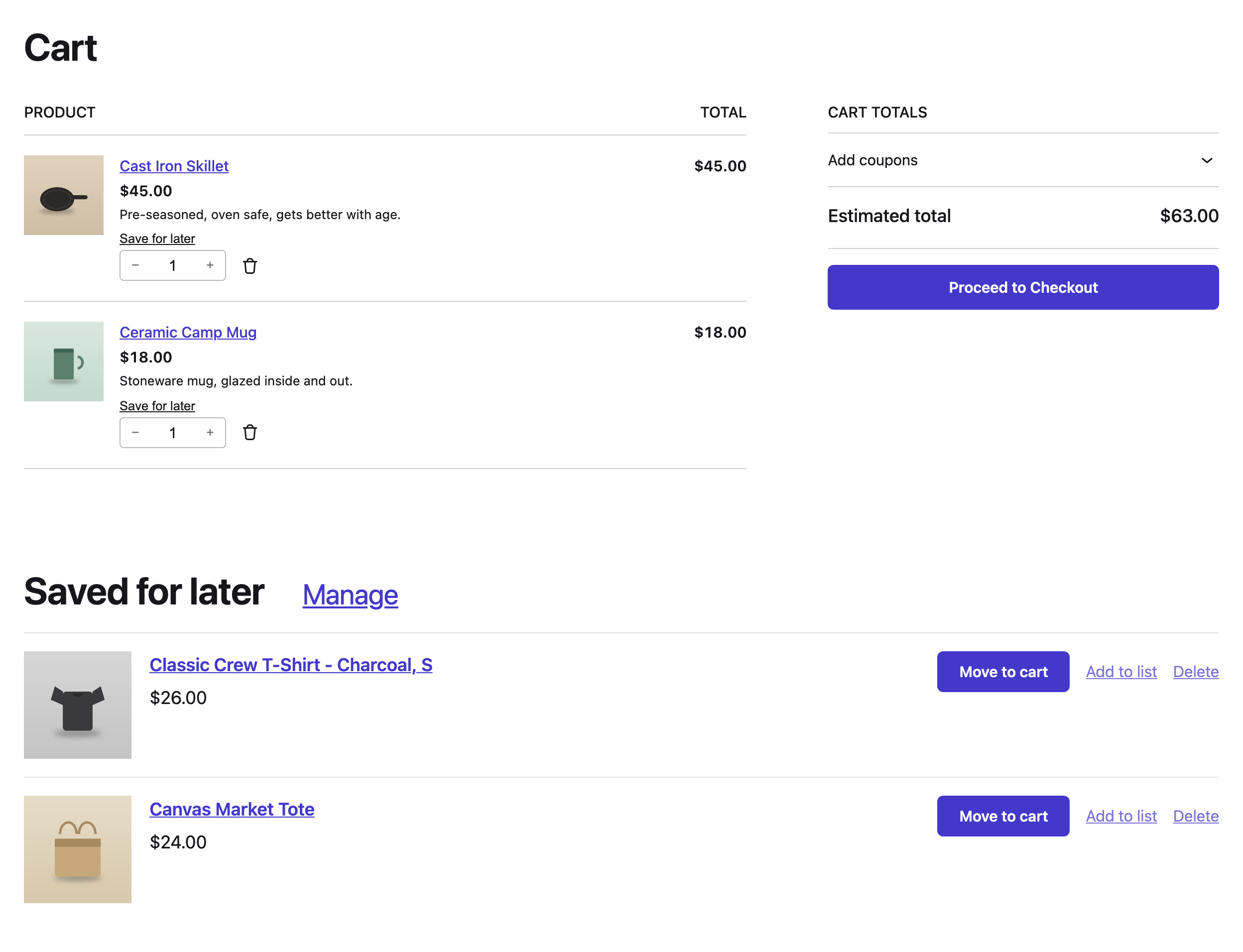
Move to cart puts the saved quantity back in the cart. If the same product is already there, the quantity is added to that line rather than creating a duplicate. A product that can only be bought once is simply removed from the saved list, since it is already in the cart.
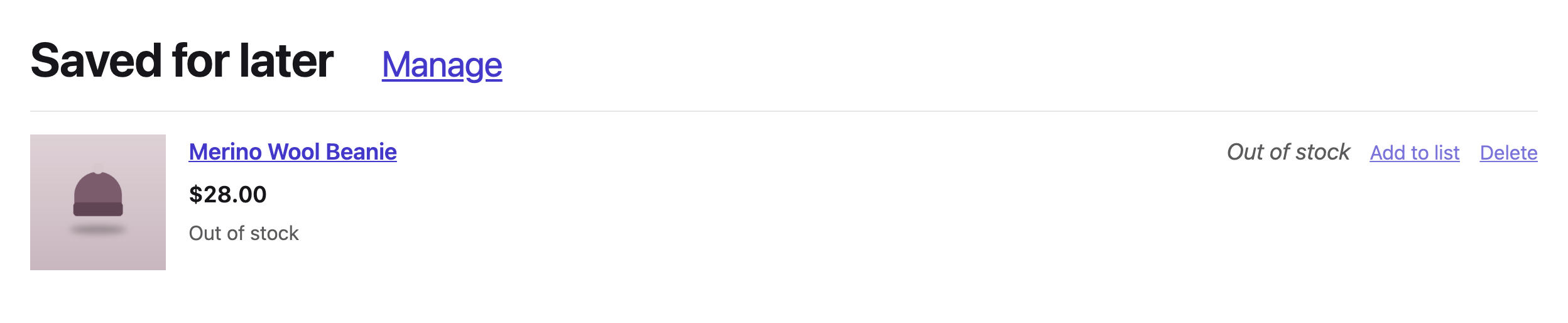
Stock is respected. A product that has sold out shows Out of stock in place of Move to cart, a quantity the stock cannot cover stays on the list with a notice, and a product that still needs options chosen shows Choose options.
Saved for later is a real list. It is created the first time a shopper saves something, there is one per shopper, and it is listed on My Lists with their other lists, marked From the cart, where it can be renamed or shared like any other. Add to list on a saved row moves the item to another list. When a guest logs in or registers, their saved items are merged into their account’s Saved for later list, with quantities added together where the same item is in both.
The classic cart page looks like this:
To switch the feature off, leave a copy in the cart instead of moving the line, or change the link’s wording, use Save for Later Options in the settings.
Guest lists
↑ Back to topA shopper who is not signed in gets a temporary list, identified by a cookie. It is available only in the browser it was created in, and clearing cookies loses it. Logging in or registering at any point claims those lists into the account, after which they are kept indefinitely.
A temporary list that is more than 30 days old and has had nothing saved to it in 30 days is deleted automatically. This keeps bot- and crawler-created lists from accumulating. Lists belonging to an account are never touched. Developers can change or disable the lifetime — see Customization below.
Viewing and managing lists
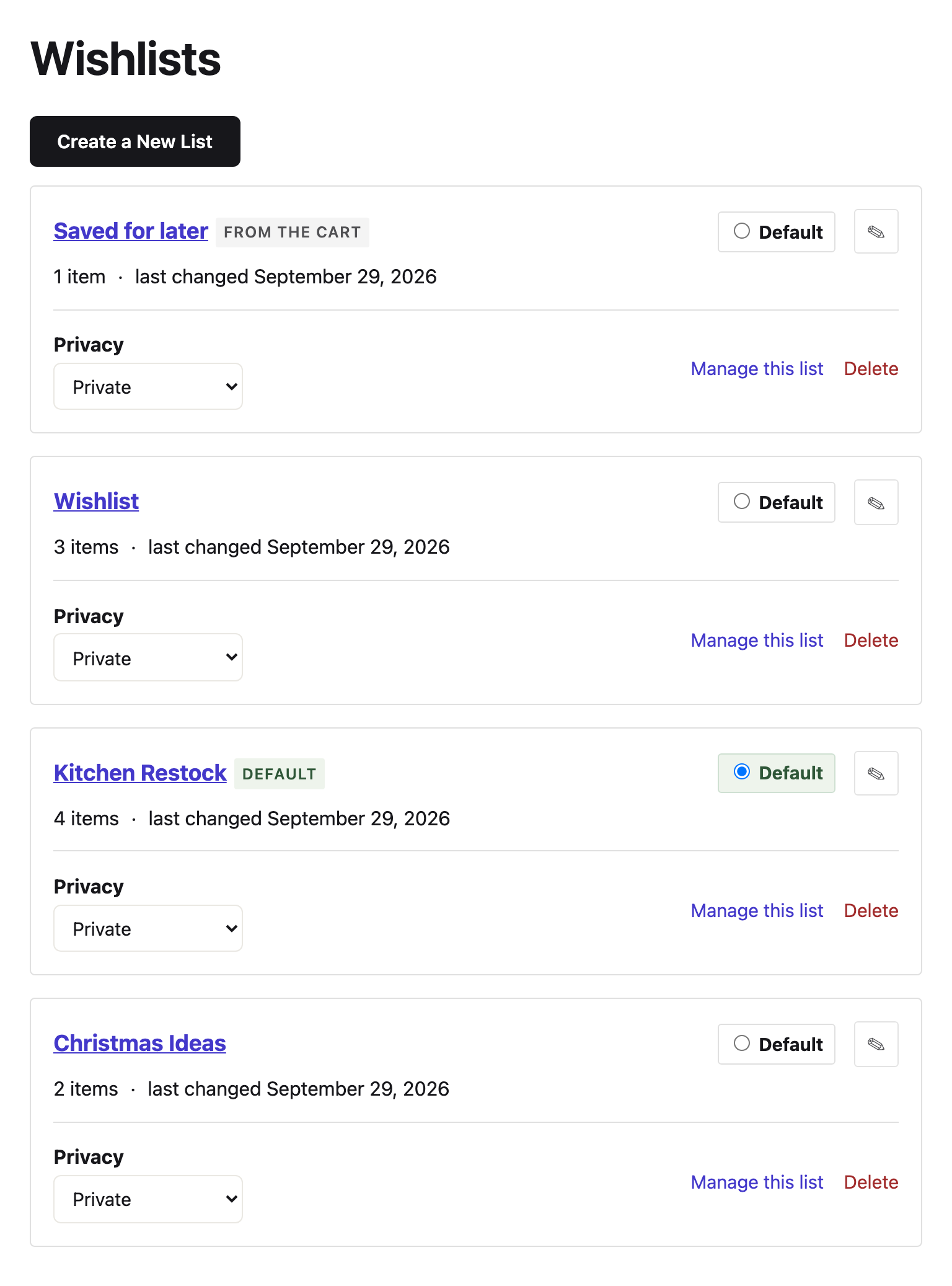
↑ Back to topShoppers reach their lists from the Wishlists page, or from the Wishlists tab of My Account.
The page shows a card for each list with its item count, when it last changed and its privacy, which can be changed there. The pencil renames a list where it stands, and Delete asks for confirmation first. Selecting Default on a list makes it the shopper’s default, which the picker shows first. The list created by Save for later is marked From the cart.
Managing a list
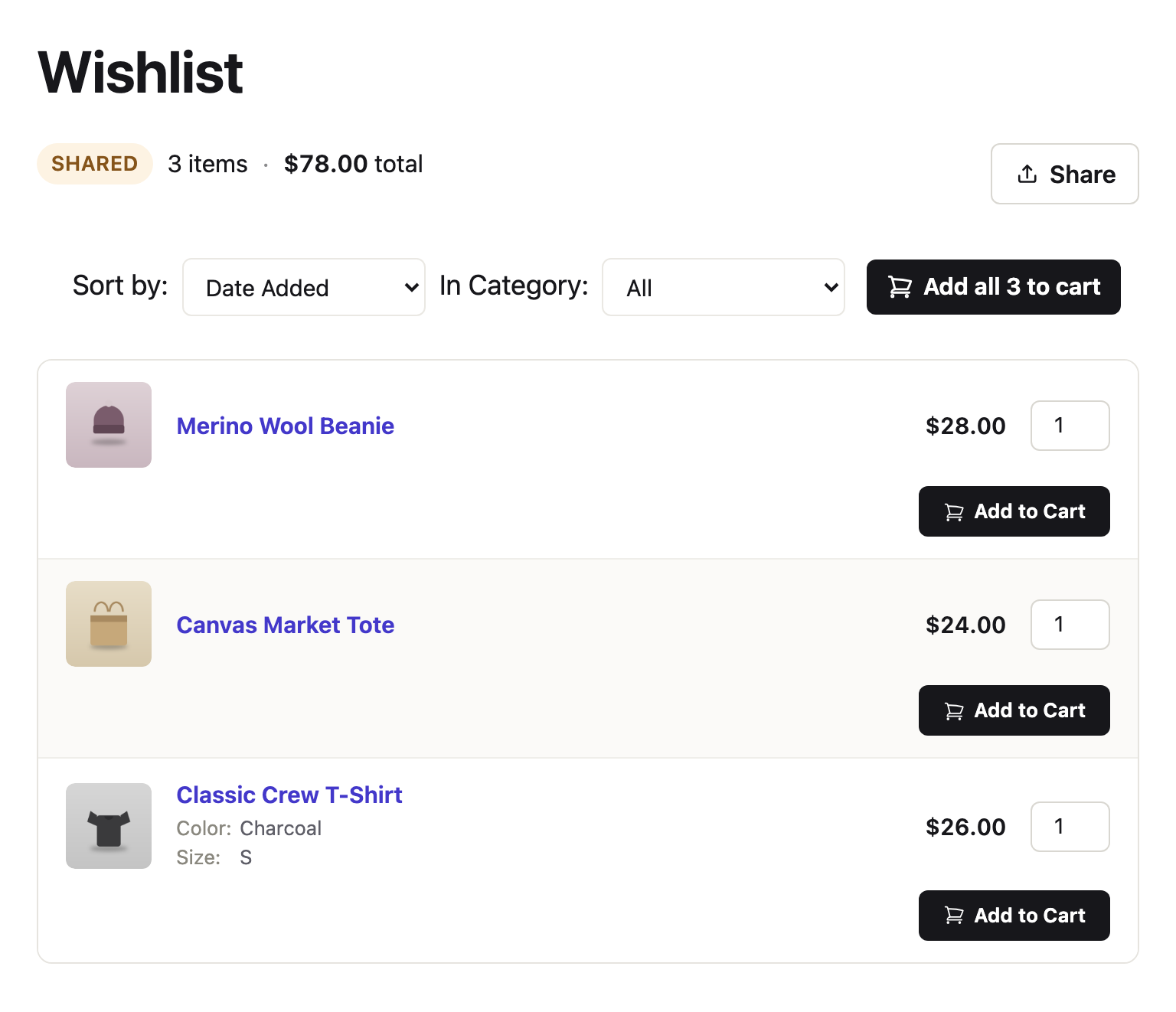
↑ Back to topClicking a list’s title opens the Manage List screen. The heading shows the list’s privacy, how many items it holds and their total price, quantities included. The List Items tab holds the items. The Settings tab covers the list itself: title, description, the name and email associated with it, and its privacy.
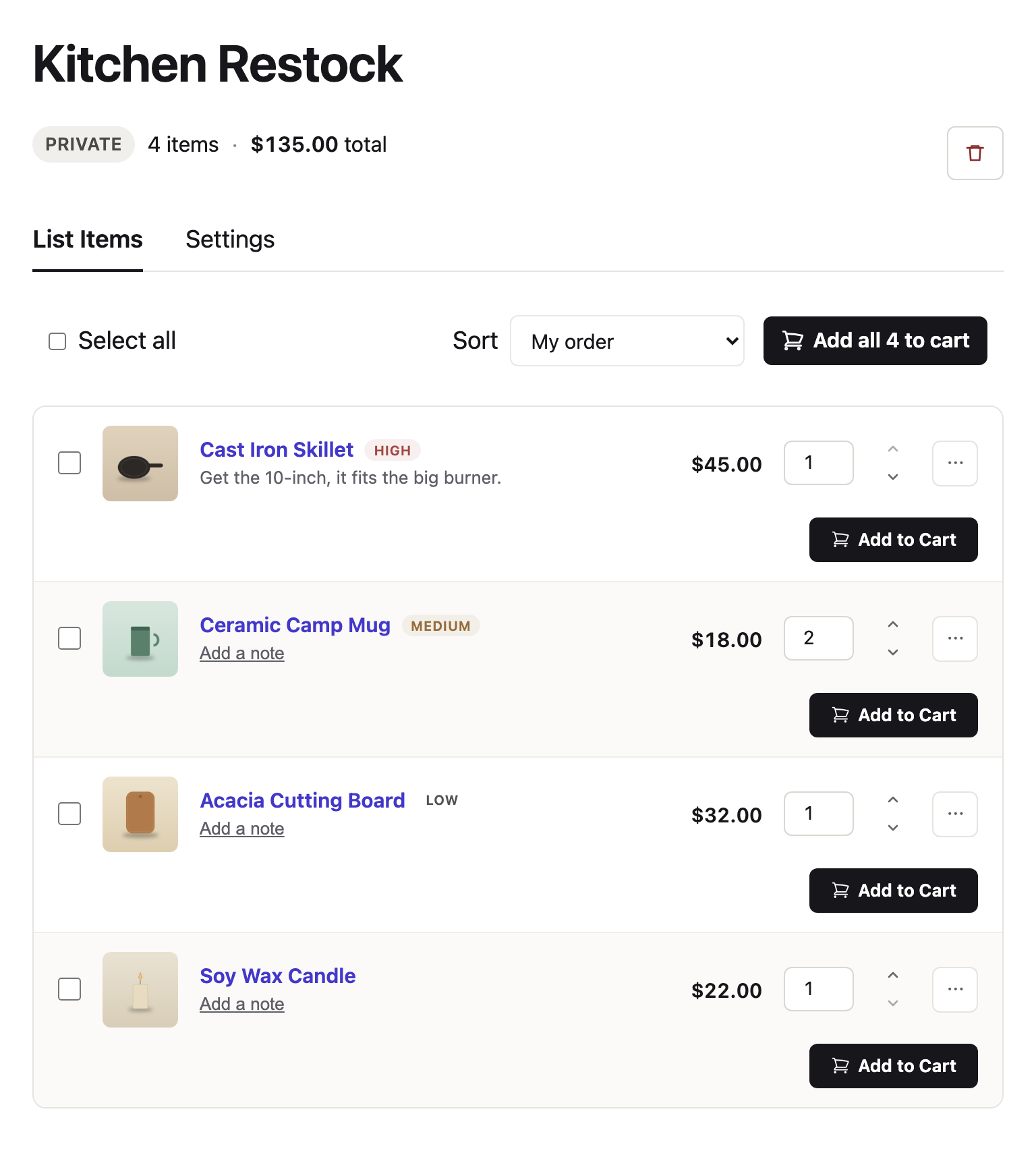
Above the items, Select all ticks every row, Sort orders the list by My order, Date Added, Name, Price or, once Allow priority is on, Priority, and Add all to cart adds everything the list can add and reports anything it skipped, and why.
Each row has a quantity field, an Add to Cart button and a menu. Editing a quantity, removing an item and adding to the cart all happen without reloading the page. The chevrons beside the quantity move a row up or down, and the up and down arrow keys do the same. My order shows the list in the order the shopper arranged.
Everything on this screen also works with JavaScript disabled; the controls fall back to ordinary links and form submissions.
Notes and priority
↑ Back to topEach item can carry a note of up to 200 characters. Select Add a note under the item’s name, or Edit note in the row menu; the note saves as it is typed. The row menu also sets a priority of Low, Medium or High, shown as a badge beside the name.
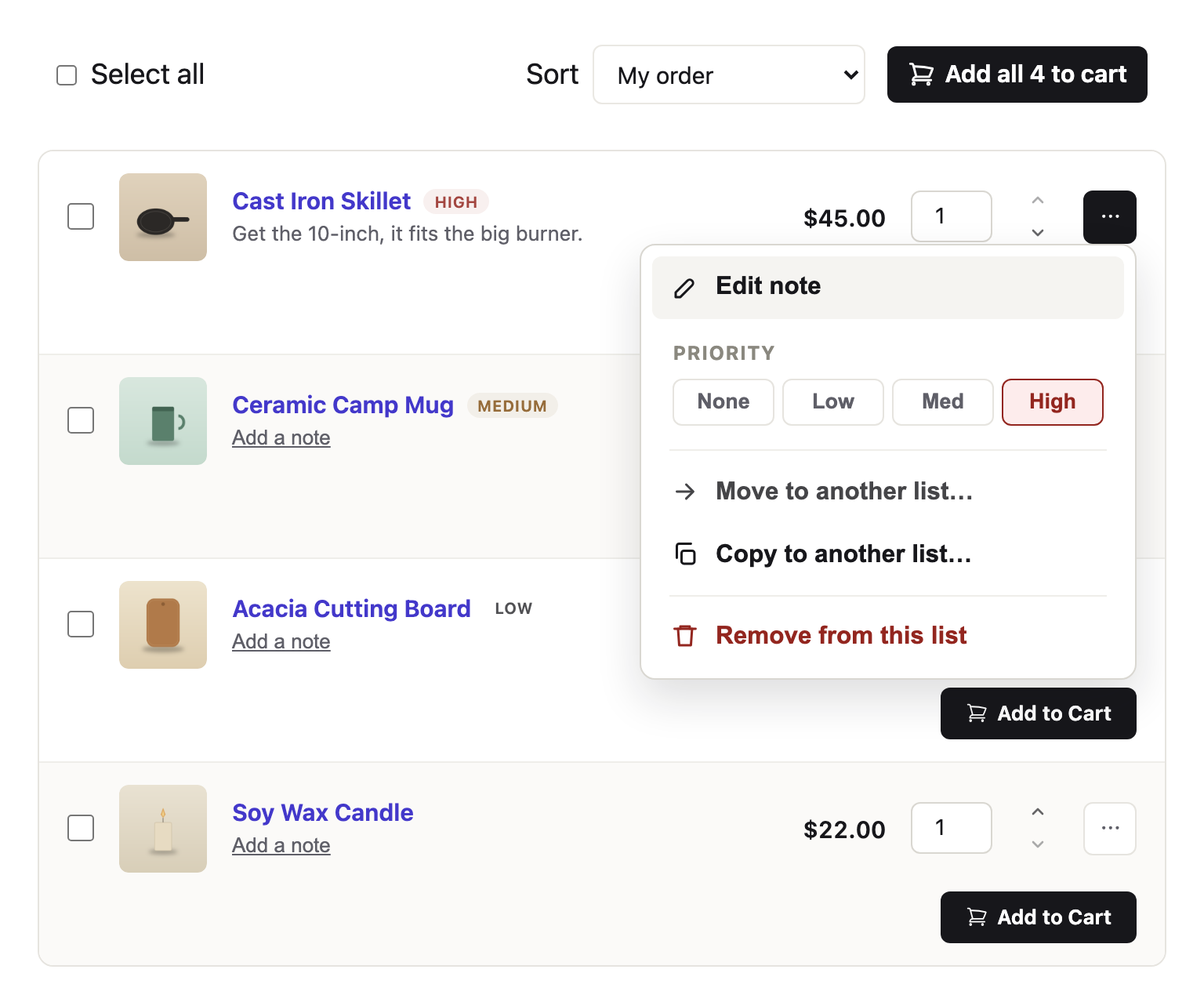
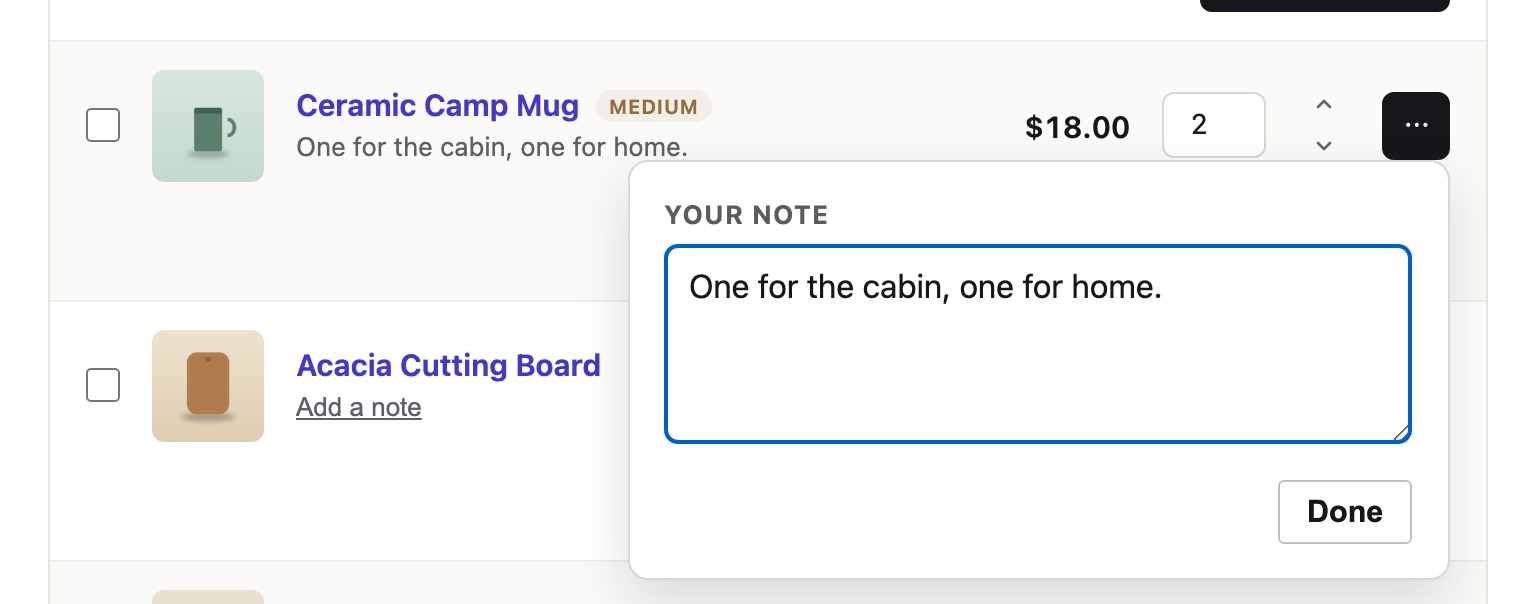
Notes are on by default and priority is off by default. Turn priority on, and decide whether visitors to a shared or public list can read notes, under List Items in the settings.
Moving and copying items
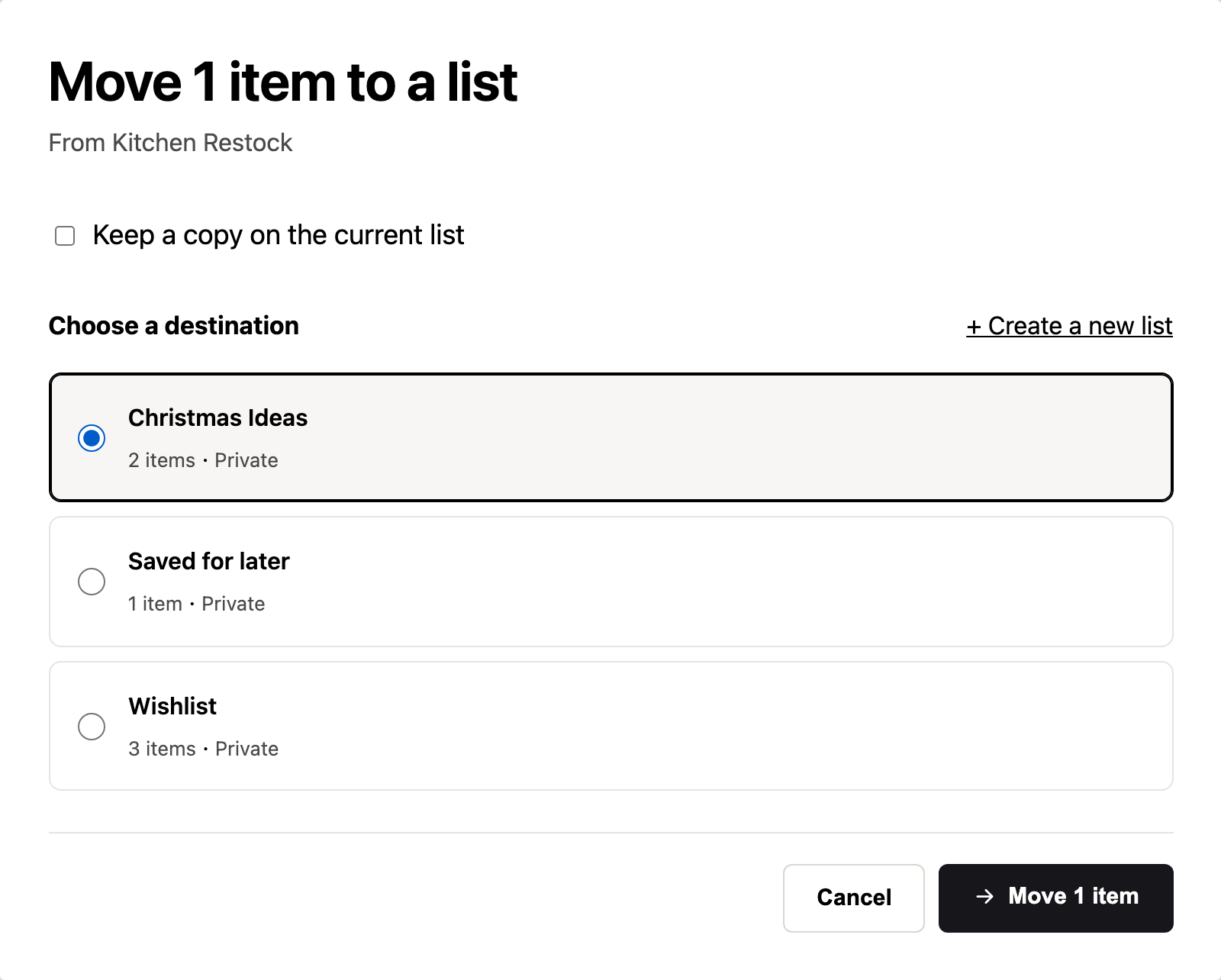
↑ Back to topTick one or more items and the toolbar becomes a selection bar with Add selected to cart and an Actions menu: Move to another list, Copy to another list and Remove selected items. A single row’s menu offers the same move and copy.
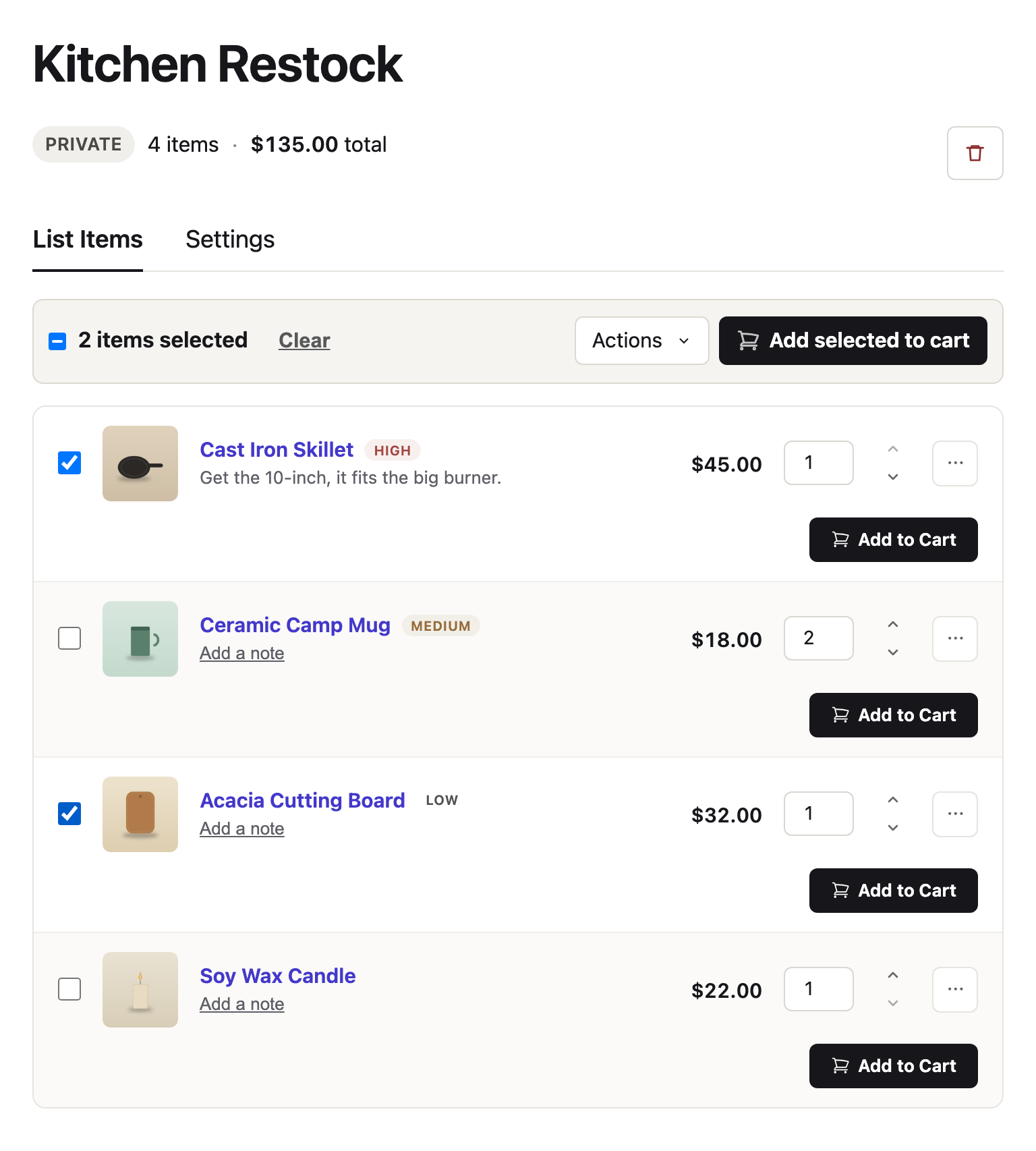
Move and copy open the same dialog. Choose a destination, or + Create a new list to make one on the spot, then confirm. Tick Keep a copy on the current list to copy instead of move. Add to list on a saved-for-later row opens the same dialog.
Without JavaScript the same choices are ordinary form actions on the Manage List screen.
Sharing a list
↑ Back to topA list’s privacy sets who can see it:
- Public — anyone can find the list by searching for the name or email on the Find a List page.
- Shared — only people with the link can see it, and it does not appear in search results.
- Private — visible only to its owner, and it cannot be shared.
A visitor who opens a shared or public list sees it in the same layout the owner does, without the editing controls, and can add its items to their own cart.
Wishlist pages are excluded from search engines by default, and are sent with no-cache headers so a shared list is never served stale by a page cache.
Managing Wishlists as a Store Owner
↑ Back to topEvery list on the store is listed under WooCommerce > Wishlists. Open one to see its items and its owner. The columns tell you, at a glance:
- Type — Permanent for a list belonging to an account, or Temporary List for a guest’s cookie-based list. Only temporary lists are ever cleaned up automatically.
- Sharing Status — Public, Shared or Private.
- User — the account that owns the list, or a dash for a guest list.
- Email on List and Name on List — what the owner entered on the list’s Settings tab, which is what a public list is found by on the Find a List page.
- Products — how many items are currently saved.
The two dropdowns above the table filter by type and by sharing status — useful for finding how many guest lists a store is carrying, or for reviewing every public list before a promotion.
Using Wishlists as a Gift Registry
↑ Back to topSet a list to Public or Shared so the owner can send the link out, then under Wishlist Processing Options:
- Set Automatic Removal to Yes.
- Set Automatic Removal Type to Remove From Any List, so an item bought by a friend clears from the owner’s registry.
- Choose the Automatic Removal on Status the order must reach first.
- Set Show Previous Ordered Total to Yes to show visitors how many of each item have already been bought.
Customization
↑ Back to topTemplates
↑ Back to topAny template in the extension’s templates folder can be overridden by copying it to wp-content/themes/your-theme/woocommerce/ and editing the copy there. Version 2.5.0 changed view-a-list.php, edit-my-list.php and my-lists.php, so overrides of those three need refreshing.
REST API
↑ Back to topLists and items are available over the REST API under the wc-wishlists/v1 namespace, with guest support and share keys:
| Route | Methods |
|---|---|
| /wp-json/wc-wishlists/v1/wishlists | GET, POST |
| /wp-json/wc-wishlists/v1/wishlists/<id> | GET, PUT, PATCH, DELETE |
| /wp-json/wc-wishlists/v1/wishlists/<id>/items | GET, POST |
| /wp-json/wc-wishlists/v1/wishlists/<id>/items/<key> | PUT, PATCH, DELETE |
| /wp-json/wc-wishlists/v1/wishlists/<id>/items/order | PUT, PATCH |
| /wp-json/wc-wishlists/v1/wishlists/<id>/items/move | POST |
An item accepts a note of up to 200 characters and a priority of low, medium or high. A list reports type and date_modified_gmt, and its is_default flag can be written. The items/order route sets the order of the items, and items/move moves them to another list, or copies them when keep_copy is true.
A price that another extension has hidden from a visitor is withheld here too, and the wc_wishlists_can_view_price filter lets any plugin withhold one.
Filters
↑ Back to top| Filter | What it controls |
|---|---|
wc_wishlists_temporary_list_lifetime_days | How long an abandoned guest list survives. Return 0 to disable the cleanup entirely. |
woocommerce_wishlists_loop_positionwoocommerce_wishlists_render_in_loop | Override the Product Listing Button settings for an individual product. |
woocommerce_wishlists_loop_template_priority | Move the listing button within its hook. |
woocommerce_wishlist_iconswoocommerce_wishlist_icon_svg | Register your own icons. |
woocommerce_wishlist_snackbar_position | Move the confirmation message. Any corner or centre edge; bottom-left by default. |
wc_wishlists_max_user_list_count | Cap how many lists one shopper may create. |
wc_wishlists_noindex_pages | Whether wishlist pages are excluded from search engines. |
wc_wishlists_can_save_for_later | Veto saving a cart line for later. Bundle and composite child lines are refused by default. |
wc_wishlists_saved_row_primary_html | Replace the main action of a saved row that cannot be moved back to the cart, for example to offer similar products. |
Styling
↑ Back to topBecause the extension inherits your theme’s button styles, most stores need no CSS at all. If you do write some, the confirmation message reads the --wl-snackbar-bg, --wl-snackbar-color and --wl-snackbar-action-color custom properties.
Upgrading from 2.4.x
↑ Back to topVersion 2.5.0 adds Save for later and list management. Almost every store can update without doing anything, but a few changes are worth knowing about.
Three templates changed. If your theme overrides view-a-list.php, edit-my-list.php or my-lists.php, refresh your copies from the extension’s templates folder.
The list grid is a list, not a table. The shop_table, shop_table_responsive, cart and wl-table classes no longer appear on it, so CSS that targets table elements or those classes needs updating. CSS that targets product-name, product-price or product-quantity is unaffected.
The settings tab is a standard WooCommerce settings page. The tab and every option keep their names and saved values. Code that removed the old WC_Wishlists_Settings_Admin::settings_tab_action() callback should use the woocommerce_get_settings_wc_wishlists filter instead.
Saving to a list does not fire the cart hooks. woocommerce_add_cart_item and woocommerce_add_wishlist_item do not run when an item is saved to a list, as has been the case since 2.4.0. Use woocommerce_add_cart_item_data or woocommerce_add_wishlist_item_data, which still apply, or the woocommerce_wishlist_add_item action.
Price-drop notification runs start only from the schedule. The storefront URL parameter that could start one has been removed. Runs now start from the scheduled event or from wp wishlists send_notifications.
PHP 7.4 is now the declared minimum.
Upgrading from 2.3.x
↑ Back to topVersion 2.4.0 replaced the add-to-wishlist control and the list screens. Almost every store can update without doing anything, but four changes are worth knowing about.
The legacy button and its templates were removed. If your theme contains a customised copy of add-to-wishlist-link.php or add-to-wishlist-modal.php, those files are no longer used. Move the customisation to the Add to Wishlist block, the [wc_wishlists_button] shortcode, or the woocommerce_wishlists_template_location filter. The old ?add-to-wishlist-itemid= URLs and the woocommerce_wishlist_already_in_list_text filter are gone as well; the button’s own state has replaced that notice.
Grouped products can no longer be added as a group. Their child products can still be saved from their own product pages.
Theme CSS may need updating. .wl-actions-table is now .wl-toolbar, .wl-rad-table is now .wl-fieldset, and the picker is .wl-add__dialog rather than #wl-list-pop-wrap / .wl-list-pop.
The Icon setting now applies to the button as well as the link. If you had left it on “Present”, a gift icon will appear where none did before. Choose None to keep the button plain.
FAQ
↑ Back to topHow do I create a wishlist on a customer’s behalf?
↑ Back to top- Install and activate the User Switching plugin.
- Go to Dashboard > Users > All Users.
- Find the customer’s account and select Switch To.
- Build the list from the storefront exactly as the customer would.
- Use “Switch back to […]” at the top right when you are done.
The list will be waiting on their My Account page the next time they log in.
Where does Save for later put a saved item?
↑ Back to topOn a list called Saved for later. It is created the first time a shopper saves something, there is one per shopper, and it appears on My Lists with their other lists, marked From the cart. It can be renamed or shared like any other list.
Can I turn Save for later off, or keep the item in the cart?
↑ Back to topYes. Under Save for Later Options, set Enable Save for Later to No to remove it, or set Behaviour to Copy to save an item to the list and leave the cart line as it is.
Why don’t my shoppers see priority badges?
↑ Back to topAllow priority is off by default. Turn it on under List Items in the settings.
Are items removed from a list after they are purchased?
↑ Back to topOnly if you set them to be. See Wishlist Processing Options above.
Can this be used as a gift registry?
↑ Back to topYes. See Using Wishlists as a Gift Registry above — set Automatic Removal Type to “Remove From Any List” and turn on the previously-ordered column.
Does it work with Product Add-ons and Gravity Forms Product Add-ons?
↑ Back to topYes. The options a shopper configured when they saved the product are stored with the list item and restored when it goes to the cart. An item whose required add-on fields were never filled in offers “Choose options” rather than adding at the base price.
Does it work with block themes?
↑ Back to topYes. Both blocks work in the Site Editor and inside Product Collection and Product Template blocks, and the Mini Cart count updates when an item is added to the cart from a list.
Is WooCommerce Wishlists compatible with WooCommerce Deposits?
↑ Back to topNot at this time. Taking a deposit on a wishlist item would need customization.
Why has a shopper’s guest list disappeared?
↑ Back to topGuest lists live in a browser cookie, so they do not follow the shopper to another browser or device, and clearing cookies loses them. A guest list that has been abandoned for 30 days is also deleted automatically. Ask the shopper to register or log in — their lists are claimed by the account and kept from then on.
Questions & Support
↑ Back to topHave a question before you buy? Please fill out this pre-sales form.
Already purchased and need some assistance? Get in touch with the developer via the Help Desk.