
Syncing with MYOB Integration Plugin
↑ Back to topSync Product Button
↑ Back to topClick this button to download the inventory counts from MYOB and update them in WooCommerce. This can take a few minutes to complete depending on the number of products you have configured.

Allow MYOB to Set the Invoice Number
↑ Back to topIf you want to allow MYOB to set the invoice number rather than passing WooCommerce order number check this option.

Create Product in MYOB if not Found
↑ Back to topMyob will create a product if it doesn’t exist in its inventory by checking this option.

Save Guests in MYOB Based on their email or User ID
↑ Back to topCreates a MYOB customer file for guest users in WooCommerce based on their email. However, the user ID will be selected instead if the email is already taken.

Working & Syncing Orders to MYOB
↑ Back to topChoosing to create orders instead of invoices in MYOB means the transaction will remain in a preliminary stage (order) for further processing or adjustments, rather than being immediately finalized for payment as an invoice. This is particularly useful for businesses managing complex sales processes or awaiting confirmation before invoicing.
Syncing Invoices to MYOB
↑ Back to topBy default Orders in WooCommerce are exported to MYOB as Invoices:
When is an choose / isolate which orders are sent to MYOB?
Orders by default are triggered and synced to MYOB when the WooCommerce Order status enters into Processing on the WooCommerce system. Orders that do not enter the processing status will not trigger the sync process and therefore not sync to MYOB.
Orders / Invoice Export can also be manually triggered from the ‘Order Actions’ dropdown on the WooCommerce Order page.
Create Closed Invoices
If selected, invoices created by WooCommerce will be closed, otherwise they will remain open. If orders are set to be created instead of invoices, this setting will be overridden regardless of selection.

Note: a bank account (in asset accounts) must be selected to create closed invoices.
Syncing Orders to MYOB
↑ Back to topCreate Orders Instead of Invoices
If checked, a MYOB order will be created instead of a MYOB invoice for WooCommerce purchases.

Choosing to create orders instead of invoices in MYOB means the transaction will remain in a preliminary stage (order) for further processing or adjustments, rather than being immediately finalized for payment as an invoice. This is particularly useful for businesses managing complex sales processes or awaiting confirmation before invoicing.
Create Orders when on-Hold
Select “create orders when on-hold” if you want to create orders in MYOB even with on-hold status in WooCommerce

Set MYOB Default Customer Designation
↑ Back to topIf selected the default designation of the customer will be selected in MYOB. Uncheck if you want to select the designation of the customer to “Company” if they write a company name while checking out in your Woo store.

Enable Debug Logging
↑ Back to topThis checkbox enables extended logging in case you are having trouble connecting to MYOB. This will have information valuable to Web Developers but can quickly fill your hard drive with detailed information on each transaction.

MYOB Sync Settings Page Overview:
↑ Back to top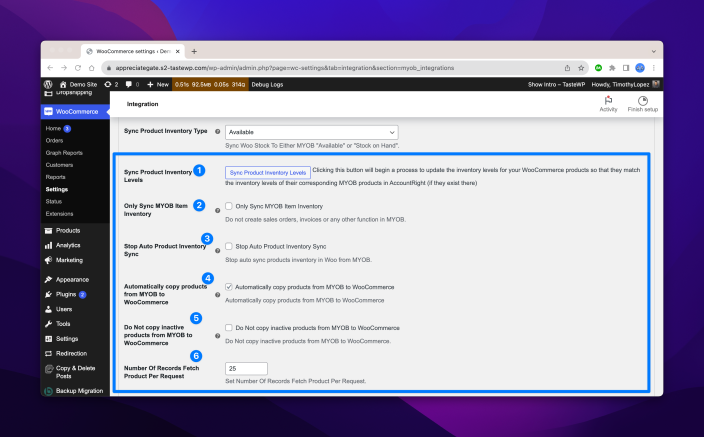
- Sync Product Inventory Button: Used to initiate product inventory sync.
- Only Sync MYOB Item Inventory: Toggle this option to enable/disable if you would like to sync other data including sales orders, invoices and other data. Enabling this option will only sync the product inventory and disable the other data.
- Stop Auto Product Inventory Sync: Toggle this option to stop the Product Inventory level sync. Enabling this option will stop the products and inventory levels from syncing between MYOB and WooCommerce.
- Automatically copy products from MYOB to WooCommerce: Enable this feature to create products in WooCommerce if they already exist in MYOB. All products with a valid SKU number will be synced.
- Do Not copy inactive products from MYOB to WooCommerce: Enable this feature if you only want active products to be copied from MYOB to WooCommerce. Any products that are inactive in MYOB will not be copied across.
- Number of Records Fetch Product Per Request: Input the number of products to be synced during batch syncing. For most people, this can be left to the default value. For inventories with 10,000+ products, this option can be configured accordingly.
Variable Product Support
Please note that product Variations are not fully supported. We have released Variation Support Phase 1, which only includes exporting variable products in Invoices.
Handling Variable Products
↑ Back to topExporting Invoices is now support for both simple and variable products, the MYOB Plugin will successfully export the Invoice and products between WooCommerce and MYOB, the plugin performs the following steps:
1. Identification of Variable Products:
- The plugin first identifies if a product in WooCommerce is a variable product. This is done using the is_type(‘variable’) method on the product object.
- If the product is identified as a variable product, the plugin checks whether variation support is enabled using the $this->support_variation_product flag.
2. Retrieving Variation Data:
- The plugin retrieves all child variations of the parent product using the get_children() method. Each variation is treated as a separate entity during the invoice export process.
- For each variation, the plugin fetches its unique SKU using get_sku(), which is crucial for identifying the variation in MYOB.
3. Exporting Variations with MYOB:
Product Name:
- The name used for each variation in MYOB is derived from the parent product’s name in WooCommerce. WooCommerce does not create distinct names for variations; instead, the parent product’s name is combined with the variation attributes to represent each variation.
- During the Invoice Export, the product name is fetched using $product->get_name(), which typically returns the parent product’s name.
SKU and Attributes:
- Each variation is distinguished by its unique SKU only. The plugin ensures these SKUs are used when syncing the product to MYOB.
Inventory Management:
- The plugin checks if the variation exists in MYOB by comparing the SKU. If a variation is not found in MYOB, the plugin automatically creates it as a new inventory item.
- If stock management is enabled for the product in WooCommerce, the variation will be created as an inventoried item in MYOB with appropriate quantity values (QuantityOnHand and QuantityAvailable).
4. Logging and Error Handling:
- The plugin includes comprehensive logging to track the synchronization process. Any errors encountered during the syncing process, such as failed product creation or inventory mismatches, are logged, and appropriate error messages are generated.
- If a variation fails to sync, the plugin logs the error and, depending on the configuration, may attempt to retry or notify the administrator.
Common Questions:
↑ Back to top- At what point is an order sent to MYOB? (e.g., immediately after creation, after a status change, or via a scheduled/background process)
Orders should be synced immediately. They are synced on change of WooCommerce Order Status.
This should be immediately when the order is placed and moves into the status “Processing” the order will queue to be synced and sync immediately when the queue is ready.
There should only be a delay if another order is currently syncing.
2. Is any manual action required to trigger the sync?
For manually execution you can use the option found under “Order Actions”.
3. Are there common reasons why an order would not sync to MYOB even if the integration is active?
If the sync attempts but there is an issue this will be logged in the Order notes.
Check the Order Notes meta box for that specific order. Additionally, you can use the debug mode to log the files.
Inventory Synchronization
4. When a product is purchased in WooCommerce, does the inventory automatically decrease in MYOB?
When an order is synced from WooCommerce to MYOB it impacts the MYOB system in the following ways.
First the order is created in MYOB (as an Order or Invoice).
Second, since every order must contain atleast 1 product this will find-and-match the product in MYOB or create a new product. If inventory is managed, it will reduce the inventory by the amount in the order.
Third, it may update and create other records including customers and customer information.
Therefore we can see that included in any order is a product update product which will reduce the product inventory by the amount of that product in the order.
5. When inventory is updated in MYOB, is it automatically update in WooCommerce?
Inventory update in MYOB is automatically updated in WooCommerce based on a frequency. This frequency is set in the plugin settings page.
Automatically but not immediate.
The products inventory is kept in sync by reducing when an order is placed and synced from WooCommerce to MYOB. The WC system will frequently check and update the inventory amount based what is in MYOB. This frequencey is set in the settings page.
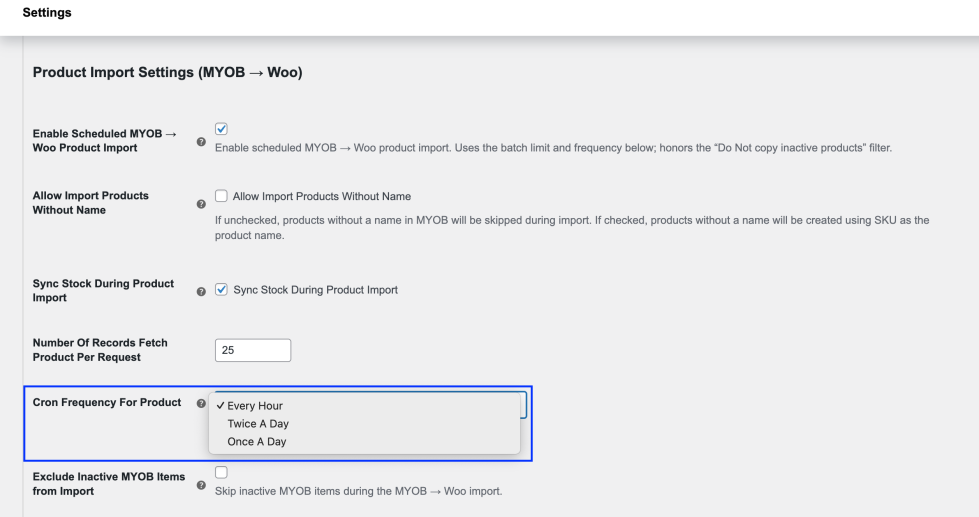
When inventory amount is updated in MYOB this will sync back to WooCommerce (based on the frequency set in the setttings).
Product Sync Scope
6. Can I choose which products are imported / not imported if we have more products in MYOB?
You can choose to only import the active products using the setting here.
If you enable “Exclude Inactive MYOB Items from Import” then the plugin will only import the active products from MYOB and not the active products.
7. Can I choose which product details are included in the import / sync process?
Yes. The MYOB Plugin syncs products between systems including the following product data:
- Product SKU (Required)
- Simple / Variable
- Product Name
- Product Description
- Product Price
- Product Inventory
You can toggle each product data value and configure this.
These rules will be used when products are imported or updated.
8. Can we use the product to only synchronization inventory in both directions?
MYOB is the Source of Truth (SoT).
When an order is placed this is synced from WC to MYOB. The MYOB (SoT) stock reduces.
The WC system will frequently check and update its own inventory amount based on the value in MYOB (SoT). How frequently WC system checks with MYOB (SoT) is set in the plugin settings.

